
Non-FictionInformativeEducational
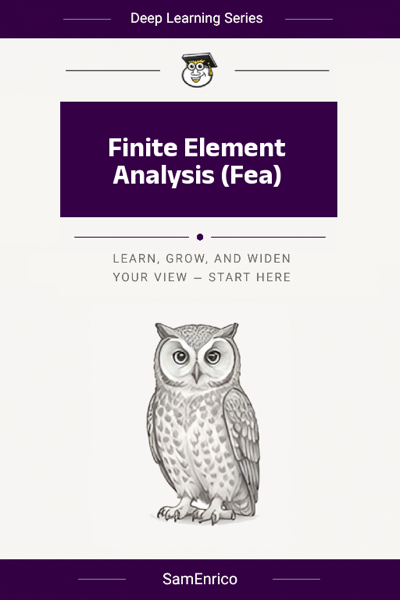
Finite Element Analysis (Fea) eBook
A Coursebook on Finite Element Analysis (Fea)
A Coursebook on Finite Element Analysis (Fea)
Formats
Free sample
Chapter 1: The Mesh That Changed Everything– In the spring of 1943, a German-born mathematician named Richard Courant was working on a problem that seemed purely theoretical: how to approximate the behavior of a twisted shaft using piecewise polynomial functions on small triangular domains. He had no idea that his pencil-and-paper exercise would, thirty years later, become the foundation of a revolution in engineering design. Today, the finite element method (FEM) is the third pillar of computational engineering, standing alongside theoretical analysis and physical testing. It is used to design aircraft that do not break, cars that do not crush, artificial hips that do not wear out, and microchips that do not overheat. Every time you board an airplane, drive over a bridge, or pick up a smartphone, finite element analysis (FEA) has almost certainly been used to ensure that product is safe, reliable, and optimized.
This chapter answers the three questions every student asks at the beginning of an FEA course: What is it? Why do we need it? And how does it work?The Engineering Problem: Why Exact Solutions Fail Most engineering students cut their teeth on elegant, closed-form solutions. You learned that a simply supported beam under a point load has a maximum deflection of PL³/48EI. You learned that the stress in a thin-walled pressure vessel is pr/t.
You learned that the temperature distribution in a cooling fin follows an exponential decay. These analytical solutions are beautiful. They are also, for most real-world problems, completely useless.Consider the wing of a commercial airliner. Its geometry is not a simple beam. It has ribs, spars, skin panels, fuel tanks, and mounting points for engines and landing gear.
The material is not a single isotropic alloy—it is a composite of aluminum, titanium, and carbon fiber in some areas, and aluminum alone in others. The loads are not a single point force—they are aerodynamic pressure distributions that vary with altitude, speed, and angle of attack. The boundary conditions are not simply "fixed at the root"—the wing flexes, twists, and interacts with the fuselage in ways that change as the wing deforms.Write down the differential equation for this wing. Even if you could—even if you had a supercomputer and a decade—you could not solve it exactly. No closed-form solution exists.
This is not a failure of mathematics. It is a recognition of reality: most real-world engineering problems are too irregular, too nonlinear, and too complicated for pencil-and-paper methods.The same problem appears in every engineering discipline:A civil engineer designing a concrete dam must account for cracks, water pressure, temperature gradients, and earthquake loads—all acting on a shape that is not a perfect rectangle.A mechanical engineer designing an engine block must understand stresses around cooling passages, bolt holes, and sharp corners—geometric features that cause stress concentrations that classical formulas cannot predict.A biomedical engineer designing an artificial knee must model the contact between two curved surfaces, the nonlinear behavior of soft tissue, and the cyclic loading of walking—none of which fit into simple beam theory.An electrical engineer designing a transformer must solve Maxwell's equations in a domain with iron cores, copper windings, and air gaps—all with different material properties that vary with frequency and temperature.So how do engineers solve these problems? They stop looking for exact answers and start looking for good enough answers. They approximate. And the most powerful approximation method ever devised is the finite element method.A Brief History: From Courant to Commercial Software The finite element method did not spring fully formed from a single mind.
It evolved over decades, with contributions from mathematicians, engineers, and computer scientists who each added a crucial piece to the puzzle.1943 – Richard Courant's Insight: Courant published a paper on using piecewise polynomial functions on triangular domains to approximate the solution of partial differential equations. He called his approach the "Ritz method with subdomains." The idea was brilliant but computationally impractical—the world did not yet have computers capable of solving thousands of simultaneous equations. The paper languished in mathematical journals for over a decade.1956 – The Boeing Breakthrough: A team of engineers at Boeing—Turner, Clough, Martin, and Topp—published a paper titled "Stiffness and Deflection Analysis of Complex Structures" in the Journal of the Aeronautical Sciences. They introduced the term "stiffness method" and showed how to analyze complex aircraft structures by breaking them into smaller pieces called elements and assembling them into a global model. This is widely considered the birth of the finite element method as an engineering tool because it connected mathematical theory to practical structural analysis.1960 – The Name That Stuck: Ray Clough, a professor at the University of California, Berkeley, coined the term "finite element method" in a paper on plane stress analysis.
The name captured the essence of the approach: dividing a continuum into a finite number of simple elements. The term resonated immediately and has never been replaced.1960s-1970s – The Mathematical Foundation: Researchers including Bruce Irons (who developed the isoparametric formulation), O.C. Zienkiewicz (who wrote the first textbook on FEM), and Thomas Hughes (who advanced convergence theory) placed FEM on solid mathematical ground. They developed curved elements, proved convergence theorems, and extended the method to heat transfer, fluid flow, electromagnetics, and other field problems. By the end of the 1970s, FEM was a mature discipline with rigorous theoretical underpinnings.1970s-1980s – Commercialization: Companies including ANSYS (founded 1970 by John Swanson), Abaqus (founded 1978 by David Hibbitt, Bengt Karlsson, and Paul Sorensen), and NASTRAN (developed for NASA in the late 1960s, commercialized in the 1970s) brought FEA to industrial practice.
Engineers no longer had to write their own codes. They could use commercial software to solve problems that were previously unimaginable—whole aircraft, entire car bodies, complete pressure vessels.Today – The Era of Multiphysics and Optimization: Modern FEA software can couple structural analysis with heat transfer, fluid flow, electromagnetics, and acoustics in a single simulation. Topology optimization uses FEA to generate lightweight designs that no human engineer would ever conceive—organic, bone-like structures that use material only where it is needed. Cloud computing allows engineers to run million-element models on problems that once required supercomputers. Artificial intelligence is now being used to accelerate simulations and automate mesh generation.The Core Idea: Discretization The finite element method works by performing one simple trick repeatedly until a complex problem becomes simple.
That trick is discretization: dividing a continuous domain (a structure, a fluid volume, a heat-conducting solid) into a finite number of smaller, simpler pieces called elements.Imagine you need to know the temperature distribution inside a metal plate. The exact temperature field T(x,y) is a continuous function—it has a value at every infinite point in the plate. That is too much information to compute directly. Instead, you divide the plate into small triangles (elements) connected at corners (nodes). You will only calculate the temperature at the nodes—perhaps a few hundred points instead of an infinite continuum.
Within each element, you interpolate the temperature using simple shape functions—mathematical formulas that guarantee the temperature varies smoothly between nodes. The shape functions are typically linear, quadratic, or cubic polynomials.Why discretization works: The differential equation…
This is the end of the free sample. Get the eBook to keep going. Buy now
About this book
Details
- Author
- Vanhorn Lyndsay
- Publisher
- SamEnrico
- Language
- English
- Genre
- Non-Fiction, Informative, Educational
- Released
- 2026-05-08
- Pages (approx.)
- 153
- Available as
- eBook, Audiobook

Read better in the ZLOADR app
Your eBooks on your phone or tablet. Sign in with your SamEnrico account and start reading.
More by Vanhorn Lyndsay
 Calorie Density Formula GuideVanhorn Lyndsay$11.99
 Middle Manager Priority GuideVanhorn Lyndsay$11.99
 Parental Anger Support Group GuideVanhorn Lyndsay$11.99
 Inner Child Healing GuideVanhorn Lyndsay$11.99
 Franchising Your Local Brand Across Borders Diplomatic ChannelsVanhorn Lyndsay$11.99
 The Oracle of Omaha: How Warren Buffett Outsmarted the Market in 1987Vanhorn Lyndsay$11.99
 The Lady Who Tamed Chance: Florence Nightingale and the Birth of Medical StatisticsVanhorn Lyndsay$11.99
 Ultimate Handbook Guide to Soweto : (South Africa) Travel GuideVanhorn Lyndsay$11.99
 Charity Registration RenewalVanhorn Lyndsay$12.99
 Community Content CalendarVanhorn Lyndsay$12.99
 Understanding Deafness Craniofacial SyndromeVanhorn Lyndsay$17.99
You may also like
 Hong Kong Handover 1997Dunn Johnnie$11.99
 Zumba For Postnatal Recovery CourseNeal Christian$11.99
 Zumba for BeginnersLadner Nikia$11.99
 YouTube Comment Mining GuideHumes Pandora$12.99
 Worry Box MeditationCarlin Rudy$11.99
 Workplace Stress MeditationNguyen Lynn$11.99
 Workplace Stress and Sleep RepairHawley Ivory$11.99
 Workplace Perfectionism CureDelaney Jeffry$11.99
 Workplace Injustice Anger GuideWallen Isabelle$11.99
 Work Addiction and Burnout LinkGreenwood Ester$11.99
 Women in Yoga and WellnessBeattie Galina$11.99
 Women in Stand Up ComedyChun Evangeline$11.99