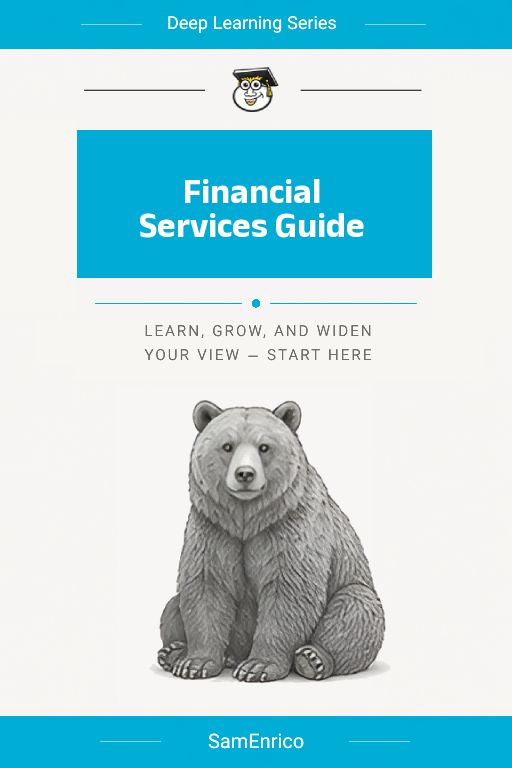
Financial Services Guide
Contrast bank branch usage, digital banking adopti
Contrast bank branch usage, digital banking adoption, credit card vs BNPL, and investment preferences.
Formats
About this book
Free sample
Chapter 1: The Spectrometer Fallacy...--The most expensive mistake in personal finance isn't buying a house you can't afford, falling for a cryptocurrency scam, or carrying credit card debt for thirty years. It is far more subtle and far more common. The mistake is believing that financial products exist on a single spectrum from "good" to "bad" and that your job as a consumer is simply to pick the best one. Call this the Spectrometer Fallacy—the false assumption that all banking products, credit options, and investment vehicles can be arranged along one line, with digital at one end, physical at the other, and virtue somewhere in the middle.The Spectrometer Fallacy sells millions of dollars worth of bad advice every year. It is the reason your cousin swears by a digital-only bank and calls anyone who walks into a branch a luddite.
It is the reason your uncle insists on doing everything at his local credit union and calls anyone who uses an app reckless. It is the reason financial Twitter erupts every few months with the same tired debate: "Branches are dead" versus "Digital banks are scams." Both sides are wrong, and both sides are right, and the truth is that they are arguing about the wrong thing entirely.This chapter dismantles the Spectrometer Fallacy once and for all. In its place, we will build a new framework: the Physical-Digital Spectrum, which acknowledges that different financial tasks require different channels, and that the financially sophisticated consumer moves fluidly between them. By the end of this chapter, you will never again ask "Is this bank good or bad?" You will ask the only question that matters: "Is this channel right for this specific task?"The Origins of a False Binary To understand why the Spectrometer Fallacy is so persistent, you have to understand the marketing wars that created it. Around 2010, a new generation of fintech companies—Chime, Simple (now defunct), N26, Monzo—began offering digital-only bank accounts with no physical branches.
Their value proposition was simple and powerful: no monthly fees, no minimum balances, no waiting in line, no dealing with…
This is the end of the free sample. Get the eBook to keep going. Buy now
Contents
- Chapter 1
- Chapter 2
- Chapter 3
- Chapter 4
- Chapter 5
- Chapter 6
- Chapter 7
- Chapter 8
- Chapter 9
- Chapter 10
- Chapter 11
- Chapter 12
Details
- Author
- Cooke Sebrina
- Publisher
- SamEnrico
- Language
- English
- Genre
- Non-Fiction, Consumer Mind Report, Finance
- Released
- 2026-05-30
- Pages (approx.)
- 155
- Available as
- eBook, Audiobook

Read better in the ZLOADR app
Your eBooks on your phone or tablet. Sign in with your SamEnrico account and start reading.
More by Cooke Sebrina
 Improv for Decision MakingCooke Sebrina$11.99
 Moai Social Connection GuideCooke Sebrina$11.99
 Congressional Committee AssignmentsCooke Sebrina$11.99
 The Green Cloud Computing ForecastCooke Sebrina$11.99
 Financial Stress for Retail StaffCooke Sebrina$11.99
 The Golden Throne of Sheba: The Queen Who Outwitted SolomonCooke Sebrina$11.99
 Understanding Ramsay Hunt Paralysis SyndromeCooke Sebrina$17.99
 Form 5472 Non Resident LLCCooke Sebrina$12.99
 How to Become a Plywood-scarfer TenderCooke Sebrina$11.99
 Hessite MiningCooke Sebrina$11.99