
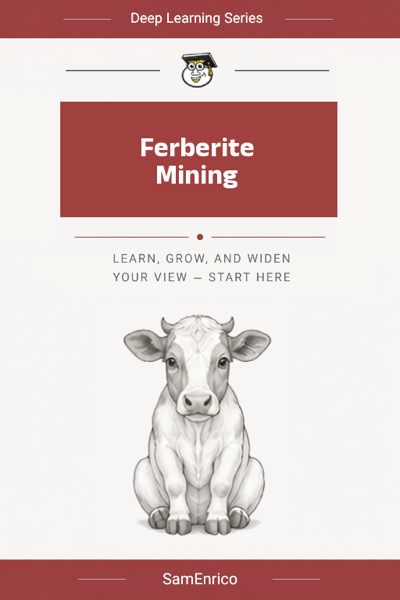
Non-FictionInformativeEducational
Ferberite Mining eBook
A Coursebook on Ferberite Mining
by Lanham Jin
A Coursebook on Ferberite Mining
Formats
Free sample
Chapter 1: The Black Crystal...-- The first thing a miner notices about ferberite is not its value—it is its weight. A single cubic foot of this dark, metallic crystal weighs nearly 475 pounds, more than three times as much as the quartz that surrounds it. Hold a chunk of high-grade ore in your palm, and you feel the density immediately: a dense, improbable heaviness that defies the rock's modest size. That weight, that strange and compelling heft, is the physical signature of tungsten locked inside an iron-rich lattice, and it has driven men to drill through mountains, bankrupted mining companies by the dozens, and quietly won the most brutal wars of the twentieth century.This is the story of ferberite. Not the most glamorous mineral, nor the most famous.
It lacks gold's yellow allure and diamond's cultural mystique. It does not fluoresce like its cousin scheelite, nor does it form the spectacular crystal clusters that grace museum display cases. Ferberite is black, dense, brittle, and unremarkable to the untrained eye—a dull metallic luster on fresh fracture surfaces, quickly tarnishing to an earthy, sooty black when exposed to air. To the casual observer walking through an abandoned mine dump, ferberite looks like nothing more than dirty rocks mixed with quartz. But to those who understand what they are seeing, those black crystals represent one of the most strategically important materials on Earth.This chapter establishes the foundation for everything that follows.
Before we can explore the geology of ferberite deposits (Chapter 2), design exploration programs (Chapter 3), or optimize processing flowsheets (Chapters 7 through 9), we must first understand what ferberite actually is—its chemical identity, its physical properties, its place within the wolframite series, and above all, why tungsten matters so profoundly to modern industrial civilization. The reader who masters this chapter will never look at a piece of dark, heavy rock the same way again.The Strategic Metal: Why Tungsten Matters Tungsten, element 74 on the periodic table, carries the chemical symbol W from its German name Wolfram. The etymology reveals something important about the metal's character: Wolf rahm translates roughly to "wolf's foam" or "wolf's cream," a medieval miners' term for the frothy, difficult material that devoured tin ores during smelting. Even seven hundred years ago, miners recognized that this troublesome mineral was different—harder, heavier, and more obstinate than anything else they encountered.That obstinacy is precisely what makes tungsten valuable today. Among all known metals, tungsten claims the highest melting point at 3,422 degrees Celsius (6,192 degrees Fahrenheit).
To put that number in perspective, iron melts at 1,538°C, and steel production requires furnaces operating around 1,600°C. Tungsten remains solid at temperatures that would vaporize most other engineering materials. This property alone makes tungsten indispensable for applications where heat is extreme: the filaments of incandescent light bulbs (though declining in use), the electrodes of welding torches, the heating elements of high-temperature furnaces, and the rocket nozzles that channel the fiery exhaust of missile engines.But melting point is only part of the story. Tungsten also possesses exceptional density: 19.25 grams per cubic centimeter, nearly identical to gold and uranium, and substantially denser than lead (11.34 g/cm³). A one-inch cube of tungsten weighs more than a third of a pound.
This density makes tungsten ideal for applications requiring concentrated mass in a small volume: counterweights in aircraft control surfaces, balance weights in race cars and golf clubs, and most critically, kinetic energy penetrators—the armor-piercing projectiles that defeat enemy tanks by concentrating immense kinetic energy onto a small impact area.When alloyed with carbon to form tungsten carbide (WC), tungsten becomes one of the hardest materials known to human industry. Tungsten carbide ranks between 8.5 and 9 on the Mohs hardness scale, approaching the hardness of corundum (sapphire and ruby) and just below diamond. This extreme hardness, combined with excellent toughness and wear resistance, makes tungsten carbide the material of choice for cutting tools, mining drill bits, wear parts in heavy machinery, and the dies used to draw wire of all materials. Every time a machinist cuts a metal part on a lathe, the cutting tool is almost certainly tipped with tungsten carbide. Every time a road is drilled for blasting, the drill bit is studded with tungsten carbide teeth.
Every time copper wire is drawn for electrical transmission, it passes through a tungsten carbide die.The strategic importance of tungsten crystallized during the twentieth century's great power conflicts. In World War I, Germany's access to tungsten from China and Portugal became a critical supply vulnerability; the Allied blockade aimed specifically to cut off tungsten shipments needed for German armor-piercing shells and machine tooling. By World War II, the stakes had grown enormously. German Panzer tanks relied on tungsten-core ammunition to penetrate Soviet T-34 armor, and German machine tools—themselves tipped with tungsten carbide—kept the Wehrmacht's production lines running despite relentless bombing. The Allies responded with a systematic campaign to deny tungsten to the Axis powers, buying up Portuguese production, blockading shipments from Spain, and later, after the 1944 Normandy invasion, capturing the strategic tungsten stockpiles of occupied France and Belgium.
The historian's verdict is clear: the side with reliable access to tungsten could produce harder, more durable weapons and the tools to make them. The side without tungsten fell behind.Today, tungsten remains on every major nation's list of critical minerals. The United States Geological Survey classifies tungsten as critical due to supply chain vulnerability and economic importance. The European Union lists tungsten among its Critical Raw Materials—thirty-four minerals deemed essential to the EU economy and at risk of supply disruption. China now controls approximately 80 to 85 percent of global tungsten mining and dominates the refining of intermediate products like ammonium paratungstate (APT).
This concentration of supply in a single geopolitical competitor has driven renewed interest in domestic tungsten sources, including the ferberite deposits of the American West. The black crystal that powered Allied victory in 1945 may yet play a role in twenty-first-century strategic competition.The Two Tungsten Minerals: Scheelite and Wolframite Tungsten does not occur in nature as a pure metal. Instead, it is found in approximately fifteen different mineral species, each with its own crystal structure, chemical formula, and processing characteristics. For the practical purposes of mining and beneficiation, however, only two minerals matter: scheelite and the wolframite series. Together, these two account for virtually all tungsten produced throughout human history.Scheelite (calcium tungstate, Ca WO₄) is the more straightforward of the two from a processing perspective.
It forms tetragonal crystals, often bipyramidal or tabular in shape, ranging in color from white to pale yellow to orange-brown depending on trace element impurities. Scheelite's most famous property is its intense blue-white fluorescence under shortwave ultraviolet light—a characteristic that revolutionized tungsten exploration when portable UV lamps became available in the 1930s. Prospectors could simply walk through mine dumps at night, shining UV light on rock piles, and scheelite would glow like scattered stars in the darkness.Chemically, scheelite is relatively easy to process because the calcium-tungsten bond breaks readily in hydrochloric acid. The reaction Ca WO₄ + 2HCl → H₂WO₄ (tungstic acid) + Ca Cl₂ proceeds efficiently, precipitating tungstic acid that can be filtered, washed, and converted to tungsten oxide by heating. This direct acid leaching route…
This is the end of the free sample. Get the eBook to keep going. Buy now
About this book
Details
- Author
- Lanham Jin
- Publisher
- SamEnrico
- Language
- English
- Genre
- Non-Fiction, Informative, Educational
- Released
- 2026-06-03
- Pages (approx.)
- 143
- Available as
- eBook, Audiobook

Read better in the ZLOADR app
Your eBooks on your phone or tablet. Sign in with your SamEnrico account and start reading.
More by Lanham Jin
 Course Launch Email StrategyLanham Jin$11.99
 Facebook Birthday ComparisonLanham Jin$11.99
 Swedish Green Tax Deduction GuideLanham Jin$11.99
 Low Self Esteem Dating PatternsLanham Jin$11.99
 The Last Light of Icarus: The Generation Ship That Never Reached HomeLanham Jin$11.99
 The Golden Lion of Ethiopia: Emperor Haile Selassie I and the Glory of the Solomonic DynastyLanham Jin$11.99
 Understanding Hypospadias FamilialLanham Jin$17.99
 GDPR Impact On Ad Targeting ManualLanham Jin$12.99
 AI Essay Grading TechnologyLanham Jin$12.99
 How to Become a Multifocal-lens AssemblerLanham Jin$11.99
You may also like
 Hong Kong Handover 1997Dunn Johnnie$11.99
 Zumba For Postnatal Recovery CourseNeal Christian$11.99
 Zumba for BeginnersLadner Nikia$11.99
 YouTube Comment Mining GuideHumes Pandora$12.99
 Worry Box MeditationCarlin Rudy$11.99
 Workplace Stress MeditationNguyen Lynn$11.99
 Workplace Stress and Sleep RepairHawley Ivory$11.99
 Workplace Perfectionism CureDelaney Jeffry$11.99
 Workplace Injustice Anger GuideWallen Isabelle$11.99
 Work Addiction and Burnout LinkGreenwood Ester$11.99
 Women in Yoga and WellnessBeattie Galina$11.99
 Women in Stand Up ComedyChun Evangeline$11.99