
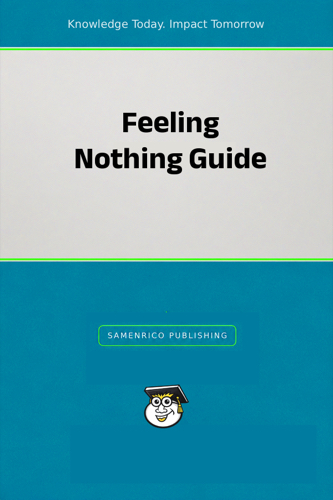
Non-FictionSelf-HelpEmotional Health
Feeling Nothing Guide eBook
Understand why you feel emotionally flat and how t
Understand why you feel emotionally flat and how to reconnect with feelings.
Formats
Free sample
Chapter 1: The Mute Button Lie--–- The first time someone told me they felt “nothing,” I almost didn’t believe them. She was a thirty-four-year-old graphic designer named Elena who had come to therapy because her husband said she was “impossible to read.” She didn’t cry at funerals. She didn’t feel joy at her daughter’s birthday parties. When she got a promotion she had worked toward for three years, she sat in her car in the parking lot and felt… nothing. Not relief.
Not pride. Not even the familiar thrum of anxiety she had grown up with. Just a vast, quiet, empty space where her feelings used to be.“I think I’m just a calm person now,” Elena told me. “Maybe I’ve finally grown up.”I asked her when she had last cried. She thought for a long time.
“My grandmother’s funeral. Eight years ago.” She paused. “But I didn’t really cry. I wanted to. I felt like I should.
But my body wouldn’t do it.”I asked her when she had last felt truly excited—the kind of excitement that makes your chest light and your hands tingle. She shook her head. “I can’t remember.”Elena had not “grown up.” She had not achieved some enlightened state of stoic calm. She had, without knowing it, pressed a mute button on her emotional life—and worse, she had convinced herself that the silence meant peace.This chapter is for everyone who has ever looked at their own emotional flatness and called it strength. It is for the people who say “I don’t care” so often that they have started to believe it.
It is for those who have mistaken the absence of pain for the presence of well-being. The lie we are about to dismantle is one of the most dangerous in modern self-help: the idea that feeling nothing is better than feeling something difficult.The Dangerous Lie at the Center of Emotional Numbness Emotional numbness is not peace. Peace is a warm, alive, present state of being relaxed but connected. Peace allows you to feel a gentle breeze on your skin, to notice the way light falls across a room, to experience quiet contentment without agitation. Numbness, by contrast, is a dead zone.
It is the emotional equivalent of a flatlined EKG—not calm, but absent.The dangerous lie is this: Because I am not suffering, I must be fine. This lie has destroyed marriages, delayed healing for decades, and convinced millions of people that they are “low-maintenance” when they are actually dissociated. The lie is seductive because numbness feels better than panic. Numbness feels better than rage. Numbness feels better than the raw, bleeding grief of losing someone you love.
So we tell ourselves we have evolved, that we have transcended messy emotions, that we are now logical creatures who have outgrown the primitive wiring of feeling.We are wrong.What Elena—and perhaps you—mistook for maturity was actually a survival response. It was the nervous system’s last resort, a shutdown so complete that it mimics peace. But here is the truth that will shape everything in this book: You cannot selectively numb. If you block sadness, you also block joy. If you suppress anger, you also suppress love.
If you train yourself not to feel the hard things, you will eventually stop feeling the good things too. The mute button does not discriminate.The Four Survival Responses: Where Numbness Lives To understand numbness, we have to understand what your nervous system was designed to do. Every human being is born with a set of automatic survival responses that have kept our species alive for hundreds of thousands of years. These responses are not choices—they are biological programs that run beneath conscious awareness. When a threat appears, your body decides how to respond before your thinking brain even registers what is happening.The four primary survival responses are:Fight.
When a threat appears and your body believes it has a chance of overcoming that threat through force or confrontation, you experience the fight response. Your heart rate increases. Blood flows to your large muscle groups. Your jaw clenches. You feel anger, irritation, or the urge to push back.
This response is useful when you are being directly attacked or when a boundary must be defended.Flight. When your body assesses that the threat can be escaped by running away, you experience the flight response. Your heart also races, but now the energy is directed to your legs and lungs. You feel anxiety, restlessness, the urge to leave, to avoid, to get distance. This response is useful when the threat is something you can outrun or outlast.Freeze.
When your body determines that neither fighting nor fleeing will work—when the threat is inescapable or overwhelming—you experience the freeze response. Your heart rate may slow. Your muscles may tighten or go limp. You feel stuck, trapped, or “played dead.” This is the nervous system’s way of hoping the threat will lose interest if you stop moving. Numbness is the chronic, long-term version of freeze—a nervous system that has decided, based on past experience, that feeling anything is dangerous.Fawn.
When your body determines that the best way to survive a threat is to appease it, you experience the fawn response. You become agreeable, helpful, pleasing. You suppress your own needs to keep someone else calm. This response is common in people who grew up with unpredictable caregivers—being “good” became a survival strategy.Here is what you need to know for this book: Numbness is the freeze response. It is not a choice.
It is not a personality quirk. It is your nervous system doing exactly what it was trained to do—protect you by shutting down. The problem is that the freeze response was designed for short-term threats (a predator in the bushes, an attacker in an alley). It was never designed to run for years or decades. When freeze becomes chronic, it becomes numbness.
And numbness, left unaddressed, becomes a prison.Why Positive Thinking Fails the Numb Brain If you have ever tried to “think your way out” of numbness, you have probably experienced something frustrating: the more you try to feel positive, the more numb you become. This is not a personal failure. It is neuroscience.The positive thinking industry has sold millions of books promising that if you just change your thoughts, you will change your feelings. Affirmations, gratitude journals, visualization—these tools work beautifully for people who are already within their window of tolerance (a concept we will explore deeply in Chapter 3). But for someone whose nervous system is locked in freeze, positive thinking does not lift you out of numbness.
It buries you deeper.Here is why. When you are numb, your brain has downregulated your entire emotional system. The neural pathways that connect your body’s sensations to your conscious awareness have been pruned or suppressed. Telling yourself “I am happy” when your body feels nothing creates what psychologists call cognitive dissonance—a clash between what you are saying and what your body knows to be true. Your brain…
This is the end of the free sample. Get the eBook to keep going. Buy now
About this book
Details
- Author
- Rosario Dollie
- Publisher
- SamEnrico
- Language
- English
- Genre
- Non-Fiction, Self-Help, Emotional Health
- Released
- 2026-06-08
- Pages (approx.)
- 144
- Available as
- eBook, Audiobook

Read better in the ZLOADR app
Your eBooks on your phone or tablet. Sign in with your SamEnrico account and start reading.
More by Rosario Dollie
 The Team Interruption CultureRosario Dollie$11.99
 Meal Prep for New ParentsRosario Dollie$11.99
 Gates Early Hacker DaysRosario Dollie$11.99
 Child Miscarriage Grief GuideRosario Dollie$11.99
 Naval Gunner Pacific TheaterRosario Dollie$11.99
 IBS Subtype GuideRosario Dollie$11.99
 Education Sector BreachesRosario Dollie$11.99
 The Iron Chancellor: Bismarck and the Forging of Modern GermanyRosario Dollie$11.99
 Merlin's Harp: The Enchanted Ballads of CamelotRosario Dollie$11.99
 How to Produce a Rotary Wheel Blow Molding SystemRosario Dollie$11.99
 A Collector's Handbook to the Andre V6Rosario Dollie$11.99
 WIPO Madrid Fee CalculatorRosario Dollie$12.99
You may also like
 Hong Kong Handover 1997Dunn Johnnie$11.99
 Zumba For Postnatal Recovery CourseNeal Christian$11.99
 Zumba for BeginnersLadner Nikia$11.99
 YouTube Comment Mining GuideHumes Pandora$12.99
 Worry Box MeditationCarlin Rudy$11.99
 Workplace Stress MeditationNguyen Lynn$11.99
 Workplace Stress and Sleep RepairHawley Ivory$11.99
 Workplace Perfectionism CureDelaney Jeffry$11.99
 Workplace Injustice Anger GuideWallen Isabelle$11.99
 Work Addiction and Burnout LinkGreenwood Ester$11.99
 Women in Yoga and WellnessBeattie Galina$11.99
 Women in Stand Up ComedyChun Evangeline$11.99