
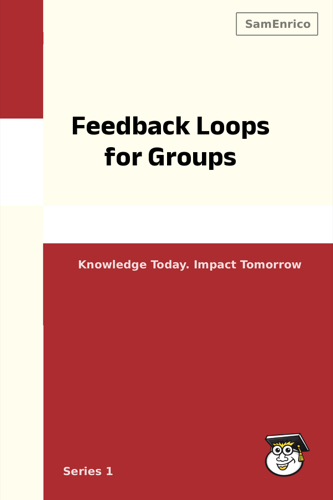
Non-FictionSelf-HelpFeedback Systems
Feedback Loops for Groups eBook
Sets up rapid cycles of share, react, revise to re
Sets up rapid cycles of share, react, revise to refine team outputs.
Formats
Free sample
Chapter 1: The Meeting That Died...--–- Every organization on earth runs on a lie. The lie is this: that groups make good decisions when they have enough time, enough data, and enough people in a room. Walk into any corporate hallway, any nonprofit conference room, any government office, and you will see the lie in action. A team has a problem. They schedule a meeting for ninety minutes.
They pack the room with smart people. They put a slide deck on the screen. And then they spend forty-five minutes watching someone talk, twenty minutes offering polite suggestions, ten minutes arguing about a single bullet point, and the final fifteen minutes agreeing to “take it offline.” The output, whatever it is, lands somewhere between mediocre and catastrophic. Not because the people are incompetent. Not because the problem is unsolvable.
But because the machine they are using to solve it was designed for a world that no longer exists.The machine is called “traditional group process.” It assumes that feedback is a thing you give at the end. It assumes that criticism should be delayed until an idea is fully formed. It assumes that the best way to refine an output is to let everyone speak in turn, then let the loudest person decide, then call it a day. And it assumes, most dangerously of all, that slow is careful. That speed is the enemy of quality.
That iteration is a sign of indecision.This book is going to dismantle every one of those assumptions.Before we build the new machine—the rapid, tight feedback loops that turn good teams into unstoppable teams—we need to understand exactly how the old machine kills progress. We need to see, in vivid and uncomfortable detail, why traditional group work fails. And we need to name the single mechanism that separates high-performing teams from the rest: the speed of their feedback loops.The Anatomy of a Group Failure Let me tell you about a meeting I once watched implode. A product team at a midsize software company had been working for six weeks on a new feature. The lead designer, a thoughtful and talented woman named Priya, had produced a detailed mockup.
She had done user research. She had iterated on her own for three weeks. She had shown the mockup to her manager, who said “looks great.” She had shown it to engineering, who said “we can build that.” And now she was presenting it to the full team of twelve people: product management, marketing, sales, executive leadership, and customer support.Priya walked through twenty slides. Each slide was beautiful. Each slide represented days of work.
She explained her reasoning. She showed user quotes. She pointed to competitor benchmarks. When she finished, the room sat in silence for a moment. Then the VP of Product said, “This is really solid work.” Then the head of Sales said, “I have one small question about the pricing page layout.” Then the marketing director said, “Have we considered a different color scheme for the call-to-action button?” Then the engineering lead said, “That animation on slide fourteen might be tricky to implement.”Priya took notes.
She nodded. She said “good point” fifteen times. The meeting ended after ninety minutes with a list of thirty-seven “action items”—most of which were contradictory. The VP wanted the feature simplified. The head of Sales wanted more pricing options.
Marketing wanted brighter colors. Engineering wanted no animation. Customer support wanted a help icon on every screen.Priya spent the next two weeks trying to incorporate all thirty-seven pieces of feedback. The result was a mockup that pleased no one. The simplified version felt stripped.
The pricing options confused users. The brighter colors looked like a toy. The missing animation made the interface feel static. The help icons cluttered every page. The feature launched three months late.
Users hated it. The team held a post-mortem where they concluded—I am not making this up—that they needed “better upfront alignment.”The problem was not alignment. The problem was not Priya’s design skills. The problem was the feedback loop itself. From the moment Priya finished her presentation to the moment she received the last comment, ninety minutes passed.
From that meeting to her first attempt at revision, three days passed. From her first revision to the second round of feedback, another week passed. By the time the feature launched, the original insight—the spark that made the feature valuable—had been buried under thirty-seven layers of polite, well-intentioned, mutually contradictory reactions.What if the loop had been tighter? What if Priya had shared her first sketch—not the polished mockup, but a rough napkin drawing—after three days instead of six weeks? What if the team had reacted in fifteen minutes instead of ninety?
What if Priya had revised in an hour instead of two weeks? The feature would have looked different. Not because the team was smarter, but because the loop was faster.This is the central insight of this book, and it is so counterintuitive that I need you to pause and really feel it: Speed is not the enemy of quality. Speed is the source of quality. A fast, messy loop that cycles ten times will always outperform a slow, elegant loop that cycles once.
Always. The only thing that matters is how quickly you can share something, receive reactions, and revise it into something better.Why Your Brain Hates Fast Feedback Before we go further, we need to understand why most teams resist this idea. It is not because they are lazy or stupid. It is because their brains are wired for a different kind of problem-solving.Human beings evolved in small tribes where feedback was rare, high-stakes, and often fatal. If you suggested the wrong hunting strategy, you might not get a second chance to revise.
So your brain learned to hoard ideas until they felt safe. It learned to polish and perfect before showing anyone. It learned to treat criticism as a threat, not as data. And it learned to prefer the comfort of a slow, unanimous decision over the discomfort of a fast, contentious one.These instincts served your ancestors well. They are killing your team’s performance.Consider the research on brainstorming, the most common group creativity technique in the world.
For decades, organizations have assumed that brainstorming works: you put people in a room, you tell them to say whatever comes to mind, you prohibit criticism, and you generate more and better ideas. The research tells a different story. In study after study, individuals working alone generate more ideas—and more novel ideas—than groups brainstorming together. The phenomenon is called “production blocking.” When one person speaks, everyone else has to hold their thoughts. By the time it is their turn, they have either forgotten their idea, decided it was stupid, or shifted their thinking to match the previous speaker.
The group converges on the first few ideas that were shared, not the best ideas.The traditional response to production blocking is to delay feedback even further. “Let’s not critique anything until we have all the ideas on the wall.” This sounds wise. It…
This is the end of the free sample. Get the eBook to keep going. Buy now
About this book
Details
- Author
- Griffis Clarence
- Publisher
- SamEnrico
- Language
- English
- Genre
- Non-Fiction, Self-Help, Feedback Systems
- Released
- 2026-06-07
- Pages (approx.)
- 151
- Available as
- eBook, Audiobook

Read better in the ZLOADR app
Your eBooks on your phone or tablet. Sign in with your SamEnrico account and start reading.
More by Griffis Clarence
 Accepting What IsGriffis Clarence$11.99
 Calcium Without Dairy GuideGriffis Clarence$11.99
 Winter Vacation For SADGriffis Clarence$11.99
 De escalation for SecurityGriffis Clarence$11.99
 Workplace Muscle Tension ReleaseGriffis Clarence$11.99
 Silent Generation Auto IntentGriffis Clarence$11.99
 Networking for Job SeekersGriffis Clarence$11.99
 The Silk Road Pioneers: Marco Polo and the West's Global AwakeningGriffis Clarence$11.99
 The Poisoned Inkwell: The Forbidden Verses of the Last Qing Dynasty PoetGriffis Clarence$11.99
 A Collector's Handbook to the Mazda 1500Griffis Clarence$11.99
 Federal Contract RenewalGriffis Clarence$12.99
 Convertible Note Angel FinancingGriffis Clarence$12.99
You may also like
 Hong Kong Handover 1997Dunn Johnnie$11.99
 Zumba For Postnatal Recovery CourseNeal Christian$11.99
 Zumba for BeginnersLadner Nikia$11.99
 YouTube Comment Mining GuideHumes Pandora$12.99
 Worry Box MeditationCarlin Rudy$11.99
 Workplace Stress MeditationNguyen Lynn$11.99
 Workplace Stress and Sleep RepairHawley Ivory$11.99
 Workplace Perfectionism CureDelaney Jeffry$11.99
 Workplace Injustice Anger GuideWallen Isabelle$11.99
 Work Addiction and Burnout LinkGreenwood Ester$11.99
 Women in Yoga and WellnessBeattie Galina$11.99
 Women in Stand Up ComedyChun Evangeline$11.99