
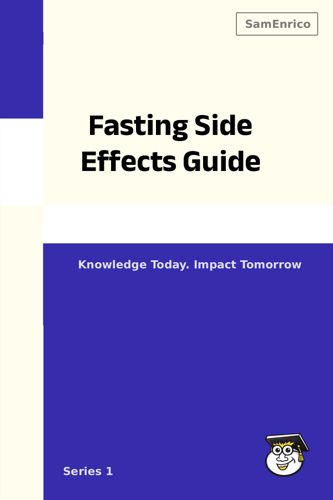
Non-FictionHealth & WellnessSide Effects
Fasting Side Effects Guide Audiobook
Headaches, fatigue, and how to minimize them.
by Cheek Alaina
Headaches, fatigue, and how to minimize them.
Formats
Free sample
Chapter 1: The 85% Problem...--Elena had prepared for everything. She’d cleared her calendar for three days. She’d bought organic vegetables. She’d told her coworkers she’d be “off-grid.” She’d even meditated on her intentions. But by 2:00 PM on Day 2, she was curled up on her bathroom floor, an ice pack wrapped around her throbbing temples, convinced she was dying.
Her husband found her there, pale and trembling, and gently handed her a granola bar. Within twenty minutes of eating, the headache vanished, and Elena swore she would never fast again.Elena’s story is not unusual. It is, in fact, the rule. Across thousands of online forums, fasting clinics, and research studies, one pattern emerges with brutal consistency: headaches and fatigue are responsible for up to 85% of all fast-abandonment cases. People do not quit fasting because they are hungry.
They quit because their head hurts, their body feels like lead, and they believe something has gone terribly wrong.This chapter is not about why you should fast. You already have your reasons—weight loss, metabolic health, mental clarity, longevity, or spiritual discipline. This chapter is about why most people fail, why that failure has nothing to do with willpower, and how a simple mental framework can transform your fasting experience from a battle against your body into a conversation with it.The Hidden Epidemic of Fasting Discomfort Let us begin with an uncomfortable truth that most fasting books gloss over: fasting is supposed to be temporarily uncomfortable. Not agonizing. Not dangerous.
But uncomfortable in ways that signal your body is working exactly as it should. The problem is that few people understand the difference between productive discomfort and dangerous distress. Even fewer understand why the same symptom—say, a headache—can be a sign of healing in one person and a warning sign in another.The medical literature is surprisingly clear on this point. The International Classification of Headache Disorders, the gold standard reference for neurologists worldwide, formally defines a “headache attributed to fasting” as a diffuse, non-pulsating pain, usually mild to moderate in intensity, that develops after at least 8 hours without food and is reliably relieved by eating. Note the key descriptors: diffuse (spread out, not one-sided like a migraine), non-pulsating (not throbbing), and mild to moderate (not severe).
When your headache meets these criteria, it falls squarely within the range of normal.But here is where the statistics become…
This is the end of the free sample. Get the Audiobook to keep going. Buy now
About this book
Details
- Author
- Cheek Alaina
- Publisher
- SamEnrico
- Language
- English
- Genre
- Non-Fiction, Health & Wellness, Side Effects
- Released
- 2026-06-08
- Pages (approx.)
- 143
- Available as
- eBook, Audiobook

Listen in the VoxFlicks app
Audiobooks and audio dramas wherever you go. Sign in with your SamEnrico account and press play.
More by Cheek Alaina
 TM for CEOsCheek Alaina$11.99
 Google Trends Validation GuideCheek Alaina$11.99
 Startup Employee Stress GuideCheek Alaina$11.99
 Team Creative Warm TransferCheek Alaina$11.99
 End Zone Celebration of SuccessCheek Alaina$11.99
 Introverted Teen ConfidenceCheek Alaina$11.99
 HGH And NADCheek Alaina$11.99
 The Fur Trade Pioneers: Canada’s Path to DestinyCheek Alaina$11.99
 Silicon Shadows: The Infamous iPhone 4 Antenna ScandalCheek Alaina$11.99
 The Grand Design: How the West Built the Modern WorldCheek Alaina$11.99
 Growing SchizanthusCheek Alaina$11.99
 Coastal and Marine Surveying with DronesCheek Alaina$11.99
You may also like
 Hong Kong Handover 1997Dunn Johnnie$11.99
 Zumba For Postnatal Recovery CourseNeal Christian$11.99
 Zumba for BeginnersLadner Nikia$11.99
 YouTube Comment Mining GuideHumes Pandora$12.99
 Worry Box MeditationCarlin Rudy$11.99
 Workplace Stress MeditationNguyen Lynn$11.99
 Workplace Stress and Sleep RepairHawley Ivory$11.99
 Workplace Perfectionism CureDelaney Jeffry$11.99
 Workplace Injustice Anger GuideWallen Isabelle$11.99
 Work Addiction and Burnout LinkGreenwood Ester$11.99
 Women in Yoga and WellnessBeattie Galina$11.99
 Women in Stand Up ComedyChun Evangeline$11.99