
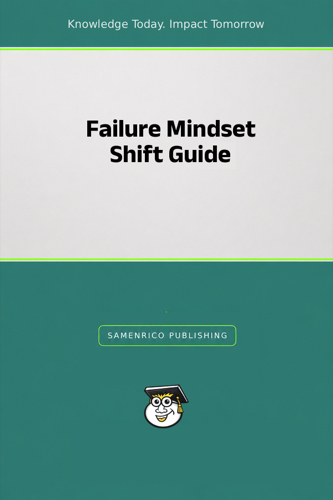
Failure Mindset Shift Guide Audiobook
Replace failure as identity with failure as event
Replace failure as identity with failure as event through linguistic changes.
Formats
Free sample
Chapter 1: The Grammar Trap...–- Elena had said “I’m just not a math person” so many times that she’d forgotten when it started. She was twenty-eight years old, a marketing manager with a team of seven, and she genuinely believed that her brain was wired wrong. The evidence, she would tell you, was irrefutable: she had failed algebra in tenth grade, cried through a college statistics course, and avoided any spreadsheet more complicated than a basic budget. “I am bad with numbers” was not a description of her behavior. It was her identity.
When her boss asked her to analyze the quarterly sales data, Elena felt something rise in her chest—not fear exactly, but a kind of resignation. This is what happens to people like me, she thought. We get exposed. We get found out.What Elena didn’t know—what no one had ever taught her—was that the sentence “I am bad with numbers” was not a fact about her brain. It was a grammatical structure.
And that grammatical structure was lying to her.This chapter is about that lie. It is about the single most destructive pattern in the English language when it comes to failure: the way we use the verb “to be” to turn temporary actions into permanent identities. By the time you finish this chapter, you will understand why “I am a failure,” “I am clumsy,” “I am bad at this,” and “I am not a math person” are not neutral descriptions. They are linguistic traps. And more importantly, you will learn how to escape them.But before we get to the escape, we need to understand the trap.The Copula Catastrophe: Why “Is” Is the Most Dangerous Word You Use In linguistics, the verb “to be” (in all its forms: am, are, is, was, were) is called a copula.
Its job is to link the subject of a sentence to a predicate—usually an adjective or a noun. “The sky is blue.” “She is a doctor.” “I am tired.” These sentences seem harmless. And most of the time, they are.But here is where the trap springs shut. When you say “I am clumsy,” you are not describing a single event. You are attaching an adjective—“clumsy”—directly to your self.
The grammar of English allows this. It encourages it, even. But the psychological consequence is devastating. The sentence “I am…
This is the end of the free sample. Get the Audiobook to keep going. Buy now
About this book
Details
- Author
- Alvarez Marion
- Publisher
- SamEnrico
- Language
- English
- Genre
- Non-Fiction, Self-Help
- Released
- 2026-06-10
- Pages (approx.)
- 157
- Available as
- eBook, Audiobook

Listen in the VoxFlicks app
Audiobooks and audio dramas wherever you go. Sign in with your SamEnrico account and press play.
More by Alvarez Marion
 Performance Review ConversationsAlvarez Marion$11.99
 Shift Work Weight ManagementAlvarez Marion$11.99
 Graduate Study GuideAlvarez Marion$11.99
 The Family CannibalAlvarez Marion$11.99
 TM for Frequent FlyersAlvarez Marion$11.99
 CPR for Ski ResortsAlvarez Marion$11.99
 Leptin Sensitivity FoodsAlvarez Marion$11.99
 The Last Whisper of the Great Barrier ReefAlvarez Marion$11.99
 The Devil's Island: Cuba's Forgotten Prison of the Cold WarAlvarez Marion$11.99
 How to Produce Electric Griddles and GrillsAlvarez Marion$11.99
 Ornamental Plants: Cut Flower & STEM Harvesting GuideAlvarez Marion$11.99
 How to Start a Hobby in BridgeAlvarez Marion$11.99
You may also like
 Workplace Stress MeditationNguyen Lynn$11.99
 Volcano Monitoring ScientistCox Alexis$11.99
 The Tech Professional NetAguiar Nevada$11.99
 The Morning Metta RitualCanales Anya$11.99
 The Chunking Memory TechniqueClanton Hyacinth$11.99
 The Beginner Mistake FixAmmons Cassondra$11.99
 Surrendering to What IsGrimm Reatha$11.99
 Self Hypnosis for Fear of FireBillups Eli$11.99
 Road Rage for Professional DriversBrackett Janise$11.99
 Psychiatric Ward Nurse StressDunning Wyatt$11.99
 Observation vs Evaluation NVCTimmons Alda$11.99
 Networking for Nonprofit ProfessionalsPoole Jesse$11.99