
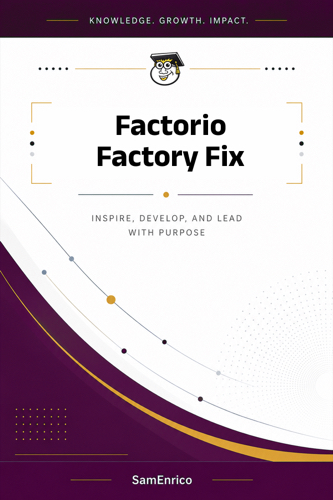
Non-FictionSelf-HelpAutomation Addiction
Factorio Factory Fix eBook
Breaks optimization compulsion and endless base ex
by Adam Ashlea
Breaks optimization compulsion and endless base expansion loops.
Formats
Free sample
Chapter 1: The Iron Promise...--–- It begins, as it always does, with a shortage.You are thirty minutes into a new factory. Your miner drills into a patch of iron ore. The belt carries it to furnaces. The furnaces spit out plates. The plates feed an assembler making gears.
Another assembler takes those gears and turns them into red science packs. A laboratory consumes those packs, and a number ticks upward. Everything works. The factory hums.Then the iron runs out.Not literally—the patch still has thousands of ore. But the belt is no longer full.
The last furnace in the row flickers on and off, starved for input. The gear assembler waits. The science assembler waits. The laboratory sits idle. You look at the belt.
You see gaps. Those gaps feel like failure.So you fix it. You add more miners. You upgrade the belt from yellow to red. You add a second furnace array.
The belt fills again. The gears flow. The science flows. The laboratory glows green. You lean back.
You feel the warm rush of a problem solved.For about ninety seconds.Then you notice the copper. Your red science needs copper plates too, and your single copper furnace array was never meant to feed both red science and the green science you just unlocked. The copper belt thins. The green science assembler starves. A new bottleneck appears, born directly from the solution to the old one.You have just completed the core gameplay loop of Factorio.
You will complete it again. And again. And again. For the next hundred hours, or five hundred, or two thousand, you will chase shortages, seal gaps, and watch new problems bloom from the ashes of old solutions. This is not a bug in the game.
It is the entire point of the game.And it is also, for many players, a trap.The Loop That Eats Time The "Problem → Fix → Improvement → New Problem" cycle is the most elegant feedback loop ever designed in a video game. It is more refined than the combat loop of Doom, more addictive than the leveling loop of World of Warcraft, and more deceptive than the "one more turn" loop of Civilization. Because in Factorio, the loop does not have a natural decay curve. It does not slow down. It accelerates.In the first hour, the loop takes five minutes.
You fix iron, then copper, then power, then iron again. In the tenth hour, the loop takes thirty minutes. You fix oil processing, then red circuit throughput, then train congestion, then oil again. In the fiftieth hour, the loop takes two hours. You fix module production, then beacon alignment, then blue circuit supply, then module production again.
The problems get larger, more complex, and more entangled, but the loop never stops. It only changes scale.This is not an accident. The developers of Factorio, Wube Software, spent years tuning this loop. They added infinite research, then space science, then quality modules, each designed to extend the loop beyond any natural endpoint. They did not do this out of malice.
They did it because players demanded it. When the game ended at the rocket launch, players felt cheated. They wanted more. So the developers gave them more. And more.
And more.The result is a game that can be played forever. Literally forever. There is no technical limit to how large a Factorio factory can grow, given enough computing power and player patience. There is no narrative endpoint. There is no final boss that, once defeated, rolls credits and asks if you would like to start New Game Plus.
There is only the loop, expanding outward like a fractal, consuming your attention in direct proportion to the size of your factory.This book is not about quitting Factorio. If you want to quit, you already know how: uninstall the game. That is not the fix this book offers. The fix this book offers is the ability to recognize the loop for what it is, to step outside of it, and to declare victory on your own terms—not because the game says you are done, but because you say you are done.But before you can declare victory, you must understand the weapon you are fighting against. And the weapon is not Factorio.
The weapon is your own brain.The Hunter-Gatherer in the Control Room Human beings did not evolve to optimize factories. We evolved to find berries and avoid predators. The dopamine system in your brain, the same system that makes Factorio feel so satisfying, was designed to reward behaviors that kept your ancestors alive. Find a berry bush? Dopamine.
Successfully track an animal? Dopamine. Avoid being eaten by a sabertooth tiger? Dopamine, mixed with relief.These rewards were designed for a world of scarcity. Your ancestors never found a berry bush and thought, "I have enough berries.
I will stop picking them." They picked until the bush was bare. They hoarded. They stockpiled. Because the next bush might be miles away, and winter was coming.Factorio hijacks this ancient circuitry with surgical precision. The game presents you with a world of infinite resources—the map stretches forever, the ore patches get richer the farther you go—but your brain still behaves as if scarcity is imminent.
You see a belt with gaps, and your hunter-gatherer instinct screams: "Not enough! Gather more! Store more!"This is the evolutionary mismatch at the heart of the Factorio compulsion. Your brain is running software designed for the African savanna, but the hardware input is an infinite procedural map. The result is a loop that your brain cannot naturally terminate, because the termination condition—"enough"—does not exist in the game.
The game does not have a "enough" state. It only has "more."The German publication Fließband im Kopf (Assembly Line in the Mind) calls this the "productivity paradox." The authors, a group of cognitive psychologists who studied Factorio players, found that the same players who reported the highest satisfaction from solving logistical puzzles also reported the highest rates of sleep deprivation, work neglect, and relationship strain. The loop that feels good is the same loop that harms. The difference is not in the loop itself, but in the player's ability to step away from it.One participant in their study, a software engineer who had logged over three thousand hours, described it this way: "I know the factory is not real. I know the iron plates do not matter.
But when I see a belt running dry, my chest tightens. It feels like a real emergency. It feels like a deadline is approaching. I cannot explain it. I just have to fix it."This is the confession that opens this book.
The author has felt that chest-tightening panic. The author has stayed up until 4 AM fixing a blue circuit shortage that did not need to be fixed until morning. The author has neglected meals, exercise, and human conversation because a train intersection was deadlocking. The author is not writing from a position of superiority. The author is writing from a position of shared compulsion, offering a map out of a maze that he…
This is the end of the free sample. Get the eBook to keep going. Buy now
About this book
Details
- Author
- Adam Ashlea
- Publisher
- SamEnrico
- Language
- English
- Genre
- Non-Fiction, Self-Help, Automation Addiction
- Released
- 2026-06-06
- Pages (approx.)
- 144
- Available as
- eBook, Audiobook

Read better in the ZLOADR app
Your eBooks on your phone or tablet. Sign in with your SamEnrico account and start reading.
More by Adam Ashlea
 Mindful Parenting MBSR CourseAdam Ashlea$11.99
 Relationship Repair GuideAdam Ashlea$11.99
 Hair System for Men GuideAdam Ashlea$11.99
 The Aging Self Esteem Affirmation PrimerAdam Ashlea$11.99
 The Golden Ghost of the Caribbean: The Untold Heist of Captain John RackhamAdam Ashlea$11.99
 UN Internship to Staff TransitionAdam Ashlea$12.99
 Understanding Mental Retardation Gynecomastia Obesity X LinkedAdam Ashlea$17.99
 Search Marketing SpecialistAdam Ashlea$11.99
 How to Start a Hobby in Puppet theatreAdam Ashlea$11.99
You may also like
 Hong Kong Handover 1997Dunn Johnnie$11.99
 Zumba For Postnatal Recovery CourseNeal Christian$11.99
 Zumba for BeginnersLadner Nikia$11.99
 YouTube Comment Mining GuideHumes Pandora$12.99
 Worry Box MeditationCarlin Rudy$11.99
 Workplace Stress MeditationNguyen Lynn$11.99
 Workplace Stress and Sleep RepairHawley Ivory$11.99
 Workplace Perfectionism CureDelaney Jeffry$11.99
 Workplace Injustice Anger GuideWallen Isabelle$11.99
 Work Addiction and Burnout LinkGreenwood Ester$11.99
 Women in Yoga and WellnessBeattie Galina$11.99
 Women in Stand Up ComedyChun Evangeline$11.99