
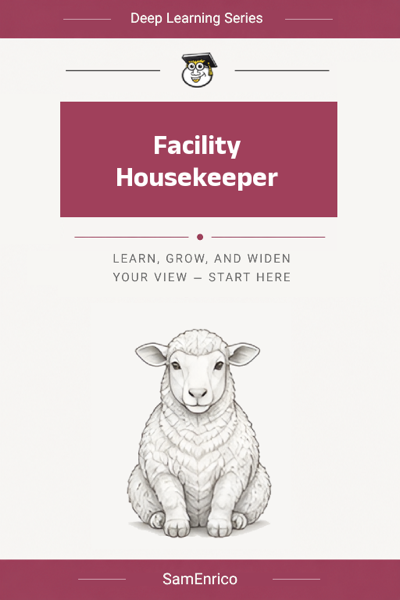
Non-FictionInformativeEducational
Facility Housekeeper eBook
A Coursebook on Facility Housekeeper
A Coursebook on Facility Housekeeper
Formats
Free sample
Chapter 1: Beyond the Broom...--–- The hotel lobby gleamed under the soft glow of chandeliers. Marble floors reflected the light like still water. Fresh flowers arranged in crystal vases perfumed the air. Guests in designer clothes checked in at the front desk, tapping credit cards and collecting key cards. Everything looked perfect.
Everything smelled perfect. Everything felt perfect.But in room 412, a different story was unfolding. The guest who had just checked out had left behind a mess that would never appear in any marketing brochure: a spilled glass of red wine on the beige carpet, a clogged toilet, and a complaint about a strange odor that housekeeping could not identify. The front desk had already promised the incoming guest that the room would be ready in thirty minutes. The clock was ticking.This is the world of the modern facility housekeeper.
Not the world of feather dusters and bleach buckets, but a high-stakes, data-driven environment where every surface matters, every minute counts, and every mistake costs money. The housekeeper in room 412 that morning was not just cleaning a room. She was protecting the hotel's reputation, ensuring the next guest's comfort, and safeguarding the health of everyone who would walk through that door.This chapter is called "Beyond the Broom" because that is where we are going. The old image of housekeeping—invisible workers pushing carts down silent hallways—is dead. In its place is a strategic profession that requires scientific knowledge, observational skill, financial awareness, and ethical judgment.
The facility housekeeper of today is the eyes and ears of the building, the first line of defense against safety hazards, the guardian of guest and patient health, and a key driver of revenue through repeat business and positive reviews.If you are reading this book, you are likely already in housekeeping or considering it as a career. You may have started because you needed a job, any job. You may have fallen into it by accident. You may have been told that housekeeping is unskilled labor, that anyone can do it, that it is a dead-end job. Those people are wrong.
This book will show you why.The Evolution of Housekeeping: From Invisible to Indispensable Let us take a brief journey back in time. One hundred years ago, housekeeping in hotels and hospitals was indeed a manual labor job. Workers used feather dusters that simply moved dust from one surface to another. They used harsh chemicals like straight bleach without understanding dilution or dwell time. They mopped floors with dirty water and the same rag for every room.
There were no standards, no measurements, no accountability. Cleanliness was a matter of opinion.The first revolution came with the discovery of germs. Once we understood that invisible microorganisms caused disease, cleaning took on a new importance. Hospitals realized that patients who stayed in cleaner rooms had lower infection rates. Hotels realized that guests who saw dust or stains complained more and returned less.
But still, housekeeping remained a low-status, low-pay occupation.The second revolution is happening right now. It is driven by three forces: data, technology, and reputation.Data allows us to measure cleanliness objectively. We can track how many minutes it takes to clean a room, how many defects inspectors find, and how much each square foot costs to maintain. These numbers are not just for managers. They are for you.
When you know your own productivity rate, you can set personal goals. When you see your inspection scores, you can identify your weak spots. When you understand costs, you can make suggestions that save money and get noticed by leadership.Technology gives us tools that did not exist a decade ago. Property management systems on handheld devices let housekeepers update room status instantly. Workforce management software tracks carts by GPS and alerts supervisors when a room is taking too long.
Automatic scrubbers clean floors faster and more consistently than any human with a mop. These tools do not replace housekeepers; they make housekeepers more effective.Reputation has become the most valuable asset any facility owns. A single negative Trip Advisor review about cleanliness can cost a hotel thousands of dollars in lost bookings. A poor HCAHPS score on hospital cleanliness can reduce Medicare reimbursement by millions. The guest who finds a hair in the bathroom is not just annoyed; they are a financial threat.
This is why housekeeping is no longer a cost center to be minimized. It is a profit center to be optimized.The housekeeper of today is indispensable. You are not pushing a broom. You are protecting revenue.The Five Levels of Clean: Knowing What You Are Actually Doing Before you can clean effectively, you need to understand what "clean" actually means. Most people use the word loosely, but in professional facilities, there are five distinct levels of cleanliness.
Each has a specific definition, specific methods, and specific applications.Level 1: Clean. This means visually free of soil, dust, and debris. A room that is clean looks good to the naked eye. There are no visible spots on the carpet, no dust on the furniture, no smudges on the mirror. Clean is the minimum standard for most hotel guest rooms and office spaces.
It requires mechanical action (wiping, vacuuming, mopping) and sometimes a mild detergent. Clean does not kill germs. It only removes visible dirt.Level 2: Sanitized. This means reducing the number of bacteria on a surface to a safe level as determined by public health standards. Sanitizing is required for food-contact surfaces in restaurants and for certain areas in healthcare facilities.
Sanitizing typically uses heat (dishwashers) or chemicals (quaternary ammonium compounds) and requires a specific dwell time—the time the chemical must remain wet to work. Sanitizing does not kill all germs, only enough to be safe.Level 3: Disinfected. This means killing specific pathogens (disease-causing microorganisms) on a surface. Disinfecting is required in healthcare settings, restrooms, and anywhere there is risk of infection transmission. Disinfectants are EPA-registered and have labels that specify which pathogens they kill and what dwell time is required.
A common mistake is wiping disinfectant off too quickly. If the label says ten minutes, the surface must stay wet for ten minutes. Disinfecting does not necessarily remove visible soil; surfaces should be cleaned before disinfected.Level 4: Sterile. This means eliminating all microbial life, including bacterial spores. Sterile environments are required only for operating rooms, pharmaceutical labs, and certain medical device manufacturing.
Sterilization uses methods like autoclaving (steam under pressure), ethylene oxide gas, or radiation. Standard housekeeping does not involve sterilization, and you should never claim a room is sterile unless it has been through a validated sterilization process.Level 5: Decontaminated. This means removing hazardous substances such as blood, bodily fluids, or chemical residues. Decontamination is required after trauma scenes, infectious disease outbreaks, or chemical spills. It is a specialized process that often requires licensed professionals.
Knowing when decontamination is needed—and when to call specialists instead of attempting in-house cleaning—is essential for safety.Why does this matter to you? Because using the wrong level of cleanliness is either ineffective (sanitizing when you need to disinfect) or wasteful (sterilizing when you only need clean). Your facility likely has written protocols specifying which level is required…
This is the end of the free sample. Get the eBook to keep going. Buy now
About this book
Details
- Author
- Sapp Laurette
- Publisher
- SamEnrico
- Language
- English
- Genre
- Non-Fiction, Informative, Educational
- Released
- 2026-05-25
- Pages (approx.)
- 141
- Available as
- eBook, Audiobook

Read better in the ZLOADR app
Your eBooks on your phone or tablet. Sign in with your SamEnrico account and start reading.
More by Sapp Laurette
 Gravity Defying NonverbalsSapp Laurette$11.99
 Cap and Hat BrandingSapp Laurette$11.99
 Gacy Surveillance FootageSapp Laurette$11.99
 Quit Smoking for Surgery PrepSapp Laurette$11.99
 The Siege of Stanleyville: Mercenaries, Diplomats, and a City Held HostageSapp Laurette$11.99
 AI Candidate Screening WorkflowsSapp Laurette$12.99
 Learn to Play the LabaSapp Laurette$11.99
 How to Start a Barber Business (Beginners Guide)Sapp Laurette$11.99
You may also like
 Hong Kong Handover 1997Dunn Johnnie$11.99
 Zumba For Postnatal Recovery CourseNeal Christian$11.99
 Zumba for BeginnersLadner Nikia$11.99
 YouTube Comment Mining GuideHumes Pandora$12.99
 Worry Box MeditationCarlin Rudy$11.99
 Workplace Stress MeditationNguyen Lynn$11.99
 Workplace Stress and Sleep RepairHawley Ivory$11.99
 Workplace Perfectionism CureDelaney Jeffry$11.99
 Workplace Injustice Anger GuideWallen Isabelle$11.99
 Work Addiction and Burnout LinkGreenwood Ester$11.99
 Women in Yoga and WellnessBeattie Galina$11.99
 Women in Stand Up ComedyChun Evangeline$11.99