
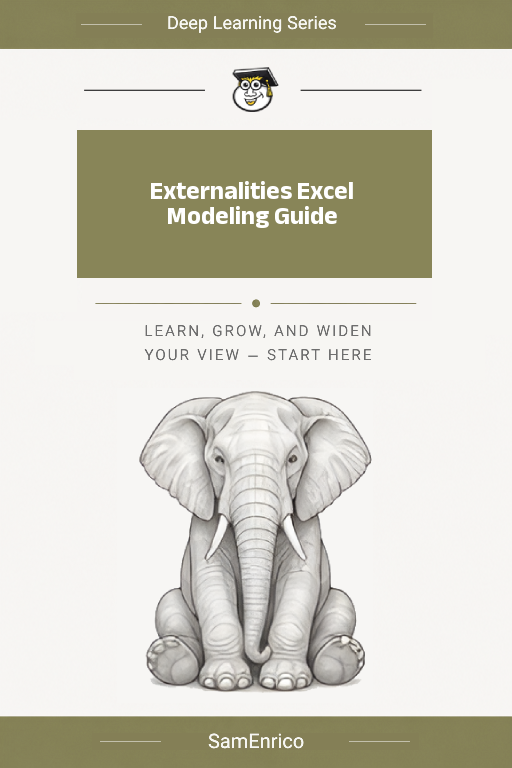
Externalities Excel Modeling Guide Audiobook
Model positive and negative externalities with soc
Model positive and negative externalities with social cost curves. Calculate Pigouvian taxes and subsidies for market failure exam questions.
Formats
Free sample
Chapter 1: The Broken Price Tag--Imagine walking into a coffee shop. You order a latte for 4.50.Youpay,youdrink,youleave.That4.50. You pay, you drink, you leave. That 4.50.Youpay,youdrink,youleave.That4.50 covers the coffee beans, the milk, the cup, the barista’s time, and a small profit for the shop owner. From your perspective, the price reflects the cost of production.
The market seems to have worked perfectly.But what if that $4.50 coffee came with hidden costs that no one paid for? What if the coffee farm was carved out of a rainforest, destroying habitat for endangered species? What if the plastic cup will sit in an ocean for four hundred years? What if the carbon emissions from shipping the beans are warming the planet, and you—along with every other person on Earth—are paying the price through more extreme weather, rising sea levels, and higher insurance premiums?That $4.50 coffee suddenly looks a lot more expensive. But here is the problem: none of those costs appeared on the receipt.
They were invisible. They were unpaid. And they are the reason that markets, left to their own devices, often produce the wrong amount of just about everything.This chapter is about those hidden costs and hidden benefits. Economists call them externalities. Understanding them is the first step toward fixing the most fundamental flaw in market economies—a flaw that costs society trillions of dollars every year in pollution, under-vaccination, congestion, and countless other problems.
By the end of this chapter, you will not only understand what externalities are, but you will build your first Excel model that visually proves why unregulated markets fail and how much society loses as a result.The Lie We Were Told About Markets If you have taken an introductory economics course, you learned about the magic of markets. Supply meets demand. Price adjusts. Everyone who values a good more than its cost gets it. Everyone who would produce it for less than the market price sells it.
The result is efficient—no one can be made better off without making someone else worse off. This is the fundamental theorem of welfare economics, and it is beautiful in its logic.But it rests on a hidden assumption: that all costs and benefits of a transaction are borne by the buyer and seller alone. When that assumption holds, markets work. When it breaks, markets fail. And it breaks constantly.An externality…
This is the end of the free sample. Get the Audiobook to keep going. Buy now
About this book
Details
- Author
- Nunes Shandra
- Publisher
- SamEnrico
- Language
- English
- Genre
- Non-Fiction, Student's Shortcut, Welfare Economics
- Released
- 2026-06-01
- Pages (approx.)
- 152
- Available as
- eBook, Audiobook

Listen in the VoxFlicks app
Audiobooks and audio dramas wherever you go. Sign in with your SamEnrico account and press play.
More by Nunes Shandra
 Cleopatra Asset Liquidation GuideNunes Shandra$11.99
 Financial Stress and Student LoansNunes Shandra$11.99
 Tutoring Stress ReductionNunes Shandra$11.99
 Mindfulness for StudentsNunes Shandra$11.99
 The Hollow Crown: Merlin's Shadow WarNunes Shandra$11.99
 EuchreNunes Shandra$11.99
 How to Start a Ferro Aluminium Business (Beginners Guide)Nunes Shandra$11.99
 How to Produce an Auto Ignition SystemNunes Shandra$11.99