
Non-FictionTrue CrimePatch Management
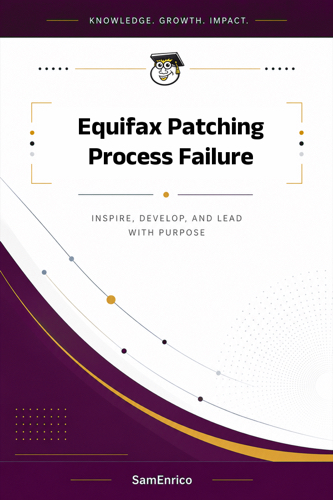
Equifax Patching Process Failure eBook
Trace how a two-month-old patch notification was i
by Mora Sibyl
Trace how a two-month-old patch notification was ignored by IT staff.
Formats
Free sample
Chapter 1: The Orphaned Portal...--The server that would bring down a Fortune 500 company sat in a climate-controlled data center in Atlanta, Georgia, humming along at 0.3 percent CPU utilization. It was a Tuesday. March 7, 2017. Nothing about this server suggested catastrophe. It was not flashing red.
It was not overheating. It was simply there, like thousands of other servers in Equifax's sprawling network, doing exactly what it had been programmed to do: receive consumer credit disputes, process them, and send back responses. The server's name was ACIS-APP-07, and it was an orphan.No one owned it. Not really.On paper, the Automated Consumer Interview System—ACIS for short—was a legacy web application built in the early 2000s to handle exactly what its name suggested: consumer interviews. When an American disputed a line item on their credit report, that dispute flowed through ACIS.
When a landlord checked a tenant's credit, that inquiry touched ACIS. When a bank verified a loan applicant's identity, ACIS was in the chain. By 2017, the portal processed millions of transactions per month, each one carrying a payload of the most sensitive data the United States produces: full names, Social Security numbers, dates of birth, driver's license numbers, addresses, and in some cases, credit card numbers.Yet the server that handled all of this had no designated system owner. The previous administrator, a mid-level IT engineer named David (last name withheld by request of his former colleagues), had left Equifax in September 2016. He had taken a job at a smaller fintech company for a twenty percent raise.
Before he left, he had sent an email to his manager: "Who should I hand the ACIS servers off to?" That email received a reply: "We'll sort it out in the next team meeting." The team meeting came and went. The agenda was full. ACIS was not discussed. David's access was revoked on his last day, and the servers he had maintained—including ACIS-APP-07—were added to a shared distribution list called "legacy-systems@equifax.com." That distribution list had 47 members. No one on the list had ever raised their hand to say, "I own ACIS."This was not an accident.
It was a design feature of Equifax's IT culture, and it is the first and most important fact a reader must understand about how a two-month-old patch notification could be ignored by an entire company. Equifax operated on what insiders called the "honor system." Employees voluntarily self-designated as system owners. There was no formal asset registry. No automated tool tracked which human being was accountable for which server. No periodic audit verified that every critical system had a named owner with an up-to-date contact method.
If you inherited a server because the previous person quit, you inherited it by word of mouth. If the person who knew about the server quit without telling anyone, the server became an orphan—still running, still vulnerable, but owned by no one.At the time of the Struts disclosure on March 8, 2017, ACIS-APP-07 had been an orphan for six months.The Unstated Contract Every company that collects sensitive data makes an implicit bet with the public. The bet goes like this: We are competent stewards of your information. We have processes in place to protect it. You do not need to understand those processes; you only need to trust that they exist.
Equifax had been making that bet for decades. As one of the three major credit reporting agencies in the United States, Equifax held data on over 200 million Americans—essentially every adult with a credit history. The company's business model depended entirely on public trust. If Americans stopped believing that Equifax could protect their Social Security numbers, the entire edifice of consumer credit would wobble.The problem with implicit bets is that they are only as strong as the processes that back them. And Equifax's processes were, to put it charitably, aspirational.The company had a written Patch Management Policy.
It was a seventeen-page document, last updated in 2014, that lived on an internal Share Point site. Section 4.2 read: "Critical severity vulnerabilities shall be patched within forty-eight (48) hours of notification." This was a binding policy, the kind that auditors asked about and executives cited in board meetings. But here is what the policy did not have: enforcement mechanisms. There was no automated ticketing system that escalated unpatched vulnerabilities to management after 48 hours. There were no consequences for missing the deadline.
There was no regular audit of patch compliance that tied to performance reviews or bonuses. The policy existed on paper. No one had ever been punished for violating it.This is a distinction that matters enormously. A policy with no enforcement is not a policy. It is a suggestion dressed in corporate formalwear.
And Equifax's IT staff knew this implicitly. They had learned, through years of experience, that the 48-hour rule was a guideline, not a requirement. When a critical patch arrived, the responsible team would assess it, prioritize it against their existing backlog of work, and apply it when they could. Sometimes that was within 48 hours. Often it was not.
The previous year, a critical Apache Struts vulnerability—CVE-2016-3081—had taken the ACIS team seventeen days to patch. No one was fired. No one was even reprimanded. The security team sent a polite reminder email, and the patch was applied eventually. The world did not end.So when CVE-2017-5638 was announced on March 8, the IT staff who received the notification did not see an emergency.
They saw another entry in a long list of critical vulnerabilities, one among thousands, and they triaged it accordingly. They had no way of knowing that this particular vulnerability was different. They had no way of knowing that the attackers who would exploit it were already scanning Equifax's network, looking for exactly this flaw. They had no way of knowing that the patch they were about to ignore would become the most expensive oversight in the history of consumer data protection.They just saw another email. And they had 847 other unread emails to get through.The ACIS Portal: A Postmortem of Legacy Systems To understand why ACIS-APP-07 was so vulnerable in the first place, it is necessary to understand what ACIS actually was.
The Automated Consumer Interview System was not a single application but a constellation of interconnected services, most of which had been written between 2002 and 2005. The core technology stack included Apache Struts 1.3—a version so old that the Apache Foundation had stopped issuing security updates for it in 2008. Equifax had never upgraded because the ACIS codebase was, in the words of one former engineer, "spaghetti with extra meatballs." The application had been modified by dozens of developers over fifteen years, each one adding features, fixing bugs, and leaving behind undocumented dependencies. Upgrading Struts would have required rewriting approximately 40,000 lines of custom code. The business team had rejected the project twice, in 2012 and 2015, because the estimated six months of development time would have delayed other revenue-generating initiatives.This is the uncomfortable reality of legacy systems at large corporations.
They are never replaced because they are never broken enough to justify the cost. ACIS worked. It processed disputes. It returned credit reports. It made money.
The fact that it was running on a twelve-year-old web framework with known security vulnerabilities was a problem for the…
This is the end of the free sample. Get the eBook to keep going. Buy now
About this book
Details
- Author
- Mora Sibyl
- Publisher
- SamEnrico
- Language
- English
- Genre
- Non-Fiction, True Crime, Patch Management
- Released
- 2026-06-07
- Pages (approx.)
- 145
- Available as
- eBook, Audiobook

Read better in the ZLOADR app
Your eBooks on your phone or tablet. Sign in with your SamEnrico account and start reading.
More by Mora Sibyl
 Kim Clijsters Mother ChampionMora Sibyl$11.99
 Overnight Binge StopperMora Sibyl$11.99
 Menopause Protein GuideMora Sibyl$11.99
 Toxic Shame Healing HandbookMora Sibyl$11.99
 The Glass Ceiling: How One Woman Built the World's Tallest SkyscraperMora Sibyl$11.99
 The Beast of the Black Forest: A Hunter’s SecretMora Sibyl$11.99
 Understanding Geen Sandford Davison SyndromeMora Sibyl$17.99
 How to Start a Software Store BusinessMora Sibyl$11.99
 Sustainable Travel SpendingMora Sibyl$12.99
 Australian Trade Visa WorkbookMora Sibyl$12.99
 Digital Media InternMora Sibyl$11.99
You may also like
 Hong Kong Handover 1997Dunn Johnnie$11.99
 Zumba For Postnatal Recovery CourseNeal Christian$11.99
 Zumba for BeginnersLadner Nikia$11.99
 YouTube Comment Mining GuideHumes Pandora$12.99
 Worry Box MeditationCarlin Rudy$11.99
 Workplace Stress MeditationNguyen Lynn$11.99
 Workplace Stress and Sleep RepairHawley Ivory$11.99
 Workplace Perfectionism CureDelaney Jeffry$11.99
 Workplace Injustice Anger GuideWallen Isabelle$11.99
 Work Addiction and Burnout LinkGreenwood Ester$11.99
 Women in Yoga and WellnessBeattie Galina$11.99
 Women in Stand Up ComedyChun Evangeline$11.99