
Epic Trainer eBook
A corsebook on Epic Trainer
by Orosco Doria
A Coursebook on Epic Trainer
Formats
Free sample
Chapter 1: The Hero’s Journey--– You have spent countless nights hunched over a laptop, rearranging bullet points that nobody will remember. You have stood in front of rooms full of humans who stare through you while their phones glow beneath the tables. You have delivered what you believed was a brilliant session—energetic, clear, well-paced—only to hear nothing change. No new behaviors. No improved metrics.
No “thank you for teaching me something I actually use.” Just another training completed, another checkbox ticked, another quiet acknowledgment that you are competing not just with distraction but with biology itself.This chapter is not about making you a better presenter of information. It is about making you an architect of transformation. And to do that, you must first understand the single greatest obstacle standing between you and every learner who has ever tuned you out.The 90% Graveyard Let us begin with a number that should terrify every trainer who reads it: ninety.According to Hermann Ebbinghaus’s forgetting curve, first published in 1885 and replicated countless times since, the average human forgets approximately 90 percent of new information within one week if no effort is made to retain it. Within one hour, learners lose roughly 50 percent. Within 24 hours, 70 percent.
By day seven, only 10 percent remains—and that remaining 10 percent is often distorted, fragmented, or misattributed.Here is what this means for your training: If you deliver a one-hour lecture on Friday afternoon, by the following Friday, your learners will recall roughly six minutes of what you said. And those six minutes will not be the six minutes you most wanted them to remember. They will be the joke you told, the weird outfit someone wore, or the one statistic that shocked them—not the five-step process you spent forty minutes explaining.Do not blame your learners. This is not a failure of attention or effort. It is a feature of how human memory evolved.
Our brains did not develop to retain Power Point slides. They developed to retain stories, threats, opportunities, and social information. The lecture—a one-way transmission of abstract symbols from a distant expert to a passive audience—is biologically unnatural. It is a cultural invention less than 2,000 years old, and it is failing because it fights against three million years of cognitive evolution.If you have ever felt that your training “went in one ear and out the other,” you were not imagining it. That is exactly what happened.
And it will keep happening until you stop delivering content and start designing journeys.The Great Misunderstanding: Activity vs. Outcome Most trainers confuse two things that could not be more different: learning activity and learning outcome.Learning activity is what you do. You create slides. You show up. You talk.
You facilitate an exercise. You hand out a quiz. These are behaviors, and they are easy to measure. Did the session happen? Yes.
Did people attend? Yes. Did they complete the post-test? Yes. These metrics feel like progress because they produce data.
But data is not impact.Learning outcome is what changes as a result of the activity. Can the learner now do something they could not do before? Do they make different decisions? Do they solve problems faster? Do they avoid errors they used to make?
Outcome is harder to measure, which is why most organizations avoid it. But outcome is the only thing that matters.Here is the painful truth that opens every chapter of this book: You can have a perfect learning activity—beautiful slides, flawless facilitation, high engagement scores—and still achieve zero learning outcome if the activity was not designed for transfer.The corporate training industry spends billions of dollars annually on learning activities that produce no measurable change in behavior. We know this because meta-analyses of workplace training consistently show that without reinforcement, spaced practice, and real-world application, most training has an effect size approaching zero. In plain English: most training does nothing.You did not cause this problem alone. You inherited a system built on convenience, not science.
But you are the one who can fix it—starting with a fundamental shift in how you see yourself.The Two Masks: Sage on the Stage vs. Guide on the Side Every trainer wears one of two masks. The mask you choose determines everything that follows.The Sage on the Stage believes their job is to transmit information. They stand at the front of the room (or the top of the Zoom grid) and deliver content. They are the expert.
The learners are empty vessels. The measure of success is how much material was covered. The Sage says things like “I have a lot to get through today” and “We are running behind” and “I will answer questions at the end if there is time.” The Sage works hard. They prepare exhaustively. They often receive high smile-sheet scores because they are confident and entertaining.
But their learners forget nearly everything.The Guide on the Side believes their job is to architect experiences. They stand beside the learner, metaphorically if not physically. They ask questions more than they give answers. They design challenges, provide tools, and celebrate victories. The measure of success is not what they taught but what the learner can do afterward.
The Guide says things like “What do you think?” and “Try it and see what happens” and “That is a great mistake—what did you learn from it?” The Guide sometimes receives lower smile-sheet scores from learners who expected to be entertained. But their learners retain skills, change behavior, and produce outcomes.Here is the twist that surprises most trainers: The Sage often gets better immediate feedback. Learners who are accustomed to passive consumption feel uncomfortable when asked to think or do. They rate the Guide lower on “entertainment value” but higher on “usefulness” six months later—if anyone bothers to ask. The Sage gets applause.
The Guide gets results.You must decide which mask you will wear. You cannot wear both. Every decision you make—how you open a session, how you respond to a question, how you structure an assessment—will align with one role or the other. This book is written entirely for the Guide. If you wish to remain a Sage, close this book now.
It will only frustrate you.The Epic Mindset: From Covering to Uncovering The shift from Sage to Guide requires a new internal operating system. I call this the Epic Mindset, and it rests on three core beliefs.First belief: Your learners are heroes, not containers. Every person who enters your training brings a lifetime of experiences, assumptions, skills, and scars. They are not blank slates. They are protagonists in the middle of their own story.
Your job is not to pour information into them. Your job is to help them overcome the specific challenge that brought them to your session. What is the dragon they are trying to slay? A difficult software migration? A compliance audit they keep failing?
A sales quota they have missed for three quarters? Until you know their dragon, you cannot guide them.Second belief: Your content is the trial, not the treasure. Most trainers treat content as the thing learners need…
This is the end of the free sample. Get the eBook to keep going. Buy now
About this book
Details
- Author
- Orosco Doria
- Publisher
- SamEnrico
- Language
- English
- Genre
- Non-Fiction, Informative, Educational
- Released
- 2026-05-04
- Pages (approx.)
- 133
- Available as
- eBook, Audiobook

Read better in the ZLOADR app
Your eBooks on your phone or tablet. Sign in with your SamEnrico account and start reading.
More by Orosco Doria
 Growth Hacking Team StructureOrosco Doria$11.99
 Anger From Night Wakings GuideOrosco Doria$11.99
 Control Related Anger GuideOrosco Doria$11.99
 Time Boxing Vs Time Blocking GuideOrosco Doria$11.99
 Starlight Serpent: The Lost Odyssey of QuetzalcoatlOrosco Doria$11.99
 The Frozen Echo: The Lost Transmissions of North Pole-22Orosco Doria$11.99
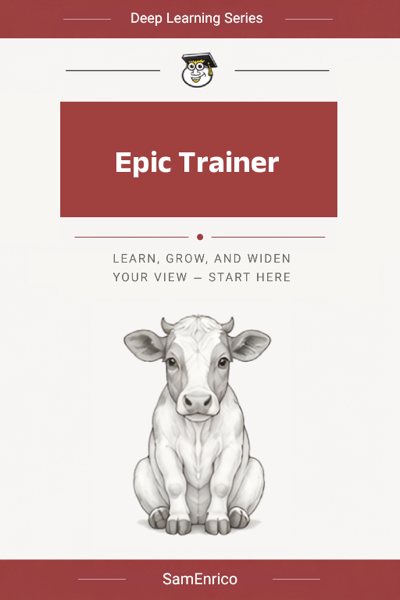 Epic TrainerOrosco Doria$11.99
 Australian Trade Recognition HandbookOrosco Doria$12.99
 2026-2030 Energy Storage OutlookOrosco Doria$12.99
 Understanding Hyperkeratosis Lenticularis PerstansOrosco Doria$17.99
 A Beginners Guide to Basketball (Volume 1)Orosco Doria$11.99