
Non-FictionStrategic AtlasTalent Intelligence
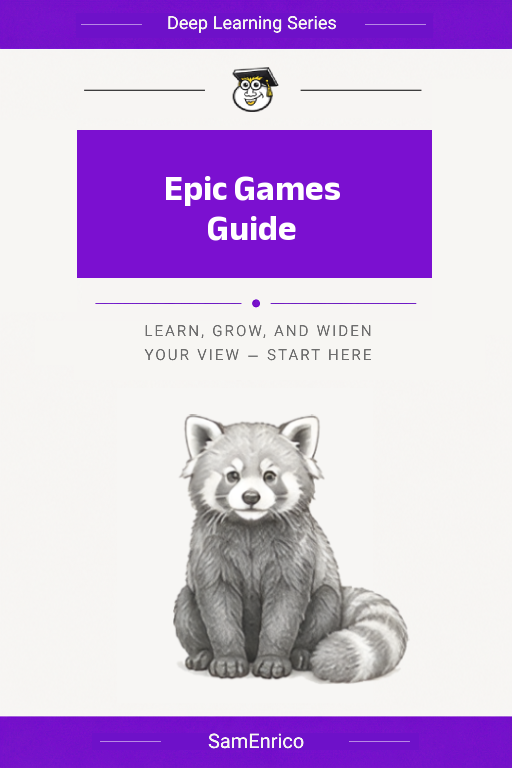
Epic Games Guide eBook
Learn Unreal Engine ecosystem, Fortnite community,
Learn Unreal Engine ecosystem, Fortnite community, and game industry veteran recruiting strategies.
Formats
Free sample
Chapter 1: The Four Doors...-- Every aspiring game developer, Fortnite player, or career-switcher eventually hits the same wall. You open You Tube and watch a tutorial on Unreal Engine 5's Nanite system. You scroll Linked In and see a job posting for "Technical Designer, Epic Games – 500 applicants." You boot up Fortnite Creative and stare at an empty grid, wondering how teenagers are building islands that generate six figures while you can't figure out where to place a spawn pad.The problem isn't your intelligence, your work ethic, or your access to resources. The problem is that you don't yet understand the ecosystem you're trying to enter.Epic Games is not a game company that happens to make tools. It is not a platform that happens to host a battle royale.
It is not a marketplace that happens to employ developers. Epic is a closed-loop ecosystem—a self-reinforcing system where players become consumers, consumers become creators, creators become professional developers, and professional developers build the tools that bring in new players. Understanding this loop is the single most important insight you will gain from this book. Without it, you will wander aimlessly, trying tactics that work for one door while standing in front of another.This chapter introduces the Four Doors framework—a mental model for understanding exactly where you are in Epic's ecosystem and, more importantly, where you want to go. By the end of this chapter, you will be able to name your current role, identify the role you want next, and map a specific, actionable path between them.
You will also understand why most people fail: they try to enter through the wrong door with the wrong key.The Ecosystem That Eats Itself Before we talk about doors, you need to understand the walls they're set into.Epic Games operates what business strategists call a "platform ecosystem"—a network of interdependent participants who create value for each other. Think of Amazon: buyers need sellers, sellers need buyers, and both need Amazon's logistics and payment infrastructure. The more buyers join, the more sellers want to join, and the more valuable the platform becomes. This is the network effect, and it's the economic engine beneath every successful tech company of the past twenty years.Epic's ecosystem has four participant types, and here's the crucial insight: these are not separate audiences. They are the same people at different moments.The thirteen-year-old who buys a battle pass with his birthday money is a consumer.
That same teenager, three years later, opens UEFN and builds his first capture-the-flag island—now he's a creator. If that island gets featured on the Discovery tab and he's invited to interview at Epic's North Carolina headquarters, he becomes a professional developer. And every feature he ships in Unreal Engine 6 will eventually trickle down to a new generation of players, consumers, and creators.This is not a ladder. It's a circle.Epic has deliberately designed every tool, payout structure, and community feature to accelerate this loop. The Fab marketplace lets creators sell assets to developers.
Epic Online Services lets players carry their progress across games. Cross-progression means the skin you bought on your Play Station follows you to your Nintendo Switch, then to your PC, then into a UEFN island built by a creator who was once just a player like you.If you only take one thing from this chapter, take this: your trajectory through the ecosystem matters more than your starting point. A player who wants to become a professional developer should not spend two years grinding ranked matches. A creator who wants to earn a living from island engagement payouts should not spend six months learning C++ optimization. The door you choose determines the skills you need, the network you build, and the timeline you can reasonably expect.Door One: The Player Who stands here: Anyone who launches Fortnite, loads into an island, and engages with gameplay without spending money or building content.Key activities: Queuing for battle royale matches, playing featured islands, participating in live events, completing quests, earning battle pass rewards.What they want: Fun, competition, social connection, escape.The trap: Players who want to become something else often mistake time played for progress.
Playing ten thousand matches will not make you a creator. It will make you a very good player. Those are different skills.The exit strategy: To leave the Player door, you must shift from consumption to observation. The aspiring creator plays a featured island and asks: "Why is this fun? What devices did they use?
How long is the engagement loop?" The aspiring professional developer plays a match and asks: "Why did the framerate drop near Tilted Towers? How does the matchmaking system balance 100 players? What would I fix?"Door One is the most crowded entrance to the ecosystem—millions of players will never leave it. That's fine. Not everyone needs to.
But if you're reading this book, you're likely standing here right now, wondering where the other doors are and how to find the key.The key to Door One is curiosity. Specifically, the willingness to break the magic circle. Players who stay players never ask how the trick works. You must become the person who pauses the movie to study the lighting rig.Door Two: The Consumer Who stands here: Players who spend money in the item shop, purchase battle passes, buy bundles, or support creators through Creator Codes.Key activities: Evaluating cosmetics, making purchase decisions, tracking the item shop rotation, managing V-Bucks balances.What they want: Self-expression, status, completionism (collecting skins or emotes), supporting favorite creators.The trap: Consumers often believe that spending money is a substitute for building skills. It is not.
Buying every skin in the shop will not teach you UEFN. It will not prepare you for a technical interview. It will empty your wallet.The exit strategy: The consumer who wants to become a creator must shift from spending to studying. Why does this skin sell well? What makes its silhouette readable from across the map?
How does Epic price bundles to encourage upselling? The consumer who wants to become a professional developer should study Epic's monetization strategy as a case study in behavioral economics—daily shop rotations create scarcity; battle passes use loss aversion; V-Bucks obscure real currency amounts.Door Two is the smallest door by number of people but the largest by revenue. Epic Games generates billions annually from consumers. That money funds Unreal Engine development, UEFN tools, and the creator payout pool. Without consumers, the ecosystem collapses.
That's not a moral judgment—it's structural reality.The key to Door Two is literacy. Specifically, understanding why you buy what you buy. The moment you can articulate the psychological principle behind a purchase—scarcity, anchoring, social proof—you've stopped being purely a consumer and started being a student of the ecosystem.Door Three: The Creator Who stands here: Builders who use UEFN (Unreal Editor for Fortnite) to design islands, write Verse scripts, create custom assets, and publish experiences for other players.Key activities: Island design, scripting, playtesting, publishing, promoting via Discord/Twitter, applying for Creator Codes, entering UEFN jams.What they want: Creative expression, audience engagement, monetization (Island Engagement Payouts, Creator Codes, Asset Store royalties), recognition, potentially a career…
This is the end of the free sample. Get the eBook to keep going. Buy now
About this book
Details
- Author
- Boudreaux Virgil
- Publisher
- SamEnrico
- Language
- English
- Genre
- Non-Fiction, Strategic Atlas, Talent Intelligence
- Released
- 2026-06-01
- Pages (approx.)
- 143
- Available as
- eBook, Audiobook

Read better in the ZLOADR app
Your eBooks on your phone or tablet. Sign in with your SamEnrico account and start reading.
More by Boudreaux Virgil
 Nobel Physics TodayBoudreaux Virgil$11.99
 The Paper Planner Time BlockingBoudreaux Virgil$11.99
 Blame Shifting Anger Management HandbookBoudreaux Virgil$11.99
 Financial Stress Survival GuideBoudreaux Virgil$11.99
 Jonathan Ross Big Beard JourneyBoudreaux Virgil$11.99
 The Architects of the Sky: The Nubian Pyramids of MeroëBoudreaux Virgil$11.99
 How to Start a Pens (retail) Business (Beginners Guide)Boudreaux Virgil$11.99
 Ethereum for African ExportersBoudreaux Virgil$12.99
 Understanding PyropoikilocytosisBoudreaux Virgil$17.99
 Fund AccountantBoudreaux Virgil$11.99
You may also like
 Hong Kong Handover 1997Dunn Johnnie$11.99
 Zumba For Postnatal Recovery CourseNeal Christian$11.99
 Zumba for BeginnersLadner Nikia$11.99
 YouTube Comment Mining GuideHumes Pandora$12.99
 Worry Box MeditationCarlin Rudy$11.99
 Workplace Stress MeditationNguyen Lynn$11.99
 Workplace Stress and Sleep RepairHawley Ivory$11.99
 Workplace Perfectionism CureDelaney Jeffry$11.99
 Workplace Injustice Anger GuideWallen Isabelle$11.99
 Work Addiction and Burnout LinkGreenwood Ester$11.99
 Women in Yoga and WellnessBeattie Galina$11.99
 Women in Stand Up ComedyChun Evangeline$11.99