
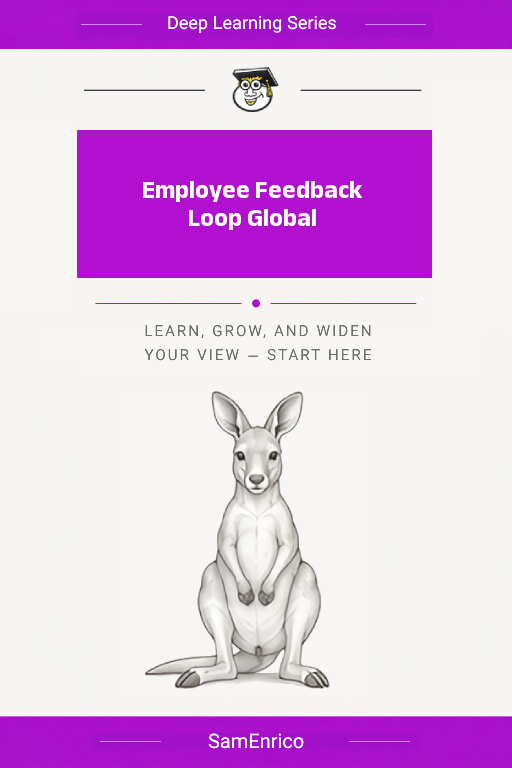
Non-FictionProfessional's Cheat SheetFeedbackEmployee Voice
Employee Feedback Loop Global Audiobook
Collect and act on employee feedback across region
by Vines Coleen
Collect and act on employee feedback across regions using anonymous surveys and follow up communications that close the loop.
Formats
Free sample
Chapter 1: The Silence Tax--–- Every year, millions of employees around the world click "Submit" on a survey they believe might change something. Every year, almost nothing changes. And then, quietly, the best ones leave.The email arrives on a Tuesday morning. Subject line: "We Value Your Feedback." Inside, a link to a sixty-question survey. The employee, let's call her Priya, has seen this before.
She works as a regional manager for a multinational tech company with offices in Singapore, London, and Austin. The survey asks about her manager, her workload, her career aspirations, her sense of belonging, her opinion on the new coffee vendor in the breakroom. She spends twenty-two minutes answering honestly. She writes a thoughtful open-text comment about how the quarterly review process feels performative and demoralizing. She clicks submit.Then nothing happens.Three months later, a company-wide email announces the "engagement survey results." The tone is upbeat.
"Overall engagement increased by 2 percent!" The email does not mention Priya's comment about performance reviews. It does not acknowledge that forty-three people in her region wrote similar comments. It does not explain what will change. A year later, Priya updates her Linked In profile to "Open to Work." When she resigns, her exit interview cites "lack of growth opportunities." No one connects her departure to the survey she filled out fourteen months earlier. No one closes the loop.This scene repeats itself thousands of times every day, across every industry, in every region of the world.
The cost is not measured in hurt feelings. It is measured in real money, real talent, and real market share. This book calls that cost the Silence Tax.The Silence Tax Defined The Silence Tax is the cumulative financial and cultural cost of ignoring employee feedback. It includes voluntary turnover attributable to "I didn't think anyone was listening," quiet quitting where employees stay physically but disengage mentally, lost innovation from ideas that were never surfaced, and the administrative waste of conducting surveys that produce no action.Let us put numbers on this. The average cost to replace a salaried employee ranges from 100 to 200 percent of their annual salary.
For a manager making 80,000,thatis80,000, that is 80,000,thatis80,000 to 160,000inrecruiting,onboarding,andproductivityloss.Ifacompanyofonethousandpeoplelosesfiftyemployeesannuallyduetounaddressedfeedback(aconservativeestimate),the Silence Taxexceeds160,000 in recruiting, onboarding, and productivity loss. If a company of one thousand people loses fifty employees annually due to unaddressed feedback (a conservative estimate), the Silence Tax exceeds 160,000inrecruiting,onboarding,andproductivityloss.Ifacompanyofonethousandpeoplelosesfiftyemployeesannuallyduetounaddressedfeedback(aconservativeestimate),the Silence Taxexceeds4 million per…
This is the end of the free sample. Get the Audiobook to keep going. Buy now
About this book
Details
- Author
- Vines Coleen
- Publisher
- SamEnrico
- Language
- English
- Genre
- Non-Fiction, Professional's Cheat Sheet, Feedback, Employee Voice
- Released
- 2026-05-30
- Pages (approx.)
- 143
- Available as
- eBook, Audiobook

Listen in the VoxFlicks app
Audiobooks and audio dramas wherever you go. Sign in with your SamEnrico account and press play.
More by Vines Coleen
 Ideal Vector Mapping ManualVines Coleen$11.99
 Navigating Medical AppointmentsVines Coleen$11.99
 Shift Work Memory GuideVines Coleen$11.99
 Deep Work Mastery for ExecutivesVines Coleen$11.99
 Canva Digital Planner Design ManualVines Coleen$11.99
 The Frozen Frontier: Antarctica's Cosmic RevelationsVines Coleen$11.99
 The Last Voyage of the SS America: A Titanic in DisguiseVines Coleen$11.99
 Understanding Child Syndrome IchthyosisVines Coleen$17.99
 Cooperative Fundraising GuideVines Coleen$12.99
 Human Resources Operations CoordinatorVines Coleen$11.99
 How to Start a Audio/visual Equipment for Professional Use Hire Business (Beginners Guide)Vines Coleen$11.99
You may also like
 Hong Kong Handover 1997Dunn Johnnie$11.99
 Zumba For Postnatal Recovery CourseNeal Christian$11.99
 Zumba for BeginnersLadner Nikia$11.99
 YouTube Comment Mining GuideHumes Pandora$12.99
 Worry Box MeditationCarlin Rudy$11.99
 Workplace Stress MeditationNguyen Lynn$11.99
 Workplace Stress and Sleep RepairHawley Ivory$11.99
 Workplace Perfectionism CureDelaney Jeffry$11.99
 Workplace Injustice Anger GuideWallen Isabelle$11.99
 Work Addiction and Burnout LinkGreenwood Ester$11.99
 Women in Yoga and WellnessBeattie Galina$11.99
 Women in Stand Up ComedyChun Evangeline$11.99