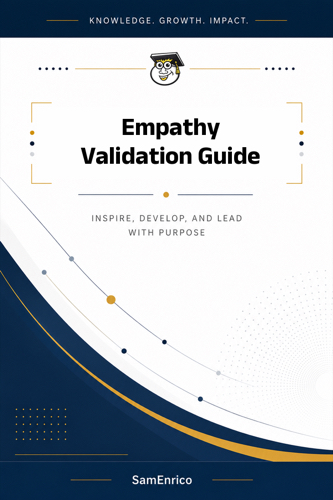
Empathy Validation Guide eBook
Teaches how to recognize feelings and respond with
Teaches how to recognize feelings and respond with genuine understanding.
Formats
Free sample
Chapter 1: The Empathy Lie--Most people believe they are empathetic. They are wrong.Not maliciously wrong. Not cruelly wrong. But wrong in a way that damages every relationship they care about. The woman who says “I know exactly how you feel” after her friend reveals a painful loss—she believes she is connecting.
She is not. She is erasing. The man who responds to his partner’s exhaustion with “Have you tried sleeping more?”—he believes he is helping. He is not. He is adding shame to fatigue.
The parent who tells a crying child “Don’t be sad, it’s okay”—they believe they are comforting. They are not. They are teaching the child that their feelings are wrong.This book exists because of a single, brutal truth: The way most people try to show up for others does the opposite of what they intend. We reach for connection and our hands close around isolation. We offer comfort and receive confusion.
We want to be the person others turn to, but somehow, again and again, people stop sharing with us.The problem is not that you lack compassion. The problem is that you were never taught the difference between sympathy, affective empathy, cognitive empathy, and validation. And without that distinction, even the most well-intentioned response can land like a door slamming shut.The Scene That Changed Everything Several years ago, before I understood any of what you are about to learn, a close friend called me late on a Tuesday night. His voice was strange—flattened, hollow, nothing like the energetic person I knew. He told me his father had been diagnosed with terminal cancer.
The doctors gave him six months, maybe eight.I listened. I nodded, even though he could not see me. And then, because I am a person who hates silence and wanted desperately to help, I said what ninety percent of people say in that situation.“I know how you feel. My grandfather died of cancer. It was really hard.”My friend went quiet.
The kind of quiet that is not peaceful. The kind of quiet where the other person is deciding whether to continue talking or to hang up and never bring this up with you again.He changed the subject. We never spoke about his father again. Not once.At the time, I told myself I had done the right thing. I had shared my own experience to show solidarity.
I had let him know he was not alone. That is what good friends do, right?Wrong. What I had done was accidentally center myself in his grief. I had taken his suffering and made it about my grandfather, my loss, my story. I had not said “Your pain makes sense.” I had said “Here is my pain, which is similar, so now we are even.” That is not validation.
That is emotional one-upmanship dressed in sympathy’s clothing.This book emerged from that phone call and a thousand smaller moments like it. I spent the next several years studying every best-selling book on listening, empathy, and emotional connection. I trained in the research behind validation. I tested every technique on myself first, then on my most difficult relationships, then with strangers in high-stakes conversations. And what I discovered is that almost everything we think we know about being a good listener is wrong.The Three Words That Ruin Everything Before we can build the skills that transform relationships, we have to tear down the single most common mistake: the assumption that feeling for someone is the same as feeling with someone, and that either of those is the same as validating them.Let us name them clearly.Sympathy is feeling for someone from a distance.
Sympathy notices pain and offers comfort from a safe remove. It says “I am sorry you are hurting” while standing on dry ground as the other person drowns. Sympathy is not cruel. It is often kind. But it is not connection.
Sympathy keeps you separate. It is the emotional equivalent of watching a disaster on television and saying “That is terrible.” You mean it. You are not helping.Empathy is more complex than most people realize. In fact, there are two entirely different forms of empathy, and confusing them is one of the reasons empathetic people burn out.Affective empathy is feeling what another person feels. When you see someone cry and your own eyes fill with tears, that is affective empathy.
When you walk into a room where two people have just argued and your stomach knots with tension, that is affective empathy. It is automatic, fast, and often exhausting. Affective empathy is why you flinch when someone else gets hurt. It is also why you might avoid difficult conversations—because you already feel the other person’s pain before they even speak.Cognitive empathy is understanding why another person feels what they feel, without necessarily sharing the feeling. Cognitive empathy allows you to say “I see that you are furious, and I understand the reasons, even though I am not furious myself.” It is slower, more deliberate, and far more sustainable.
Cognitive empathy is the difference between drowning with someone and throwing them a rope while standing on solid ground.Most people assume empathy is always affective. They think being empathetic means feeling what others feel. And for some people, that is true. Those people often end up exhausted, resentful, and secretly wishing everyone would just stop having feelings. We will address that directly in Chapter 11, when we discuss the Empath’s Trap.
For now, understand this: empathy is not one thing. It is two things. And only one of them is sustainable.Validation is the third and most misunderstood response. Validation is any response—verbal or non-verbal—that communicates: “Your internal experience is real, understandable, and acceptable to me.”Notice what validation does not say. It does not say “I agree with you.” It does not say “Your facts are correct.” It does not say “I would feel the same way.” Validation simply says: What you are feeling right now makes sense given who you are and what you have experienced.
You are not crazy. You are not broken. You are not wrong for feeling this.That is it. That is the entire game.And it changes everything.Why “I Know How You Feel” Is Emotional Violence Let me be direct. When you say “I know how you feel” to someone who is suffering, you are not connecting.
You are erasing.Here is why.No two people experience the same event identically. Your divorce is not my divorce. Your cancer diagnosis is not my grandfather’s cancer diagnosis. Your grief over a miscarriage is not her grief over a miscarriage, even if she also miscarried. The moment you say “I know how you feel,” you are telling the other person that their unique, complex, personal experience is reducible to something you have already processed and filed away.But the damage goes deeper.
When you say “I know how you feel,” you implicitly close the door on further exploration. Why would they need to explain more? You already know. So they stop. They pull back.
They learn that you are not a safe person to share unfinished, messy, unprocessed emotion with.The research on this is…
This is the end of the free sample. Get the eBook to keep going. Buy now
About this book
Details
- Author
- Branham Tanisha
- Publisher
- SamEnrico
- Language
- English
- Genre
- Non-Fiction, Self-Help / Emotional Intelligence
- Released
- 2026-06-08
- Pages (approx.)
- 128
- Available as
- eBook, Audiobook

Read better in the ZLOADR app
Your eBooks on your phone or tablet. Sign in with your SamEnrico account and start reading.
More by Branham Tanisha
 Parent Fitness Time FinderBranham Tanisha$11.99
 Anger Restructuring FlashcardsBranham Tanisha$11.99
 Withdrawal Medication TaperingBranham Tanisha$11.99
 MDD in Urban PopulationsBranham Tanisha$11.99
 Riding the Wave DBTBranham Tanisha$11.99
 Managing Remote Work HoursBranham Tanisha$11.99
 Blue Zone Root Vegetable GuideBranham Tanisha$11.99
 The Resurrectionists: Europe's Darkest Trade in CorpsesBranham Tanisha$11.99
 The Gold of the Vandals: How a Treasure Funded a War That Shaped EuropeBranham Tanisha$11.99
 A Collector's Handbook to the Healey 2.4-litre Elliot SaloonBranham Tanisha$11.99
 Service Providers Guide to Auto AlarmsBranham Tanisha$11.99
 How to Produce Hydroponics Equipment and SuppliesBranham Tanisha$11.99