
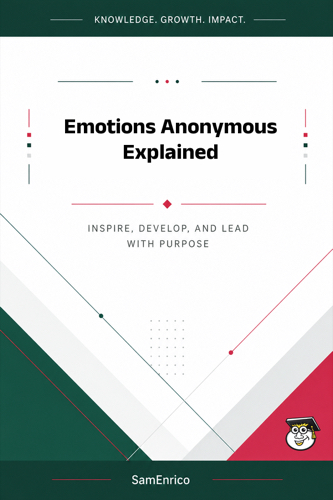
Non-FictionSelf-HelpEmotional Health
Emotions Anonymous Explained eBook
Use twelve steps to manage depression, anxiety, an
Use twelve steps to manage depression, anxiety, anger, and emotional disorders.
Formats
Free sample
Chapter 1: The Cage Door...–- You are not broken. You are not weak. And you are certainly not alone. But if you are reading this book, there is a very good chance that you feel exhausted—bone-tired in a way that sleep cannot fix. You have tried to think your way out of your emotions.
You have tried to outrun them, outsmart them, outshout them, and outlast them. And yet, here you are. Still anxious. Still angry. Still sinking into the gray fog of depression that seems to have no bottom.
Still wondering why everyone else appears to glide through life while you feel like you are dragging a hundred-pound chain behind you.The premise of this entire book—and the premise of Emotions Anonymous itself—rests on a single, uncomfortable, and radically liberating idea. That idea is this: You cannot manage your emotional reactions on your own. Not through sheer willpower. Not through positive thinking. Not through self-help books that tell you to “just breathe” or “just reframe your thoughts.” Not through another promise you make to yourself at midnight, swearing that tomorrow will be different.
If you could have managed this alone, you would have already done so. The fact that you haven’t is not a sign of failure. It is a sign that you have been fighting the wrong battle.This chapter is about that battle. Specifically, it is about the difference between feeling an emotion and being controlled by it. It is about the phenomenon that Emotions Anonymous calls “emotional bingeing” and “emotional hangovers.” And it is about the most misunderstood word in all of recovery: powerlessness.
By the time you finish this chapter, you will understand why admitting “I cannot manage this alone” is not an act of defeat—it is the first real breath of air you have taken in years.The Two Kinds of Pain Before we go any further, let us name something that most books, therapists, and well-meaning friends get wrong. There are two distinct kinds of emotional pain. The first is inevitable. The second is optional.Inevitable emotional pain is the biological response to being human. You will feel sadness when you lose something you love.
You will feel anxiety when you face an unknown threat. You will feel anger when someone crosses a boundary. You will feel fear when your safety is compromised. These are not disorders. These are the warning lights on the dashboard of your nervous system.
They are designed to keep you alive, to alert you to danger, to motivate you to act, and to help you bond with others. A person who never felt sadness, anxiety, or anger would not be enlightened—they would be neurologically damaged.Optional emotional pain is everything that happens after the initial feeling arrives. This is the pain you add on top of the original signal. It is the three-hour spiral of replaying an angry conversation in your head. It is the week you spend in bed because a single critical comment convinced you that you are worthless.
It is the obsessive checking, the reassurance-seeking, the outburst that you regret thirty seconds later, and the shame that follows for days. This optional pain is not caused by the original emotion. It is caused by your reaction to the original emotion. And that is where the cage door begins to close.Here is the central distinction that will determine whether this book helps you or not: You are not powerless over the arrival of an emotion. But you are also not powerless over your response to it.
Most people get this exactly backward. They believe they should be able to prevent difficult emotions from arriving—and when they cannot, they conclude that they are powerless over everything. That is a trap. Let us say that again, because it matters more than anything else in this chapter: You cannot control the weather of your emotional arrival. But you can absolutely control whether you stand in the rain or build a shelter.This distinction—arrival versus response—is the foundation upon which the entire twelve-step approach to emotional disorders is built.
If you forget everything else in this chapter, remember this: your goal is not to stop feeling. Your goal is to stop being ruled by what you feel.The Myth of Emotional Management Let us be honest about the phrase “managing your emotions.” It sounds reasonable, does it not? Adult. Responsible. Like something a competent person should be able to do.
But here is the problem: the very phrase implies that emotions are like a misbehaving employee or a cluttered inbox—something to be organized, controlled, and filed away. And for years, you have likely tried to do exactly that. You have tried to:Think your way out by repeating affirmations, challenging “irrational thoughts,” or analyzing the root cause of every feeling.Will your way out by gritting your teeth, tensing your muscles, and telling yourself to “just get over it.”Distract your way out by scrolling social media, working compulsively, drinking, eating, or binge-watching television until the feeling passes.Avoid your way out by canceling plans, staying silent in meetings, or withdrawing from relationships entirely.Explode your way out by yelling, slamming doors, sending angry texts, or saying things you later pretend you did not mean.And how has that worked? If you are like the thousands of people who have walked into Emotions Anonymous meetings around the world, the answer is: it has not worked. It has worked for a few minutes, perhaps.
It has worked just long enough for you to believe that you have finally figured it out. And then the feeling returns. Or a new feeling arrives. Or the old feeling mutates into something worse—shame, self-hatred, hopelessness. And you are back at the beginning, exhausted and wondering what is wrong with you.Nothing is wrong with you.
You have simply been using the wrong tool for the job. You cannot manage your emotional reactions by yourself for the same reason you cannot lift a car by yourself or perform surgery on yourself. It is not a moral failing. It is a limitation of the design. Your brain, wonderful as it is, was never built to regulate its own emotional storms while also being inside the storm.
That is like asking a flashlight to illuminate its own broken bulb.Emotional Bingeing: The Secret Addiction You have likely heard of binge eating, binge drinking, or binge watching. But have you ever considered that you might binge on your own emotions?Emotional bingeing is the compulsive, repetitive replaying of an emotional event long after the event itself has ended. It looks like this: someone says something critical to you at 10:00 AM. By 10:15 AM, the conversation is over. But by 10:30 AM, you are replaying it in your head.
By 11:00 AM, you have imagined three different responses you should have given. By noon, you have escalated the memory into a full-blown fantasy of confrontation. By 2:00 PM, your heart rate is still elevated, your jaw is clenched, and you have accomplished nothing because your mind has been running a marathon inside a prison cell.Emotional bingeing is not limited to…
This is the end of the free sample. Get the eBook to keep going. Buy now
About this book
Details
- Author
- Whaley Candie
- Publisher
- SamEnrico
- Language
- English
- Genre
- Non-Fiction, Self-Help, Emotional Health
- Released
- 2026-06-07
- Pages (approx.)
- 140
- Available as
- eBook, Audiobook

Read better in the ZLOADR app
Your eBooks on your phone or tablet. Sign in with your SamEnrico account and start reading.
More by Whaley Candie
 The Cope Ahead GuideWhaley Candie$11.99
 Vocal Power Public SpeakingWhaley Candie$11.99
 Receiving Feedback GracefullyWhaley Candie$11.99
 IBS And Interstitial CystitisWhaley Candie$11.99
 Parent of Child with AnxietyWhaley Candie$11.99
 CIWA Withdrawal Scale GuideWhaley Candie$11.99
 Cleopatra Daughter SuccessionWhaley Candie$11.99
 The Golden Voices of the Diaspora: Black Opera's Timeless TriumphsWhaley Candie$11.99
 The Opium Clipper Scandal: How a Victorian-Era Fraud Sank a FleetWhaley Candie$11.99
 Service Providers Guide to Hip OrthopedicsWhaley Candie$11.99
 Media and PR Time BlockingWhaley Candie$12.99
 Portfolio Career Exit StrategyWhaley Candie$12.99
You may also like
 Hong Kong Handover 1997Dunn Johnnie$11.99
 Zumba For Postnatal Recovery CourseNeal Christian$11.99
 Zumba for BeginnersLadner Nikia$11.99
 YouTube Comment Mining GuideHumes Pandora$12.99
 Worry Box MeditationCarlin Rudy$11.99
 Workplace Stress MeditationNguyen Lynn$11.99
 Workplace Stress and Sleep RepairHawley Ivory$11.99
 Workplace Perfectionism CureDelaney Jeffry$11.99
 Workplace Injustice Anger GuideWallen Isabelle$11.99
 Work Addiction and Burnout LinkGreenwood Ester$11.99
 Women in Yoga and WellnessBeattie Galina$11.99
 Women in Stand Up ComedyChun Evangeline$11.99