
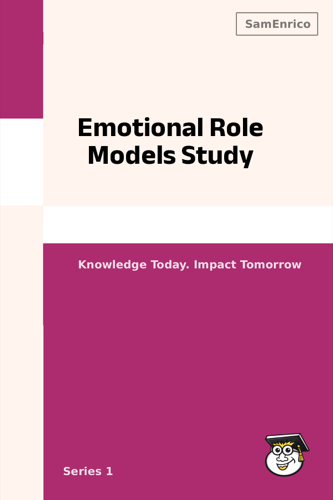
Non-FictionSelf-HelpRole Models
Emotional Role Models Study
Learning regulation from emotionally skilled peopl
by Fusco Marth
Learning regulation from emotionally skilled people.
Formats
About this book
Free sample
Chapter 1: The Mirror Test--–- Every time you feel a surge of panic, a flash of irritation, or a wave of relief, you are not experiencing a purely private event. You are participating in an ancient, invisible dance that began the moment you were born—the dance of emotional contagion. Your brain is wired to scan the faces, voices, and postures of everyone around you, and without your permission, it copies what it finds. You think you feel what you feel because of circumstances. But the truth is more unsettling: you feel what you feel largely because of who you are watching.This chapter introduces the central argument of this book: you cannot learn emotional regulation in a vacuum.
You cannot meditate your way out of a reactivity pattern you absorbed from a volatile parent at age four. You cannot breathe your way past a stress response you have been mirroring from an anxious colleague for five years. The fastest, most efficient, and most biologically natural way to change how you regulate emotion is to change the human templates your brain is silently imitating. We call these templates Emotional Role Models (ERMs). By the end of this chapter, you will understand why you already have ERMs—whether you chose them or not—and you will learn how to deliberately select new ones.The Neuroscience of the Social Nervous System Let us begin with a simple experiment you can perform right now.
Sit across from another human being—a friend, a partner, or even a stranger willing to humor you. Ask them to smile genuinely for thirty seconds. Do not smile back. Try to remain neutral. You will find it nearly impossible.
Your mouth will twitch. Your cheeks will lift. You may even feel a small lift in your own mood. This is not politeness. This is facial mimicry, a reflexive response that occurs in less than one second, too fast for conscious control.
Electromyography studies have shown that your facial muscles activate in response to another person’s expression even when you are trying not to react.Now try the opposite. Ask…
This is the end of the free sample. Get the eBook to keep going. Buy now
Contents
- Chapter 1
- Chapter 2
- Chapter 3
- Chapter 4
- Chapter 5
- Chapter 6
- Chapter 7
- Chapter 8
- Chapter 9
- Chapter 10
- Chapter 11
- Chapter 12
Details
- Author
- Fusco Marth
- Publisher
- SamEnrico
- Language
- English
- Genre
- Non-Fiction, Self-Help, Role Models
- Released
- 2026-06-10
- Pages (approx.)
- 147
- Available as
- eBook, Audiobook

Read better in the ZLOADR app
Your eBooks on your phone or tablet. Sign in with your SamEnrico account and start reading.
More by Fusco Marth
 Self Esteem for Late Bloomers LoveFusco Marth$11.99
 Rental Lease Agreement GuideFusco Marth$11.99
 Sobriety Journal MethodFusco Marth$11.99
 Belgium Diamond HeistFusco Marth$11.99
 Chinese Family SeparationFusco Marth$11.99
 Sadhguru Jaggi VasudevFusco Marth$11.99
 Advisory Board Payments GuideFusco Marth$11.99
 The Unstoppable Lions: Cameroon's 1990 World Cup MiracleFusco Marth$11.99
 The Alchemists of Timbuktu: Unveiling the Lost Sciences of the SahelFusco Marth$11.99
 How to Produce Hair ColorFusco Marth$11.99
 Mastering The Art of IrelandFusco Marth$11.99
 How to Produce Sterilization EquipmentFusco Marth$11.99
You may also like
 Hong Kong Handover 1997Dunn Johnnie$11.99
 Zumba For Postnatal Recovery CourseNeal Christian$11.99
 Zumba for BeginnersLadner Nikia$11.99
 YouTube Comment Mining GuideHumes Pandora$12.99
 Worry Box MeditationCarlin Rudy$11.99
 Workplace Stress MeditationNguyen Lynn$11.99
 Workplace Stress and Sleep RepairHawley Ivory$11.99
 Workplace Perfectionism CureDelaney Jeffry$11.99
 Workplace Injustice Anger GuideWallen Isabelle$11.99
 Work Addiction and Burnout LinkGreenwood Ester$11.99
 Women in Yoga and WellnessBeattie Galina$11.99
 Women in Stand Up ComedyChun Evangeline$11.99