
Non-FictionBusiness BriefEmailScheduling
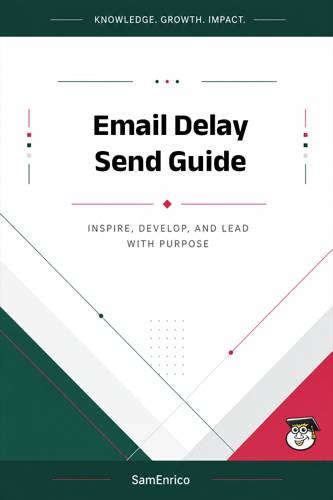
Email Delay Send Guide eBook
Schedule emails to send later to avoid after hours
by Gunn Carrol
Schedule emails to send later to avoid after hours pressure on others.
Formats
Free sample
Chapter 1: The 9 PM Betrayal--You have just committed an act of violence. Not the kind that leaves bruises or draws blood, but the kind that slowly erodes trust, frays relationships, and chips away at the psychological safety of the people you work with every day. You did not mean to. You would never intentionally hurt your colleagues. But at 9:17 PM on a Tuesday, you finished an email, your thumb hovered over the send button for less than a second, and you pressed down.
A quiet whoosh. A momentary sense of relief. And somewhere across town, across the country, or across the world, a phone buzzed on a dinner table. A partner looked up with tired eyes. A child paused mid-sentence.
A quiet evening became, in an instant, a work evening.This is the 9 PM Problem. And it is not about working late.The Lie We Tell Ourselves About After-Hours Email Let us be honest with each other in a way that most productivity books are not. You already know that sending emails late at night is not ideal. You have probably read articles about work-life balance. You have certainly heard colleagues joke about being “always on.” But you keep hitting send because of a quiet, unspoken rationalization that goes something like this: “I’m working late anyway.
They don’t have to read it now. I’m just getting it off my plate.”That rationalization is a lie. A gentle lie, a well-intentioned lie, but a lie nonetheless.Here is what actually happens when you send that 9:17 PM email. The notification arrives on your colleague’s phone. Their screen lights up.
Even if they do not open the email, they see your name and the subject line. Their brain, which had finally begun to disengage from work mode, snaps back to attention. A small spike of cortisol—the stress hormone—releases into their bloodstream. Their next bite of dinner tastes slightly different. Their next sentence to their partner comes a beat too late.
They are no longer fully present because you have just asked them, silently and without malice, to return to work.And here is the part we do not talk about: they will feel guilty no matter what they do next.If they ignore the email, they spend the rest of the evening vaguely aware that something is waiting for them. They might check it “just to be sure it’s not urgent.” They might draft a reply in their head while brushing their teeth. If they do reply, they have now worked late—not because their work required it, but because your email demanded a response. Either way, you have stolen something from them. Not minutes or hours.
You have stolen their ability to fully disconnect.The Psychology of Notification: Why a Buzz Hurts More Than a Conversation We need to understand the science here, because the 9 PM Problem is not just about politeness. It is about how human brains are wired. In the early 2000s, researchers began studying what they called the “anticipatory cortisol response.” The discovery was counterintuitive: the stress of waiting for a possible notification is often higher than the stress of receiving one. Your colleague’s brain, upon seeing your name on their lock screen, immediately begins a rapid-fire sequence of unconscious calculations. Is this about the project deadline?
Did something go wrong? Does my boss need me? Do I need to apologize for something?This cascade happens in less than a second. And it happens even if they do not open the email.Now multiply that by the number of after-hours emails your team sends in a given week. Five people, each sending two late-night emails, means your colleagues receive ten after-hours notifications.
Ten cortisol spikes. Ten small interruptions to dinner, to time with children, to the fragile act of trying to forget about work for a few hours. These are not major traumatic events. They are paper cuts. But a thousand paper cuts will still draw blood.A 2018 study published in the Journal of Applied Psychology followed 1,200 employees across seven industries.
The researchers measured something they called “work-related rumination”—the tendency to think about work tasks outside of working hours. They found that each after-hours email notification increased rumination by an average of 23 percent. Employees who received regular late-night emails reported lower sleep quality, higher morning fatigue, and significantly reduced engagement with their families. The effect was strongest not among people who replied to after-hours emails, but among people who ignored them. The act of choosing not to reply, it turns out, requires cognitive energy.
You are making a decision. You are evaluating consequences. You are wondering if your silence will be noticed.That is exhaustion by a thousand tiny decisions.Urgency Versus Availability: The Distinction That Changes Everything Here is the single most important distinction in this entire book. Memorize it. Write it on a sticky note and put it on your monitor.Urgency is rare, time-critical, and genuinely cannot wait.
A server is down. A safety issue has arisen. A legal deadline expires in forty-five minutes. A client has a true emergency. These events constitute perhaps 2 percent of all email traffic in most organizations.Availability is the false assumption that because you happen to be working, everyone else must also be available.
This is not urgency. This is projection. This is the quiet arrogance of assuming that your schedule is the default schedule.The tragedy of modern knowledge work is that we have conflated these two concepts. When you send a non-urgent email at 9 PM, you are not solving an urgent problem. You are making a statement about availability.
The statement is: “I am working. Therefore, you should be aware that I am working. And because you are now aware, you might feel obligated to acknowledge my work.”You would never say that out loud. You would be embarrassed to admit that this is what you are doing. But your behavior says it for you.Top performers in every industry have learned to separate urgency from availability.
They do not work less. Many of them work more than average. But they have mastered one specific discipline: they do not export their working hours onto other people. They write emails at midnight, at 5 AM, on Sunday afternoons. And then they schedule those emails to send at 9 AM on the next business day.
They are not hiding their hours. They are respecting other people’s autonomy. This is not a technical trick. It is a leadership behavior.The Autonomy Tax: What Instant Sending Costs Your Team Let us put a price tag on the 9 PM Problem. Not in dollars, though we could.
Studies have estimated that after-hours email costs large organizations millions annually in reduced productivity and increased turnover. But the real cost is harder to measure and far more important: the cost to psychological safety.Psychological safety is the belief that you will not be punished or humiliated for speaking up, asking questions, or admitting mistakes. It is the single strongest predictor of team performance, according to decades of research by Harvard professor Amy Edmondson. Teams with high psychological safety innovate faster, make fewer errors, and retain talent longer. Teams with low…
This is the end of the free sample. Get the eBook to keep going. Buy now
About this book
Details
- Author
- Gunn Carrol
- Publisher
- SamEnrico
- Language
- English
- Genre
- Non-Fiction, Business Brief, Email, Scheduling
- Released
- 2026-06-09
- Pages (approx.)
- 147
- Available as
- eBook, Audiobook

Read better in the ZLOADR app
Your eBooks on your phone or tablet. Sign in with your SamEnrico account and start reading.
More by Gunn Carrol
 Elevator Small Talk GuideGunn Carrol$11.99
 Blue Zone Fermented Foods GuideGunn Carrol$11.99
 Heavy Meal Sleep InterferenceGunn Carrol$11.99
 The Budget Meal Planning GuideGunn Carrol$11.99
 Ipsus: The Day the Diadochi ShatteredGunn Carrol$11.99
 Understanding Willems–de Vries SyndromeGunn Carrol$17.99
 Ghana Startup Community GuideGunn Carrol$12.99
 Founder Leave of Absence PlanGunn Carrol$12.99
 How to Start a Fish Paste Business (Beginners Guide)Gunn Carrol$11.99
 Wardite MiningGunn Carrol$11.99
You may also like
 Hong Kong Handover 1997Dunn Johnnie$11.99
 Zumba For Postnatal Recovery CourseNeal Christian$11.99
 Zumba for BeginnersLadner Nikia$11.99
 YouTube Comment Mining GuideHumes Pandora$12.99
 Worry Box MeditationCarlin Rudy$11.99
 Workplace Stress MeditationNguyen Lynn$11.99
 Workplace Stress and Sleep RepairHawley Ivory$11.99
 Workplace Perfectionism CureDelaney Jeffry$11.99
 Workplace Injustice Anger GuideWallen Isabelle$11.99
 Work Addiction and Burnout LinkGreenwood Ester$11.99
 Women in Yoga and WellnessBeattie Galina$11.99
 Women in Stand Up ComedyChun Evangeline$11.99