
Non-FictionStudent's ShortcutShort Programs
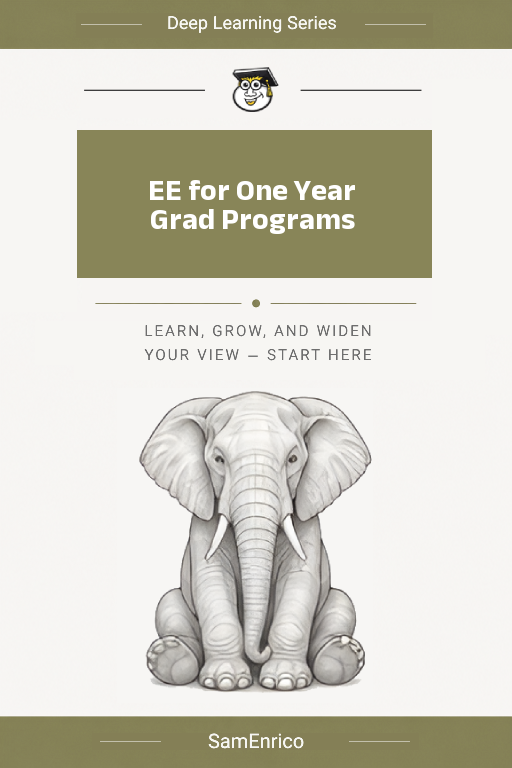
EE for One Year Grad Programs eBook
Maximize points from one-year graduate certificate
Maximize points from one-year graduate certificates and diplomas with strategic work experience.
Formats
Free sample
Chapter 1: The Hidden Ledger--–- Most electrical engineers approach a one-year graduate program the same way they approach a complex schematic: they assume every component is necessary, every connection is critical, and the only way forward is to rebuild the entire system from scratch. They enroll. They pay full tuition. They sit through every lecture, complete every lab, and grind through every problem set. Twelve months later, they emerge with a diploma, a lighter bank account, and the nagging suspicion that at least three of those courses were mostly review.That suspicion is correct.
And the tuition they wasted on those redundant courses could have bought a new oscilloscope, funded a startup, or covered six months of mortgage payments.The problem is not that graduate programs are bloated or inefficient. The problem is that most applicants suffer from a severe case of amnesia about their own professional lives. They look forward at the program requirements and see twelve months of unknown challenges. They rarely look backward at the three, five, or ten years of hands-on engineering work they have already completed. And when they do look backward, they have no idea how to translate what they see into academic currency.This chapter is designed to cure that blindness.
It introduces the single most important concept in this entire book: the portfolio mindset. This is not a metaphor or a motivational slogan. The portfolio mindset is a systematic, repeatable method for inventorying everything you have already learned—every circuit you debugged, every design review you survived, every certification you earned, every junior engineer you mentored—and converting that inventory into formal academic credit, reduced tuition, and accelerated graduation.I have watched technicians with fifteen years of bench experience complete a Master’s degree in eight months while paying forty percent less than their classmates. I have watched military veterans with radar repair backgrounds skip entire foundational courses. I have watched self-taught FPGA programmers test out of required digital design classes.
These students did not cheat the system. They simply understood something that most applicants never learn: universities are hungry for evidence of prior learning, and they will pay you in credits for what you already know.The Hidden Ledger Every working engineer carries an invisible ledger. On one side of this ledger are the formal credentials: the bachelor’s degree, the EIT certificate, the occasional training course. On the other side—the side most engineers ignore—is everything else: the all-nighters spent debugging a power supply ripple problem, the six months of trial and error that finally produced a stable control loop, the lessons learned from a field failure that cost the company a quarter million dollars.Most graduate admissions processes only look at the first side of the ledger. That is a tragedy, because the second side is often far more valuable.
The engineer who has spent five years designing mixed-signal PCBs for medical devices has almost certainly mastered more practical knowledge than any one-semester course on PCB layout could teach. The engineer who has commissioned twenty industrial motor drives knows more about power electronics than most adjunct professors.The portfolio mindset is simply the decision to bring that second side of the ledger into the light. It is the recognition that your work history, properly documented and framed, is a legitimate form of academic achievement. It is the refusal to pay twice for knowledge you already possess.Let me be very specific about what I am not saying. I am not saying that work experience replaces a graduate degree.
Advanced education provides structured exposure to theory, new techniques, and research methods that on-the-job learning rarely covers. I am not saying that every course can be waived or that every engineer should challenge every class. That would be absurd.What I am saying is this: within every one-year graduate program, there are typically two to four courses that overlap significantly with the day-to-day work of a practicing electrical engineer. For a power systems engineer, the introductory power electronics course may be mostly review. For an embedded systems developer, the microcontroller programming course may be redundant.
For a test engineer, the signal integrity course may cover material you have been debugging for years.Those two to four courses represent anywhere from six to twelve credits. At typical graduate tuition rates of 800to800 to 800to1,500 per credit, that is 5,000to5,000 to 5,000to18,000 of unnecessary expense. It also represents six to twelve weeks of your life that you could have spent on advanced topics, networking, job applications, or simply sleeping.The goal of this book—and the purpose of this chapter specifically—is to help you identify those redundant courses, build a credible claim for credit, and negotiate that credit from your university. You will not test out of an entire degree. You will simply stop paying for what you already know.What Counts as a Learning Asset?Most people think of “experience” as full-time employment in their current job title.
That is far too narrow. For the purposes of graduate credit, a learning asset is any verifiable activity that produced demonstrable knowledge or skill relevant to your target program. Here is the complete inventory:Paid Work History. This is the obvious category, but even here, most people undercount. Every engineering position you have held contains learning assets.
An electrical engineer who spent two years in technical sales still learned product specifications, customer requirements, and application engineering. An engineer who worked in manufacturing test still learned measurement techniques, debug methodology, and statistical process control. A field service engineer learned troubleshooting under pressure—a skill that maps directly to diagnostic courses. Do not dismiss roles that lack your ideal title. Look at the tasks you actually performed.Military Training.
Veterans possess some of the most valuable learning assets in existence. Military training is rigorous, standardized, and heavily documented. A Navy electronics technician who repaired radar systems has demonstrable knowledge of RF circuits, signal processing, and systematic troubleshooting. An Army power generation specialist understands three-phase systems, load balancing, and protective relay coordination. A Marine Corps communications officer has practical experience with encryption, link budgets, and antenna theory.
The military also provides detailed training records, course completion certificates, and often college credit recommendations through the American Council on Education (ACE). If you are a veteran, you are likely sitting on ten to twenty credits that you have never claimed.Self-Directed Study. This category is the most overlooked because it feels informal. But self-directed study absolutely counts if you can prove it. Did you complete MOOCs from MIT Open Course Ware, Coursera, or ed X?
Save the certificates and your notes. Did you teach yourself FPGA programming using online tutorials and build a working project for fun? Document it with schematics, code, and test results. Did you read the entire Art of Electronics cover to cover and work through every exercise? That matters.
The key is verification. A self-taught skill with no evidence is a hobby. A self-taught skill with a portfolio of work, a certification exam, or a letter from a mentor is a legitimate learning asset.Volunteer Leadership. If you served as an officer in your local IEEE chapter, mentored a FIRST Robotics team for three…
This is the end of the free sample. Get the eBook to keep going. Buy now
About this book
Details
- Author
- Savoy Gearldine
- Publisher
- SamEnrico
- Language
- English
- Genre
- Non-Fiction, Student's Shortcut, Short Programs
- Released
- 2026-05-30
- Pages (approx.)
- 130
- Available as
- eBook, Audiobook

Read better in the ZLOADR app
Your eBooks on your phone or tablet. Sign in with your SamEnrico account and start reading.
More by Savoy Gearldine
 The Allergic Child Sleep GuideSavoy Gearldine$11.99
 Tech Talent Migration 2030Savoy Gearldine$11.99
 Calisthenics Nutrition HandbookSavoy Gearldine$11.99
 Singaporean Green Tax Credits GuideSavoy Gearldine$11.99
 Stress Management for Creative ProfessionalsSavoy Gearldine$11.99
 The Art of the Deal: How One Trade Changed the NBA ForeverSavoy Gearldine$11.99
 Riders of the Forgotten Trail: The Black Cowboys of the Chisholm TrailSavoy Gearldine$11.99
 PDP For Legal ProfessionalsSavoy Gearldine$12.99
 Understanding Chromosome 2, Trisomy 2p13 P21Savoy Gearldine$17.99
 Customer Service & Sales RepresentativeSavoy Gearldine$11.99
 How to Start a Hobby in Outdoor/nature activitiesSavoy Gearldine$11.99
You may also like
 Hong Kong Handover 1997Dunn Johnnie$11.99
 Zumba For Postnatal Recovery CourseNeal Christian$11.99
 Zumba for BeginnersLadner Nikia$11.99
 YouTube Comment Mining GuideHumes Pandora$12.99
 Worry Box MeditationCarlin Rudy$11.99
 Workplace Stress MeditationNguyen Lynn$11.99
 Workplace Stress and Sleep RepairHawley Ivory$11.99
 Workplace Perfectionism CureDelaney Jeffry$11.99
 Workplace Injustice Anger GuideWallen Isabelle$11.99
 Work Addiction and Burnout LinkGreenwood Ester$11.99
 Women in Yoga and WellnessBeattie Galina$11.99
 Women in Stand Up ComedyChun Evangeline$11.99