
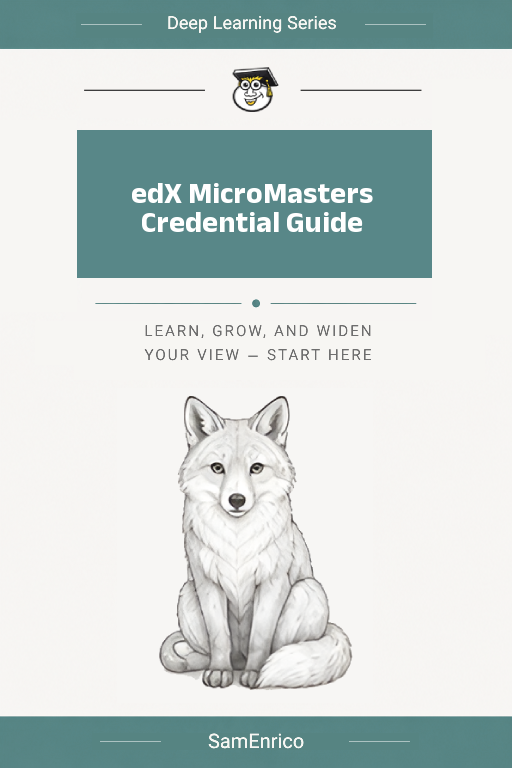
edX MicroMasters Credential Guide eBook
Earn credit eligible MicroMasters from top univers
by Sena Magan
Earn credit eligible MicroMasters from top universities to waive master degree requirements.
Formats
Free sample
Chapter 1: The $100,000 Mistake--–- My name is Sarah, and I almost spent $80,000 on a master’s degree I didn’t need.Not because the degree lacked value. Not because the university wasn’t reputable. But because nobody told me there was a faster, cheaper, and smarter path. I had the acceptance letter in my hand. I had calculated the loan payments: $947 per month for fifteen years.
I had resigned myself to the math, the same way millions of students before me had resigned themselves to the quiet humiliation of lifelong debt.Then, three days before I was supposed to enroll, a mentor asked me a question that stopped me cold: “Before you sign that loan, have you checked whether you can test out of half the program for less than two thousand dollars?”I didn’t even know that was possible.That conversation changed everything. Two years later, I held the same master’s degree from the same university, but I had paid less than one-third of the original price. I finished four months faster than my peers. And I learned a secret that the multi-billion-dollar graduate education industry would rather you never discover: a master’s degree is not a single product you must buy off the shelf. It is a collection of credits.
And credits can be bought individually, often for pennies on the dollar.This book is the guide I wish I had on that day. It is the blueprint for what I now call the Down Payment Degree—a strategy that treats a $1,500 ed X Micro Masters credential not as a certificate to hang on your wall, but as a financial down payment on a six-figure master’s degree. By the time you finish this chapter, you will understand why traditional graduate education is structurally broken, how the Micro Masters model fixes that brokenness, and why you should never again think of “applying to grad school” as your only option.The Three Lies You Were Sold About Graduate School Before we can talk about the solution, we need to name the enemy. The enemy is not education. The enemy is not professors or universities or even the student loan system.
The enemy is a set of assumptions—three lies, specifically—that have been sold to you so repeatedly and so convincingly that you have accepted them as reality.Lie #1: “You Need the Full Degree to Get the Job”This is the most pervasive lie, and it survives because it contains a grain of truth. Yes, many jobs require a master’s degree. No, you cannot walk into a hospital and practice as a nurse practitioner with only a Micro Masters in Healthcare Management. Licensure and accreditation exist for good reason.But here is what the lie conceals: for the vast majority of professional master’s degrees—MBA, computer science, supply chain, cybersecurity, project management, data analytics, and dozens more—employers do not care where you took each individual course. They care that you have the credential.
They care that you can do the work. And they care, sometimes, about the brand name on your diploma.What they do not care about is whether you took Introduction to Financial Accounting at the university’s main campus or online through a verified Micro Masters track. They do not care whether you paid 5,000forthatthree−creditcourseor5,000 for that three-credit course or 5,000forthatthree−creditcourseor300. The transcript does not include a column for “price paid.”The lie survives because universities have a financial incentive to maintain the fiction that every credit must be purchased from them directly. The truth is that accreditation is portable.
If an articulation agreement exists between ed X, the host university, and a partner school, those credits transfer as if you had taken them on campus. The receiving university cannot tell the difference—because legally, there is no difference.Lie #2: “Prestige Equals Return on Investment”This lie is more seductive because it feels true. Surely a master’s degree from Harvard or MIT or Stanford is worth more than one from a regional public university. Surely the prestige premium pays for itself over a lifetime.Sometimes, it does. But the data tell a more complicated story.According to a 2023 analysis by the Foundation for Research on Equal Opportunity, nearly 40% of master’s degree programs leave graduates financially worse off than if they had never enrolled.
Not “breaking even.” Worse off. The culprit is not the quality of education but the debt-to-earnings ratio—the simple math of how much you borrow versus how much your salary increases.Here is the uncomfortable truth that prestige sells but does not advertise: a 100,000degreefroman Ivy Leagueschoolthatraisesyoursalaryby100,000 degree from an Ivy League school that raises your salary by 100,000degreefroman Ivy Leagueschoolthatraisesyoursalaryby15,000 per year has a lower ROI than a 30,000degreefromawell−regardedpublicuniversitythatraisesyoursalarybythesame30,000 degree from a well-regarded public university that raises your salary by the same 30,000degreefromawell−regardedpublicuniversitythatraisesyoursalarybythesame15,000. The prestige premium vanishes into the interest payments.The Micro Masters path does not ask you to choose between prestige and affordability. In many cases, you can have both. MIT’s Supply Chain Management Micro Masters costs $1,500.
It waives one full semester (48 units) toward MIT’s own master’s degree in supply chain management. You pay MIT-level tuition for the remaining credits, but you have already eliminated one-third of the degree. The diploma says MIT. The debt says something else entirely.Lie #3: “There Is No Shortcut”This is the lie that infuriates me most because it is so clearly self-serving. Universities tell you that the path to a master’s degree is fixed: apply, get accepted, pay tuition, take courses in a prescribed sequence, graduate.
Any deviation from this path is framed as cheating—or worse, as “not rigorous.”But rigor is not measured by seat time. It is measured by learning outcomes. If you can demonstrate mastery of graduate-level material through a proctored, verified examination, why should you be required to sit through lectures you have already proven you understand?The answer, of course, is that you shouldn’t. And increasingly, universities agree.The stackable credential model is the evidence. The idea is simple: you earn smaller, discrete credentials (certificates, Micro Masters, professional badges) that aggregate into a formal degree.
Each credential stands alone as proof of competency. Together, they form a degree. This is not a shortcut in the sense of skipping learning—you still learn the material. It is a shortcut in the sense of skipping the bureaucratic and financial friction that has nothing to do with education and everything to do with university revenue models.The Micro Masters is the most powerful stackable credential available today because it carries graduate-level credit recommendation from the American Council on Education (ACE) or direct articulation agreements with partner universities. That means when you earn a Micro Masters with a sufficiently high grade, you are not holding a certificate that says “nice job.” You are holding a legally transferable academic credit that university registrars are contractually obligated to accept.There is a shortcut.
It is called the articulation agreement. And this book will teach you exactly how to use it.The Student Debt Crisis as a Systemic Failure Let us pause for a moment and name the scale…
This is the end of the free sample. Get the eBook to keep going. Buy now
About this book
Details
- Author
- Sena Magan
- Publisher
- SamEnrico
- Language
- English
- Genre
- Non-Fiction, Student's Shortcut
- Released
- 2026-06-01
- Pages (approx.)
- 151
- Available as
- eBook, Audiobook

Read better in the ZLOADR app
Your eBooks on your phone or tablet. Sign in with your SamEnrico account and start reading.
More by Sena Magan
 The Stress Tics GuideSena Magan$11.99
 Dashcam for Road Rage EvidenceSena Magan$11.99
 Metta for a Sibling RivalSena Magan$11.99
 Math Working MemorySena Magan$11.99
 Cocaine and Alcohol Dual RecoverySena Magan$11.99
 Asthma Ayurveda GuideSena Magan$11.99
 Parenting With NVCSena Magan$11.99
 Construction Immigrant Success PlaybookSena Magan$11.99
 The Witch of the Iron Wood: A Slavic Arthurian QuestSena Magan$11.99
 Whispers in the Bamboo: The Enigma of the KappaSena Magan$11.99
 The Vanishing Code: The Unsolved Mystery of the Arecibo MessageSena Magan$11.99
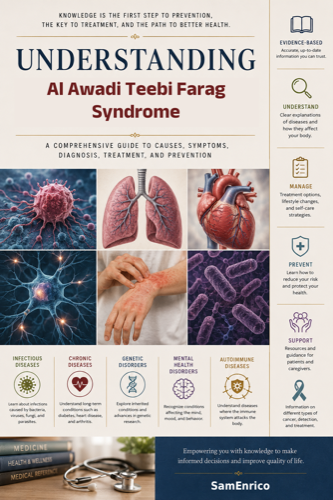 Understanding Al Awadi Teebi Farag SyndromeSena Magan$17.99
You may also like
 Hong Kong Handover 1997Dunn Johnnie$11.99
 Zumba For Postnatal Recovery CourseNeal Christian$11.99
 Zumba for BeginnersLadner Nikia$11.99
 YouTube Comment Mining GuideHumes Pandora$12.99
 Worry Box MeditationCarlin Rudy$11.99
 Workplace Stress MeditationNguyen Lynn$11.99
 Workplace Stress and Sleep RepairHawley Ivory$11.99
 Workplace Perfectionism CureDelaney Jeffry$11.99
 Workplace Injustice Anger GuideWallen Isabelle$11.99
 Work Addiction and Burnout LinkGreenwood Ester$11.99
 Women in Yoga and WellnessBeattie Galina$11.99
 Women in Stand Up ComedyChun Evangeline$11.99