
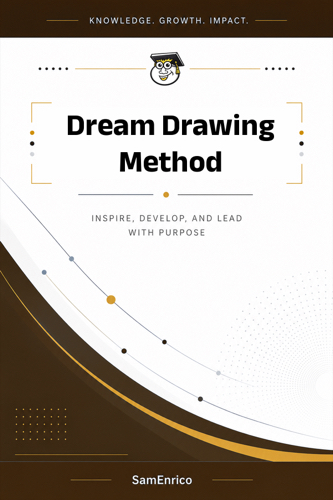
Dream Drawing Method eBook
Use art to help young children express their dream
by Barrett Tina
Use art to help young children express their dreams verbally.
Formats
Free sample
Chapter 1: The Scribble Paradox...–- On a humid Tuesday afternoon in Columbus, Ohio, a four-year-old named Marcus sat on a kitchen floor with a broken orange crayon and a piece of junk mail. His mother, Lena, had just asked him a simple question: “What do you want more than anything in the whole world?” Marcus looked at the ceiling, then at his feet, then at the crack in the linoleum tile. He shrugged. He picked at a scab on his knee. He said nothing.Lena tried again.
“Do you want a new toy? A trip to the park? To see Grandma?” Marcus picked up the crayon and began dragging it back and forth across the back of the envelope. “Marcus, please,” Lena said, a familiar edge of exhaustion creeping into her voice. “Use your words.”But Marcus was already somewhere else.
His hand moved in furious, looping circles—orange on white, then orange on orange, then a black crayon he’d found under the refrigerator. He drew with the focused intensity of a surgeon. Lena stopped asking questions and just watched. After eight minutes, Marcus stopped, held up the envelope, and said: “That’s the monster who lives in the closet. He says I have to be quiet about Mommy being sick.”Lena’s breath caught.
She had not told Marcus about her upcoming biopsy. She had not told anyone except her sister. The monster in the drawing had three eyes, jagged teeth, and a speech bubble that said nothing—just a scribbled black rectangle where words would go. Marcus pointed to the black rectangle. “That’s where the quiet goes,” he said.In ten minutes of drawing, Marcus had said what he could not say in ten weeks of being asked.
The scribbles were not random. They were a map.The Problem That Spoke in Silence Every parent, teacher, and caregiver knows this scene with painful familiarity. You ask a young child a simple, heartfelt question—“What do you want?” “What are you afraid of?” “What do you dream about?”—and you receive a shrug, a changed subject, a tantrum, or the most frustrating answer of all: “I don’t know.”You tell yourself the child is too young. You tell yourself they don’t have the words yet. You tell yourself they’ll open up when they’re ready.
And sometimes, that’s true. But more often than not, the silence is not a lack of content. It is a lack of access.Children between the ages of three and seven have rich inner lives. Decades of developmental psychology research have established that preschoolers experience complex emotions, form sophisticated theories about other people’s minds, and engage in elaborate fantasy play that reveals their deepest hopes and fears. In one landmark study, researchers asking four-year-olds about their wishes received an average of just 1.2 responses per child when using direct verbal questions.
But when the same children were asked to draw their wishes first, the average jumped to 4.7 responses—and the responses were longer, more detailed, and more emotionally nuanced.The gap between what a child feels and what a child can say is not a failure of feeling. It is a failure of the question. And the most profound failure of all is the assumption that words are the only path to words.The Language Filter: Why Words Fail To understand why drawing works when talking fails, we have to look at how the young brain processes language. The left hemisphere of the brain—responsible for linear, sequential, grammatical speech—develops more slowly than the right hemisphere, which handles visual-spatial processing, holistic thinking, and emotional recognition. In children ages three to seven, the right hemisphere is not merely active; it is dominant.
This means that when you ask a child a verbal question, you are asking a right-brain-dominant person to produce a left-brain-dominant output.The result is what neuroscientists call the language filter. Before a thought can become speech, it must pass through multiple neural checkpoints: semantic selection (choosing the right words), grammatical assembly (putting them in the right order), emotional regulation (deciding whether it is safe to say), and social evaluation (anticipating how the listener will respond). For an adult, this process happens in milliseconds. For a young child, each checkpoint is a potential bottleneck.Drawing bypasses almost all of these checkpoints. The motor act of drawing is controlled by the same hemisphere that holds the visual memory.
There is no translation from image to word before the image exists. The child does not have to decide if a scribble is “correct” or “safe.” They simply move their hand, and the image appears. Only after the image exists does the brain begin the slower work of attaching words to it.This is not a theory. Functional MRI studies of children ages four to six have shown that drawing activates the default mode network—a set of brain regions associated with autobiographical memory, future planning, and self-referential thought—more robustly than either speaking or listening to stories. In plain English: when children draw, they remember themselves.
They imagine their futures. They tell themselves who they are.The Three Promises of the Dream Drawing Method This book is built on three core promises. Each promise is supported by research, tested in real homes and classrooms, and designed to work for children across the full range of verbal ability—from the selectively mute child who has not spoken in school to the chatterbox who cannot seem to say anything that matters.Promise One: Any child can express a hidden dream within 10–15 minutes of uninterrupted drawing.The time window is flexible because children are flexible. Some children will produce a coherent dream narrative in four minutes. Others will need the full fifteen, plus a short break, plus a second drawing.
The promise is not a stopwatch; it is a ceiling. If a child has not produced a drawing after twenty minutes, the problem is not the child—it is the environment, the prompt, or the adult’s presence. The method gives you the tools to fix all three.Promise Two: Parents and adults learn to listen without interpretation, creating emotional safety.The single greatest barrier to children’s verbal expression is not vocabulary size. It is fear of the listener. Children are exquisitely sensitive to adults’ reactions.
They know when you are pleased, confused, impatient, or alarmed. And they adjust their speech accordingly—often by saying less. The Dream Drawing Method trains adults to replace judgment with presence. You will learn specific, concrete rules for what not to say (no praise, no criticism, no guessing, no teaching) and what to do instead (active silence, timed reflection, and the five-step loop).Promise Three: Over time, the child’s verbal fluency about their desires grows alongside their art.The goal of this method is not to replace speech with drawing. The goal is to use drawing as a scaffold for speech.
Children who begin the method unable to name a single wish often progress, within eight to twelve weeks, to speaking complete sentences about their dreams without any drawing at all. The drawings become less necessary over time—but they never become useless. Many…
This is the end of the free sample. Get the eBook to keep going. Buy now
About this book
Details
- Author
- Barrett Tina
- Publisher
- SamEnrico
- Language
- English
- Genre
- Non-Fiction, Self-Help, Art Therapy
- Released
- 2026-06-09
- Pages (approx.)
- 154
- Available as
- eBook, Audiobook

Read better in the ZLOADR app
Your eBooks on your phone or tablet. Sign in with your SamEnrico account and start reading.
More by Barrett Tina
 Daycare Toxin Prevention GuideBarrett Tina$11.99
 Arthritis Cycling BenefitsBarrett Tina$11.99
 PFAS Forever Chemicals PreventionBarrett Tina$11.99
 Bipolar Triggers GuideBarrett Tina$11.99
 Gluten And Skin Rashes GuideBarrett Tina$11.99
 Transcendental Meditation for First RespondersBarrett Tina$11.99
 Exfoliation Anti Aging Routine HandbookBarrett Tina$11.99
 Crisis PR Consultant StressBarrett Tina$11.99
 The Hollow Shield: Thermopylae's Forgotten Brothers (480 BC)Barrett Tina$11.99
 The Great Wall of China: A Brick-by-Brick AdventureBarrett Tina$11.99
 The Druids of the Waves: Celtic Mariners and the Birth of Atlantic NavigationBarrett Tina$11.99
 The Dancer's Guide to TecktonikBarrett Tina$11.99
You may also like
 The Workaholic's Art Therapy GuideCervantes Lucie$11.99
 Body Scan Meditation Coloring BookFields Daisy$11.99
 Self Esteem Through Creative Expression CourseMcgee Kathleen$11.99
 Smoking Cessation Vision BoardSmyth Zetta$11.99
 Teen Self Esteem ColoringSteele Becky$11.99
 Senior Art Therapy GuideWilks Rayford$11.99
 Child Loss Art TherapyDowdy Chanell$11.99
 The Workaholic's Art Therapy RecoveryHalverson Fay$11.99
 Spouse Loss Art Therapy GuideTurley Kiyoko$11.99
 Opioid Dependency Art Therapy Healing GuideSpivey Suellen$11.99
 Creative Outlet Recovery GuideNeil Stephania$11.99
 Cocaine Recovery Art TherapyGannon Danille$11.99