
Non-FictionBusiness BriefBehavioral Finance
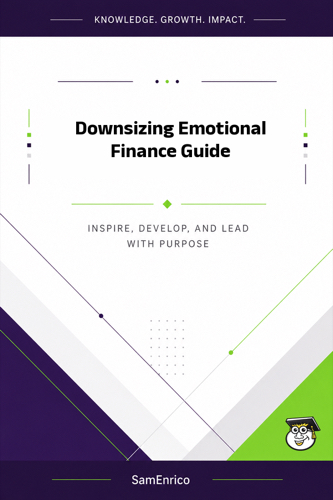
Downsizing Emotional Finance Guide
Balance emotional attachment against financial gai
Balance emotional attachment against financial gains in downsizing decisions.
Formats
About this book
Free sample
Chapter 1: The Memory Mortgage...--–- The pencil marks on the doorframe were faint now, three decades of dust settling into the grooves like fossilized evidence of a life fully lived. Margaret, sixty-seven, stood in the hallway of her four-bedroom colonial, running her finger along the last mark—her son Michael at age eighteen, just before he left for college. She had measured every birthday, every growth spurt, every silent promise that this house would hold her family together forever. Now Michael lived twelve hundred miles away, called once a week, and visited twice a year. The guest room where he slept had not been touched in eleven months except by the cleaning service she could barely afford.The house was worth $620,000 on paper.
But to Margaret, it was priceless. And that was precisely the problem.This chapter is for everyone who has ever stood in a room full of memories and felt the impossible weight of a decision that should be purely financial but never is. You know you should downsize. The numbers are clear: too much space, too many repairs, too much of your retirement savings going to heat empty bedrooms and insure a roof that covers no one. But every time you try to make the rational choice, something stops you.
That something is not weakness. It is the Memory Mortgage—and this chapter will show you how to recognize it, calculate its true cost, and finally decide whether you own your house or your house owns you.The Invisible Debt You Did Not Know You Were Paying In behavioral economics, the Sunk Cost Fallacy describes our tendency to continue investing in something—money, time, emotion—simply because we have already invested in it, even when future costs outweigh future benefits. The classic example is a movie you are hating after twenty minutes but stay for the full two hours because "I already paid for the ticket." That is irrational, yet every human does it.When applied to homeownership, the sunk cost fallacy becomes devastating. You have lived in this house for twenty years. You raised children here.…
This is the end of the free sample. Get the eBook to keep going. Buy now
Contents
- Chapter 1
- Chapter 2
- Chapter 3
- Chapter 4
- Chapter 5
- Chapter 6
- Chapter 7
- Chapter 8
- Chapter 9
- Chapter 10
- Chapter 11
- Chapter 12
Details
- Author
- Ketchum Bernadine
- Publisher
- SamEnrico
- Language
- English
- Genre
- Non-Fiction, Business Brief, Behavioral Finance
- Released
- 2026-06-06
- Pages (approx.)
- 143
- Available as
- eBook, Audiobook

Read better in the ZLOADR app
Your eBooks on your phone or tablet. Sign in with your SamEnrico account and start reading.
More by Ketchum Bernadine
 The Comeback Mindset GuideKetchum Bernadine$11.99
 Teen Imposter Syndrome HelpKetchum Bernadine$11.99
 Teacher Burnout Prevention CourseKetchum Bernadine$11.99
 Securities Fraud Case LawKetchum Bernadine$11.99
 The Hellfighters' Last Stand: The Battle of Château-Thierry That Changed HistoryKetchum Bernadine$11.99
 The Midnight Rescue: How a Blind Man Scaled Mount EverestKetchum Bernadine$11.99
 How to Start a Parts and Accessories for Electroplating Machinery Business (Beginners Guide)Ketchum Bernadine$11.99
 Starbucks Union Success GuideKetchum Bernadine$12.99
 Medical School Argentina GuideKetchum Bernadine$12.99
 Understanding Distal Arthrogryposis Moore–weaver TypeKetchum Bernadine$17.99
 Bobsled BuilderKetchum Bernadine$11.99
You may also like
 Hong Kong Handover 1997Dunn Johnnie$11.99
 Zumba For Postnatal Recovery CourseNeal Christian$11.99
 Zumba for BeginnersLadner Nikia$11.99
 YouTube Comment Mining GuideHumes Pandora$12.99
 Worry Box MeditationCarlin Rudy$11.99
 Workplace Stress MeditationNguyen Lynn$11.99
 Workplace Stress and Sleep RepairHawley Ivory$11.99
 Workplace Perfectionism CureDelaney Jeffry$11.99
 Workplace Injustice Anger GuideWallen Isabelle$11.99
 Work Addiction and Burnout LinkGreenwood Ester$11.99
 Women in Yoga and WellnessBeattie Galina$11.99
 Women in Stand Up ComedyChun Evangeline$11.99