
Non-FictionCapital & Valuation RegisterCash Management
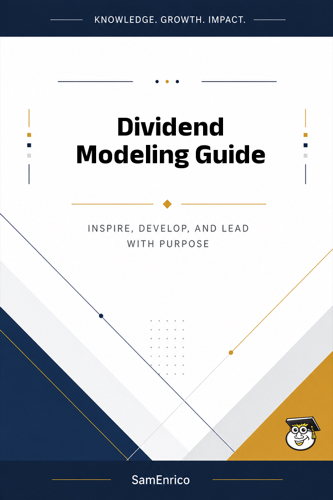
Dividend Modeling Guide eBook
Project dividend capacity and shareholder distribu
Project dividend capacity and shareholder distributions in hold period.
Formats
Free sample
Chapter 1: The 7% Trap...-- John had done everything right. For thirty-five years, he had saved diligently, avoided debt, and followed the conventional wisdom that had made his parents financially secure. When he retired at sixty-two, his portfolio generated a seemingly comfortable 7% dividend yield from a carefully selected basket of blue-chip stocks. AT&T was the centerpiece. The yield had historically been reliable.
The company was too big to fail. John planned to live off the dividends and leave the principal to his grandchildren.Three years later, John was back at work part-time. AT&T had cut its dividend by 40%, the stock price had fallen 35%, and his portfolio's income stream had collapsed. He had fallen into what this book calls the 7% Trap — the seductive but dangerous belief that a high current yield guarantees long-term wealth.John's story is not an outlier. It is a predictable outcome of a flawed approach to dividend investing that dominates retail finance.
The purpose of this book is to ensure that you never become John.The Seduction of Yield Let us begin with an uncomfortable truth: most dividend investors are optimizing for the wrong variable. They search for stocks with the highest current yield, believing that a large check today is the path to financial freedom. This intuition is understandable. If you need $50,000 per year in retirement income, a 5% yield on a $1 million portfolio seems to solve the problem. A 7% yield seems even better.
Why would anyone settle for less?The answer lies in a concept that professional investors understand but rarely explain to retail clients: Total Shareholder Return (TSR). TSR is the sum of three components:Capital appreciation – the increase in share price over time Dividend income – cash payments received during the hold period Share buyback impact – the increase in per-share value resulting from share count reduction Here is the critical insight that John missed: a high dividend yield often comes at the expense of capital appreciation and buyback impact. Companies that pay out most of their cash flow as dividends have less left over to reinvest in growth or repurchase shares. A 7% yield with zero growth produces less long-term wealth than a 3% yield with 8% annual growth in per-share value.Table 1.1: The Yield vs. Growth Trade-Off (10-Year Hold Period)Stock A (High Yield)Stock B (Low Yield)7% dividend yield3% dividend yield0% annual price growth5% annual price growth0% buyback impact3% annual buyback accretion Total return: 7% per year Total return: 11% per year$100,000 grows to $196,715$100,000 grows to $283,942Stock B produces 44% more wealth despite having a yield less than half of Stock A's.
This is the mathematics that dividend yield chasers systematically ignore.The Modigliani-Miller Challenge Before we go further, we must address a foundational question: do dividends even matter? In 1961, economists Franco Modigliani and Merton Miller published a paper that won them Nobel Prizes and challenged everything investors believed about dividends. Their dividend irrelevance theory argued that in a world without taxes, transaction costs, or information asymmetries, a company's dividend policy has no effect on its value.The logic is elegant and irrefutable under its assumptions. Consider a company worth $100 million. If it pays a $10 million dividend, its value drops to $90 million because it has $10 million less cash.
Shareholders receive $10 million in cash but their shares are worth $10 million less. They are exactly where they started. A buyback produces an identical result under the same assumptions. Dividends, buybacks, and retained earnings are all mathematically equivalent in a frictionless world.Why, then, do investors care so much about dividends? The answer is frictions — the real-world complications that Modigliani and Miller deliberately abstracted away.
This book systematically incorporates three frictions that matter most for the individual investor:Friction 1: Taxes In the real world, dividends are taxed immediately as ordinary income (or at preferential qualified dividend rates, depending on holding period and income level). Capital gains from buybacks are taxed only when shares are sold, and often at lower rates. This tax asymmetry means that $1 of dividend is worth less than $1 of buyback for most investors in most situations. Chapter 3 quantifies this gap in detail.Friction 2: Information Asymmetries Managers know more about the company's prospects than outside investors. Dividend policy becomes a signal — a costly, difficult-to-fake communication of management's confidence.
A dividend increase signals that management expects sustainable cash flow growth. A dividend cut signals distress. This signaling function, explored fully in Chapter 6, explains why managers are reluctant to change dividends and why markets react violently when they do.Friction 3: Investor Constraints Not all investors can access buybacks equally. Retirement accounts may have different tax treatments. Trusts and endowments may have distribution requirements that favor dividends.
Individual investors with margin accounts may face forced sales (Chapter 9). These constraints mean that the optimal distribution policy depends on who you are, not just what company you own.The rest of this book builds a framework for navigating these frictions. But before we can optimize, we must be able to distinguish between genuine wealth-building machines and the traps that destroyed John's retirement.The Yield Trap vs. The Total Return Machine The 7% Trap is a specific instance of a broader category: the Yield Trap. A yield trap is a stock that appears attractive based on its current dividend yield but is likely to destroy shareholder wealth over the hold period.
Yield traps share four common characteristics:Characteristic 1: Payout Exceeds Sustainable Cash Flow The most reliable predictor of a dividend cut is a payout ratio above 100% of Free Cash Flow to Equity (FCFE). Earnings may cover the dividend, but earnings include non-cash charges. Cash is truth. When a company pays out more cash than it generates, it must borrow money or sell assets to fund the dividend. Neither is sustainable.Case Example: General Electric maintained its dividend for decades using earnings that bore little relation to cash flow.
When the gap became impossible to ignore, the dividend was cut to $0.01 per share. Investors who had relied on GE's "safe" 4% yield lost both income and principal.Characteristic 2: Declining Share Count Masks Operational Deterioration Some companies aggressively repurchase shares even as their underlying business deteriorates. The reduction in share count props up earnings per share (EPS), making the dividend appear safer than it truly is. This is financial engineering, not value creation.Warning Sign: A company whose EPS is growing while total net income is flat or declining is likely using buybacks to mask operational problems. Calculate both metrics.
If they diverge, investigate further.Characteristic 3: High Yield Relative to Industry and History A yield that stands out as unusually high relative to the company's own history or industry peers is often a market signal that a dividend cut is expected. The price has fallen because investors anticipate bad news. The yield rises mechanically as the price falls. You are not getting a bargain; you are getting a warning.Rule of Thumb: If a stock's yield is more than double its five-year average yield, treat it as suspicious until proven otherwise. The market is not always right, but it is rarely this wrong without reason.Characteristic 4: Management Has Not Committed to the Dividend Some companies pay dividends as a residual — whatever is left over after reinvestment needs are met.
Others treat the dividend as a commitment — a promise to shareholders that will be maintained even through difficult periods.…
This is the end of the free sample. Get the eBook to keep going. Buy now
About this book
Details
- Author
- Murillo Idell
- Publisher
- SamEnrico
- Language
- English
- Genre
- Non-Fiction, Capital & Valuation Register, Cash Management
- Released
- 2026-06-08
- Pages (approx.)
- 145
- Available as
- eBook, Audiobook

Read better in the ZLOADR app
Your eBooks on your phone or tablet. Sign in with your SamEnrico account and start reading.
More by Murillo Idell
 LBO Financial Sector GuideMurillo Idell$11.99
 Unrecovered Gem ListMurillo Idell$11.99
 Bariatric Surgery Taste Changes WorkbookMurillo Idell$11.99
 Lactose Free Cheese Making GuideMurillo Idell$11.99
 The Geometer's War: How a Farmer's Son Mapped the Unseen WorldMurillo Idell$11.99
 The Last Waltz: How a Single Song Changed the WorldMurillo Idell$11.99
 Understanding Caudal Regression SyndromeMurillo Idell$17.99
 How to Start a Potash Mine Business (Beginners Guide)Murillo Idell$11.99
 AI Financial KPI Monitoring GuideMurillo Idell$12.99
 Proposal Page Limit StrategyMurillo Idell$12.99
 Commercial Enterprise Installation TechnicianMurillo Idell$11.99
You may also like
 Hong Kong Handover 1997Dunn Johnnie$11.99
 Zumba For Postnatal Recovery CourseNeal Christian$11.99
 Zumba for BeginnersLadner Nikia$11.99
 YouTube Comment Mining GuideHumes Pandora$12.99
 Worry Box MeditationCarlin Rudy$11.99
 Workplace Stress MeditationNguyen Lynn$11.99
 Workplace Stress and Sleep RepairHawley Ivory$11.99
 Workplace Perfectionism CureDelaney Jeffry$11.99
 Workplace Injustice Anger GuideWallen Isabelle$11.99
 Work Addiction and Burnout LinkGreenwood Ester$11.99
 Women in Yoga and WellnessBeattie Galina$11.99
 Women in Stand Up ComedyChun Evangeline$11.99