
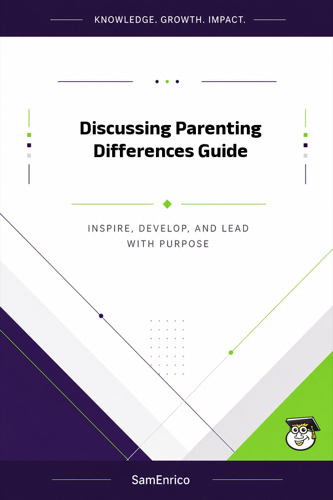
Non-FictionSelf-HelpCo Parenting
Discussing Parenting Differences Guide eBook
Aligns co parenting approaches without conflict.
by Asher Boyce
Aligns co parenting approaches without conflict.
Formats
Free sample
Chapter 1: The Ghosts We Carry--–- The argument started over a juice box. Not the kind of juice box that changes lives, not the kind anyone would remember a week later. Just a small, crinkly, straw-attached juice box in a grocery store checkout line. Their four-year-old had grabbed it from the display, and the mother had said, "Put it back, we have apple slices at home." The father had said, "It's one dollar, let him have it." And then, in the space between the credit card swipe and the receipt printing, something old and heavy had entered the room. Not the juice box.
Not even the marriage. Something much older. Something from 1987.The mother heard: "You are depriving him for no reason." Because her own mother had deprived her—of treats, of affection, of the words "I'm proud of you." The father heard: "You are spoiling him the way your father spoiled you." Because his own father had used gifts to replace presence, and he had sworn never to do that, and now here he was, defending a juice box like it was a constitutional right. Neither of them knew any of this was happening. They thought they were arguing about sugar and cavities and who remembered to pack the apple slices.
They were wrong.This is the first and most important truth of parenting differences: you are never just arguing about the thing you are arguing about. Every parenting conflict is two ghosts having a conversation that living people happen to overhear.The Invisible Rules Hypothesis Let us name what just happened in that grocery store. The mother and father were operating under what this book calls Invisible Rules—unexamined expectations about how parenting should work, inherited so deeply from their own childhoods that they feel not like choices but like gravity. You do not decide to believe that the earth is round; you simply know it. Invisible Rules work the same way.
A parent who was raised with strict bedtimes does not think "I prefer early bedtimes." They think "7:30 PM is when children go to sleep." When their co-parent suggests 8:00 PM, it does not feel like a difference of opinion. It feels like a violation of reality.The problem with Invisible Rules is not that they are wrong. Many of them are wise, loving, and evidence-based. The problem is that they are invisible. You cannot negotiate with something you cannot see.
And because they feel like universal truths rather than personal preferences, you will defend them with the same intensity you would use to defend the laws of physics. "Everyone knows children need a routine" is not an argument. It is a ghost.This chapter will help you excavate your own Invisible Rules, identify the three root causes of parenting conflict (Invisible Rules, Unspoken Fears, and Unequal Loads), and complete the Baggage Check worksheet—a practical tool that surfaces the ghosts before they start talking.The Three Root Causes of Parenting Conflict After analyzing hundreds of parenting disagreements across intact couples, divorced co-parents, and never-together parents, three root causes emerge again and again. Every fight you have will trace back to at least one of these three. Most trace back to all three.Root Cause One: Invisible Rules (The Inheritance)Your first parenting teacher was your own parent.
Not the parent you wish you had, not the parent you swore you would be, but the actual parent who put you to bed, fed you dinner, and decided whether you could have a juice box in the checkout line. That parent installed operating software in your brain. Some of it is excellent. Some of it is disastrous. All of it feels like the default setting of humanity.How Invisible Rules Form: Between the ages of zero and eighteen, you observed thousands of parenting decisions.
Most of them you do not consciously remember. But your brain was watching. It was noting patterns: what happens when a child cries? What happens when a child disobeys? What happens when a child asks for something they want?
These observations became neural pathways—shortcuts that your brain now uses to predict what "should" happen in any parenting situation.Examples of Invisible Rules in Action:The parent who was spanked as a child and "turned out fine" may believe that physical discipline is normal. They are not being cruel; they are being faithful to their neural programming.The parent who was ignored when they cried may now over-respond to every whimper. They are not being permissive; they are healing their own childhood through their child.The parent who had to clean their plate before leaving the table may now panic when their child leaves food uneaten. They are not controlling; they are haunted by their own hunger.The Baggage Check Preview: Later in this chapter, you will complete a worksheet that asks you to list three rules from your childhood you swear to keep and three you swear to reject. This simple exercise is often the first time parents realize that their "common sense" is actually their childhood.Root Cause Two: Unspoken Fears (The Future)Beneath every parenting argument is a fear.
Not a small fear, not a reasonable concern, but a deep, often unconscious terror about what will happen if the other parent "wins." These fears are rarely spoken aloud because they sound irrational when stated plainly. "If we let him stay up late, he will fail out of high school and live in our basement forever" is not a proportionate response to a thirty-minute bedtime delay. But that is exactly what many parents are thinking.The Anatomy of Unspoken Fears: Most parenting fears fall into one of four categories:Safety Fears – "If we do this your way, our child will get hurt." This includes physical safety (injuries, illness) and emotional safety (bullying, rejection).Failure Fears – "If we do this your way, our child will fail at life." This includes academic failure, career failure, relationship failure, and the vague but terrifying prospect of the child "not reaching their potential."Moral Fears – "If we do this your way, our child will become a bad person." This includes dishonesty, selfishness, cruelty, or any other moral failing that keeps parents up at night.Connection Fears – "If we do this your way, our child will not love me." This is the quietest and most powerful fear. It hides behind permissiveness ("I don't want to be the bad guy") and behind strictness ("I need to earn their respect") alike.Why Fears Cause Conflict: Fear narrows your options. When you are afraid, you cannot brainstorm, compromise, or see nuance.
You can only fight or flee. Parenting disagreements that trigger fear become binary: my way or your way, safe or dangerous, success or failure. The child disappears from the equation entirely.The Question You Must Learn to Ask: In any parenting disagreement, before you state your position, ask yourself: What am I afraid will happen if we do this the other way? And then ask your co-parent: What are you afraid will happen if we do it my way? You may discover that you are both afraid of the same thing.
Or you may discover that your fears are compatible. Either way, you have stopped fighting about bedtime and started talking…
This is the end of the free sample. Get the eBook to keep going. Buy now
About this book
Details
- Author
- Asher Boyce
- Publisher
- SamEnrico
- Language
- English
- Genre
- Non-Fiction, Self-Help, Co Parenting
- Released
- 2026-06-08
- Pages (approx.)
- 119
- Available as
- eBook, Audiobook

Read better in the ZLOADR app
Your eBooks on your phone or tablet. Sign in with your SamEnrico account and start reading.
More by Asher Boyce
 IBS Bloating Reduction PlanAsher Boyce$11.99
 Pelvic Floor MythsAsher Boyce$11.99
 Anger and Financial StressAsher Boyce$11.99
 Pattern Recognition for MCATAsher Boyce$11.99
 Managing Interruptions for AccountantsAsher Boyce$11.99
 Postpartum Anxiety Cognitive Behavioral GuideAsher Boyce$11.99
 Mental Illness at Home WorkbookAsher Boyce$11.99
 Body Image For Stoma PatientsAsher Boyce$11.99
 The Great Golf Cart Heist: How a $2,000 Bet Sparked a Global ScandalAsher Boyce$11.99
 Icebound Enigma: The Lost Franklin Expedition’s Final BroadcastAsher Boyce$11.99
 The Ballad of Sister Rosetta Tharpe: The Electric Guitar’s Forgotten PioneerAsher Boyce$11.99
 Commissioning ManagerAsher Boyce$11.99
You may also like
 Hong Kong Handover 1997Dunn Johnnie$11.99
 Zumba For Postnatal Recovery CourseNeal Christian$11.99
 Zumba for BeginnersLadner Nikia$11.99
 YouTube Comment Mining GuideHumes Pandora$12.99
 Worry Box MeditationCarlin Rudy$11.99
 Workplace Stress MeditationNguyen Lynn$11.99
 Workplace Stress and Sleep RepairHawley Ivory$11.99
 Workplace Perfectionism CureDelaney Jeffry$11.99
 Workplace Injustice Anger GuideWallen Isabelle$11.99
 Work Addiction and Burnout LinkGreenwood Ester$11.99
 Women in Yoga and WellnessBeattie Galina$11.99
 Women in Stand Up ComedyChun Evangeline$11.99