
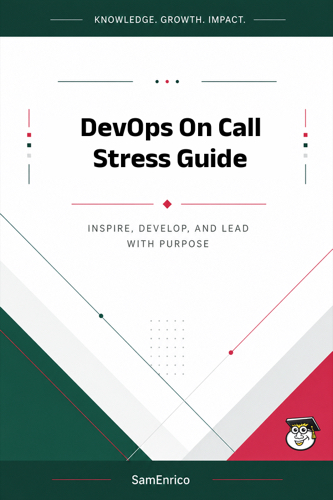
DevOps On Call Stress Guide eBook
Manage pager duty anxiety and production incident
Manage pager duty anxiety and production incident pressure.
Formats
Free sample
Chapter 1: The 2:47 AM Heart...--–- The sound arrives without warning. It slices through the deepest stage of sleep—the slow-wave phase where the body repairs itself, where memories consolidate, where the brain cleans itself of metabolic waste. For the engineer sleeping beside the phone, this is not merely an interruption. It is a biological event.The distinctive trill of a Pager Duty alert triggers a cascade that was designed millions of years ago for saber-toothed tigers, not YAML configuration files. Within milliseconds, the amygdala—the brain's ancient threat-detection center—activates before the prefrontal cortex, the seat of rational decision-making, has any idea what is happening.
Cortisol floods the system. The heart rate jumps twenty to forty beats per minute. Blood pressure rises. The body prepares to fight or flee.Neither response is particularly useful for debugging a database connection pool.The engineer reaches for the phone with hands that are slightly less coordinated than they were twelve hours ago. The screen glares.
The alert reads: "High error rate on api-prod - 5xx rate 12.4%." The brain, still swimming in adenosine (the chemical that builds up during wakefulness and is normally cleared during sleep), struggles to parse the message. Words blur. The engineer blinks, reads it again, and begins the slow, groggy ascent into operational consciousness.This scene plays out thousands of times every night across the world. And in almost every case, the organization that paged that engineer has no idea what it just cost them.The Unspoken Contract Every on-call rotation is built on an unspoken contract. The organization says: "We need you to be available in case something breaks.
We will compensate you with additional pay, comp time, or simply the implicit understanding that this is part of the job." The engineer nods, adds the Pager Duty app to their phone, and sets the ringer volume to maximum.But the contract goes deeper than either party acknowledges. The organization is asking the engineer to sacrifice something that cannot be paid back: uninterrupted sleep, the biological bedrock of cognitive function, emotional regulation, and long-term health. Sleep is not a luxury. It is not a negotiable resource. It is the single most important maintenance process the human body performs, and its disruption carries consequences that accumulate over days, weeks, and months.When an engineer is paged at 2:47 AM, they are not simply "waking up for work." They are being asked to perform complex technical reasoning at a time when their cognitive ability is equivalent to someone with a blood alcohol concentration of 0.05 to 0.10 percent.
They are being asked to make production-altering decisions while operating at the level of legal intoxication in most jurisdictions.And then they are expected to show up at 9:00 AM and function as if nothing happened.The Neuroscience of the Page To understand why on-call stress is not a matter of "toughening up," we must first understand what happens inside the human body when the pager goes off. This is not psychology. This is physiology.The amygdala, as mentioned, triggers first. It is the brain's smoke alarm, designed to detect threats and activate the sympathetic nervous system—the fight-or-flight response. This system evolved to handle immediate physical dangers: a predator, a falling tree, a rival tribe.
It is exquisitely tuned for survival in a world that no longer exists. In the modern world, that same response is triggered by a notification sound.Cortisol staircasing is the term this book introduces to describe a specific pattern of stress accumulation during on-call rotations. When the amygdala activates, cortisol levels spike. They remain elevated for approximately sixty to ninety minutes after the threat passes—long after the incident is resolved and the engineer has returned to bed. If a second page arrives during that window, the cortisol level does not start from baseline.
It spikes from an already elevated plateau. A third page sends it higher still.Cortisol staircasing has measurable consequences. The elevated hormone interferes with the glymphatic system—the brain's waste-clearing mechanism that operates primarily during deep sleep. Metabolic waste products like beta-amyloid (associated with neurodegenerative disease) accumulate. The brain literally does not clean itself properly.
Over weeks and months of disrupted sleep, this accumulation may have long-term health implications that are only beginning to be understood.But the short-term effects are unmistakable. The engineer who experiences cortisol staircasing is not simply tired. They are biochemically compromised.Sleep Deprivation as Technical Debt The analogy between sleep deprivation and technical debt is not merely clever—it is operationally precise. Technical debt is the accumulation of shortcuts and suboptimal decisions that must eventually be "paid back" with interest. Sleep debt operates identically.When an engineer loses two hours of sleep, their cognitive impairment equals a blood alcohol concentration of 0.05 percent—the legal limit for driving in many countries.
When they lose four hours, impairment equals 0.10 percent, legally drunk. This is not an opinion. It is the conclusion of dozens of sleep studies conducted over decades, most famously by Dr. David Dinges at the University of Pennsylvania and Dr. Charles Czeisler at Harvard Medical School.The studies are damning.
After fourteen days of six hours of sleep per night—a pattern common for engineers on weekly on-call rotations—cognitive performance degrades to the level of someone who has been awake for forty-eight hours straight. The subjects in these studies reported feeling "fine." They had adapted to fatigue. They had lost the ability to accurately assess their own impairment. But objective testing revealed significant deficits in reaction time, working memory, and risk assessment.This is the hidden cost of on-call rotations. The engineer who is paged three times in a night does not feel drunk.
They feel tired, perhaps irritable, but capable. They are not capable. Their brain is lying to them about its own function. And when they make a production change at 10:00 AM that cascades into a major outage, they will have no idea that the decision was impaired—because the impairment is invisible even to themselves.The Two-Hour Threshold Through extensive research and field observation across dozens of organizations, a clear threshold emerges. Engineers who average more than two hours of interrupted sleep per night during on-call rotations show statistically significant increases in:Post-incident recovery time Time to resolve subsequent incidents Uncharacteristic errors during troubleshooting Irritability and interpersonal conflict Physical symptoms (headaches, nausea, elevated resting heart rate)The two-hour threshold is not arbitrary.
It represents the point at which the cumulative disruption of sleep cycles—the prevention of sufficient REM and slow-wave sleep—produces measurable degradation across all cognitive domains. Below two hours of interruption, engineers generally recover within a day or two. Above two hours, the degradation accumulates like compounding interest.Organizations that track this metric find a predictable pattern. When any engineer averages more than two hours of interrupted sleep per night for two consecutive weeks, their error rate during incidents doubles. When they average more than four hours, their error rate quadruples—and they begin making mistakes so uncharacteristic that they often question their own competence.The engineer is not becoming incompetent.
The engineer is being asked to perform surgery while legally drunk.Alert Fatigue: The Brain That Learned to Ignore Danger The body's stress response is…
This is the end of the free sample. Get the eBook to keep going. Buy now
About this book
Details
- Author
- Briones Trinity
- Publisher
- SamEnrico
- Language
- English
- Genre
- Non-Fiction, Self-Help, DevOps
- Released
- 2026-06-09
- Pages (approx.)
- 146
- Available as
- eBook, Audiobook

Read better in the ZLOADR app
Your eBooks on your phone or tablet. Sign in with your SamEnrico account and start reading.
More by Briones Trinity
 Sibling Jealousy HealingBriones Trinity$11.99
 Healing Your Own Angry Inner ChildBriones Trinity$11.99
 The IBS Support Group GuideBriones Trinity$11.99
 The CBT Relapse Prevention WorkbookBriones Trinity$11.99
 The Celestial Tailors: How Western Astronomers Sewed the CosmosBriones Trinity$11.99
 Retail Meat CutterBriones Trinity$11.99
 Free Waitlist Building GuideBriones Trinity$12.99
 Payment Nostro Account ManagementBriones Trinity$12.99
 Understanding Thrombocytopenia Robin SequenceBriones Trinity$17.99
 How to Start a Doped Compounds for Use In Electronics Business (Beginners Guide)Briones Trinity$11.99
You may also like
 Hong Kong Handover 1997Dunn Johnnie$11.99
 Zumba For Postnatal Recovery CourseNeal Christian$11.99
 Zumba for BeginnersLadner Nikia$11.99
 YouTube Comment Mining GuideHumes Pandora$12.99
 Worry Box MeditationCarlin Rudy$11.99
 Workplace Stress MeditationNguyen Lynn$11.99
 Workplace Stress and Sleep RepairHawley Ivory$11.99
 Workplace Perfectionism CureDelaney Jeffry$11.99
 Workplace Injustice Anger GuideWallen Isabelle$11.99
 Work Addiction and Burnout LinkGreenwood Ester$11.99
 Women in Yoga and WellnessBeattie Galina$11.99
 Women in Stand Up ComedyChun Evangeline$11.99