
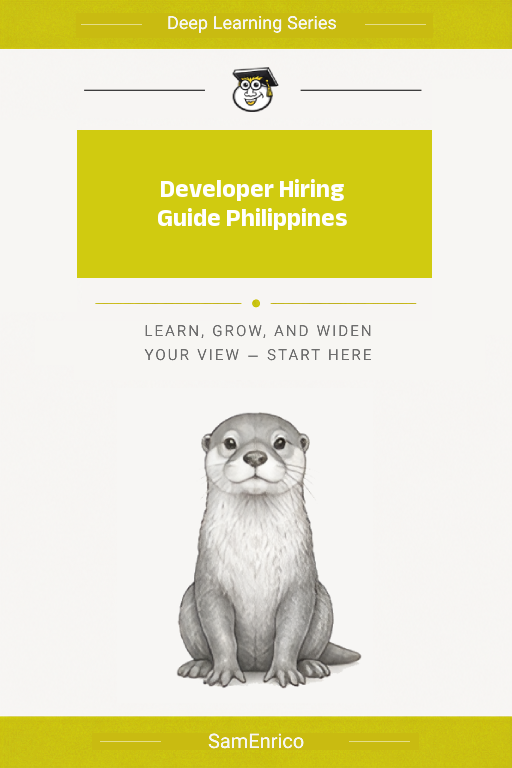
Non-FictionBusiness BriefGlobal Talent Guide
Developer Hiring Guide Philippines eBook
Hire software developers from Philippines. English
Hire software developers from Philippines. English communication, tech stacks, and salary benchmarks.
Formats
Free sample
Chapter 1: The $50k Mistake--I once flew to Manila with a suitcase full of cash. Not literally—but I might as well have. It was 2021, my startup had just raised a Series A, and our CTO had quit. We needed engineers fast. India was too expensive for what we wanted.
Eastern Europe had time-zone problems. Someone said, “Have you looked at the Philippines?”I hadn’t. Like most Western founders, I knew the country as a call center capital, not a coding hub. I assumed the talent was junior, the English was “good enough,” and the savings would be the main event. I was wrong on every count—and my first hire taught me a $50,000 lesson in what not to do.That developer, let’s call him Marco, had a beautiful resume.
Eight years of experience. AWS certified. A portfolio full of React dashboards. He interviewed well—confident, articulate, quick with answers. I hired him at 4,500permonth,whichfeltlikeastealcomparedtothe4,500 per month, which felt like a steal compared to the 4,500permonth,whichfeltlikeastealcomparedtothe12,000 I would have paid in San Francisco.Marco started on a Monday.
By Wednesday, I noticed something strange. I would assign a task in our morning stand-up (8 AM EST, which was 8 PM in Manila). The next morning, the task would be done—but done wrong. Not wrong like buggy. Wrong like he had built something completely different from what I asked.I tried to debug it.
I wrote clearer tickets. I made Loom videos. I scheduled extra calls. Marco always said, “Yes, I understand,” with a warm, reassuring smile on Zoom. But the next day, the same mismatch.
After six weeks, I had paid him nearly $7,000 for maybe two weeks of actual usable code. I let him go. He asked for a severance package. I paid it just to make him go away.I blamed Marco. Then I hired another Filipino developer.
Same story. Different name, same pattern: polite agreement, mismatched output, mysterious delays. I started to think the Philippines was a scam—a place where nice people pretended to be engineers.Then I met someone who changed my mind. A founder in my network had built a forty-person engineering team in Cebu. His developers shipped on time, communicated clearly, and stayed for years.
I asked him, “What am I doing wrong?”He said, “You’re hiring the wrong way. You’re looking for cheap labor. The Philippines isn't cheap labor. It's strategic capacity—but only if you know how to access it.”That conversation changed everything. I spent the next eighteen months learning the real landscape of Filipino tech talent.
I interviewed over two hundred developers. I built a team of twelve. I stopped making Marco-level mistakes. And I wrote this book so you don’t have to learn the hard way.The Global Talent Crisis You Can’t Ignore Let’s start with a number that should terrify every tech leader: 74 percent of employers globally cannot find the talent they need. That’s not a projection.
That’s the current reality, according to Manpower Group’s 2024 Talent Shortage survey. In software engineering specifically, the gap is even worse. The U.S. alone has over 400,000 unfilled developer positions. Europe is short by more than half a million.
And the situation is accelerating. By 2030, the global tech talent shortage is projected to cost companies $8.5 trillion in unrealized revenue.Every CTO I know has a version of the same problem. You have funding. You have product-market fit. You have customers demanding features.
But you cannot find people to build them. Local hiring is a bloodbath. Recruiters send you resumes for junior developers who want senior salaries. The few good candidates are fought over by Google, Meta, and every well-funded startup within a hundred miles.So you look offshore. Maybe you try India first—the traditional outsourcing giant.
You discover that the best Indian developers now command near-Western rates, and the time zone difference (10-12 hours ahead of US East Coast) makes real-time collaboration almost impossible. You try Eastern Europe. The talent is excellent, but the costs have risen 40 percent in three years, and geopolitical uncertainty makes you nervous. You try Latin America. The time zone is perfect, but the English proficiency varies wildly, and the talent pool is much smaller.Then someone mentions the Philippines.Why the Philippines Is Not “Just Another Outsourcing Destination”If you only know one thing about the Philippines, it’s probably the call centers.
The Business Process Outsourcing (BPO) industry generates $38.7 billion annually and employs over 1.3 million Filipinos. That industry exists because the Philippines has something most other offshore destinations lack: near-native English proficiency combined with deep cultural alignment with the West.But the BPO industry is not the story. The story is what that industry created. For two decades, the Philippines has been training hundreds of thousands of workers in Western business communication, project management, and client relations. Those workers have children.
Those children grew up watching American movies, listening to American music, and navigating the same internet you do. Then many of them learned to code.Today, the Philippines produces approximately 70,000 new tech graduates every year. The total tech workforce is projected to reach 1.2 million by 2030, up from roughly 500,000 today. The tech sector itself is growing at 11 percent annually and is expected to hit $51.55 billion by the end of the decade.But numbers don’t tell the full story. What makes the Philippines different is the cultural alignment—a factor that most hiring guides ignore but is actually more important than technical skill.The Cultural Alignment Advantage The Philippines was an American colony for nearly fifty years.
That history left deep traces. English is an official language. The legal system is based on American common law. The education system follows a US model. Filipino professionals grow up watching American television, reading American books, and absorbing American business norms.What does this mean for you as an employer?
It means a Filipino developer will understand your sarcasm in a Slack message. They will get your pop culture references. They will know what a “stand-up meeting” is and why you have them. They will not be confused by terms like “sprint” or “retrospective” or “pull request.” They will have opinions about the same tech Twitter personalities you follow.This is not true of most offshore destinations. I have hired developers in Vietnam who were technically brilliant but culturally opaque.
I have worked with teams in Ukraine who wrote beautiful code but struggled with the implicit communication styles of American product managers. I have watched Indian developers nod along in meetings and then build something completely different because they were too polite to admit they didn’t understand.That last point—the politeness—is actually a double-edged sword in the Philippines. It leads us to the most important cultural concept you need to understand.“Hiya” and Why Your First Hire Will Fail If You Ignore It Filipino culture has a concept called “hiya.” It translates roughly to “shame” or “saving face,” but that undersells it. Hiya is a deep, visceral aversion to causing embarrassment or disappointment to others. It manifests in the workplace as a tendency to say “yes” even when you mean “no,” to nod along even when you don’t understand, and…
This is the end of the free sample. Get the eBook to keep going. Buy now
About this book
Details
- Author
- Bellamy Earle
- Publisher
- SamEnrico
- Language
- English
- Genre
- Non-Fiction, Business Brief, Global Talent Guide
- Released
- 2026-06-01
- Pages (approx.)
- 145
- Available as
- eBook, Audiobook

Read better in the ZLOADR app
Your eBooks on your phone or tablet. Sign in with your SamEnrico account and start reading.
More by Bellamy Earle
 Endometriosis after MenopauseBellamy Earle$11.99
 Coros Wearable Sleep GuideBellamy Earle$11.99
 Assertive Negotiation Skills WorkbookBellamy Earle$11.99
 The German Tuition Free Master GuideBellamy Earle$11.99
 Brazil Green Tax CreditsBellamy Earle$11.99
 The Silk Road of the Sahel: The Merchant Kings of TimbuktuBellamy Earle$11.99
 Understanding Retinal DegenerationBellamy Earle$17.99
 Student PR Timeline PlannerBellamy Earle$12.99
 Lead AccountantBellamy Earle$11.99
 How to Start a Bandage Cloth Weaving Business (Beginners Guide)Bellamy Earle$11.99
You may also like
 Hong Kong Handover 1997Dunn Johnnie$11.99
 Zumba For Postnatal Recovery CourseNeal Christian$11.99
 Zumba for BeginnersLadner Nikia$11.99
 YouTube Comment Mining GuideHumes Pandora$12.99
 Worry Box MeditationCarlin Rudy$11.99
 Workplace Stress MeditationNguyen Lynn$11.99
 Workplace Stress and Sleep RepairHawley Ivory$11.99
 Workplace Perfectionism CureDelaney Jeffry$11.99
 Workplace Injustice Anger GuideWallen Isabelle$11.99
 Work Addiction and Burnout LinkGreenwood Ester$11.99
 Women in Yoga and WellnessBeattie Galina$11.99
 Women in Stand Up ComedyChun Evangeline$11.99