
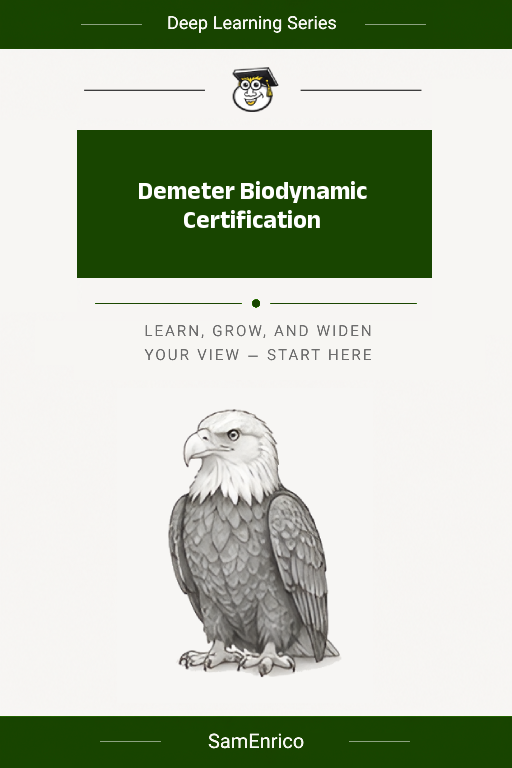
Non-FictionBusiness BriefDemeter
Demeter Biodynamic Certification eBook
Certify biodynamic agriculture products under Deme
by Taggart Mana
Certify biodynamic agriculture products under Demeter for premium European natural food markets.
Formats
Free sample
Chapter 1: The Soil's Secret...--The first time I watched a conventional farmer stare at his own field and say "I don't know what happened," I was standing in the middle of the Spanish plains, twenty kilometers from the nearest town, surrounded by wheat that should have been waist-high but barely reached my knees. The farmer's name was Miguel. He had done everything right. He had followed the agronomist's recommendations to the letter. He had applied the fertilizers at the prescribed times, sprayed the approved fungicides, rotated his crops on the schedule printed in the official handbook.
His grandfather had farmed this same land with none of those things, and the wheat had reached his chest. Now Miguel was looking at a harvest that would not cover his seed costs, let alone his tractor payments, his fertilizer bills, or the interest on the loans he had taken out to buy the very inputs that had failed him."This isn't sustainable," he told me. "I mean that literally. In three more years, I will be bankrupt."Miguel's story is not unique. Across Europe, thousands of farmers are waking up to the same terrifying arithmetic.
Conventional farming, for all its technological marvels and yield statistics, has become an economic trap. Input costs rise every year. Commodity prices stay flat or fall. The soil—the one asset that actually produces value on a farm—gets thinner, harder, and less alive with each passing season. The conventional response to this crisis has been to double down: more precise applications, more data, more technology, more debt.
But there is another path. It is not new. It is nearly one hundred years old. And it is growing faster today than any other agricultural certification in Europe.This chapter is about that path. It is about Demeter certification, the only agricultural standard in the world that requires a farm to function as a living organism rather than a production line.
It is about why thousands of European farmers—from Spanish vineyards to German dairies to French wheat fields—are abandoning the conventional playbook and embracing a system that most agronomists dismissed as mystical nonsense a generation ago. And it is about the single most important question facing any farmer who picks up this book: What is actually happening beneath your feet, and why does Demeter produce soil that organic certification alone cannot?The Crisis Beneath Our Feet Let us begin with a fact that most agricultural conversations avoid: the world's farmable topsoil is disappearing. According to the European Commission's Joint Research Centre, soil degradation costs the European Union approximately fifty billion euros per year in lost agricultural productivity, water treatment costs, and carbon emissions. In Spain alone, an estimated seventy percent of agricultural land shows signs of desertification. The problem is not just erosion in the dramatic sense—dust storms and gullies.
It is the slow, invisible death of soil biology. Conventional farming, even many forms of organic farming, treats soil as a physical medium. You put seeds in it. You add nutrients. You extract crops.
The soil is a container, a substrate, a passive participant.This is wrong. Soil is not dirt. Soil is a living ecosystem. A single teaspoon of healthy agricultural soil contains more individual microorganisms than there are people on Earth. Those bacteria, fungi, protozoa, and nematodes form a food web that transforms rock dust and organic matter into plant-available nutrients.
They build soil structure, creating the microscopic pore spaces that hold water against drought and drain it against flood. They produce glue-like compounds that bind soil particles into stable aggregates, the very architecture of fertility. When you kill that biology—with synthetic nitrogen that feeds plants directly but starves the microbial partners, with fungicides that wipe out beneficial mycorrhizae, with tillage that shreds fungal networks—the soil stops being alive. It becomes what the Romans called terra mortua. Dead earth.Conventional agriculture has been waging a quiet war on soil biology for decades.
The results are everywhere. Soils that once held three hundred tons of water per hectare now hold one hundred. Soils that once sequestered carbon now release it. Soils that once produced nutrient-dense food now produce empty calories. The organic movement, for all its genuine achievements, has not solved this problem.
Organic certification prohibits synthetic pesticides and fertilizers, but it does not require soil regeneration. An organic farm can import fertility from off-site in the form of approved organic manure or compost. It can till as aggressively as it wants. It can treat the soil as a container for organic-approved inputs rather than a living system that must be fed, protected, and rebuilt.Demeter is different. Demeter requires the farm to be a closed-loop organism.
That phrase—closed-loop organism—is the most important concept in this entire book. It means that the farm must produce its own fertility from within its boundaries. Animals must be integrated so that their manure feeds the soil. Compost must be made on-site from farm-generated materials. Forage must be grown on the farm to feed the animals.
The only inputs allowed from outside are the nine biodynamic preparations, which are not fertilizers but biological catalysts, applied in homeopathic quantities to stimulate the farm's own ecological processes. This is not a philosophical preference. It is a practical requirement with measurable outcomes.The Rudolf Steiner Question No discussion of Demeter certification can avoid the elephant in the room: Rudolf Steiner. The Austrian philosopher, scientist, and spiritual teacher delivered his Agriculture Course in 1924 at a manor house in what is now Poland. A group of farmers had noticed declining seed vitality, weakening livestock, and deteriorating soil.
They asked Steiner for help. What he gave them was neither a set of technical recommendations nor a ideological manifesto. It was a framework for thinking about the farm as a living organism embedded in cosmic and terrestrial forces.Steiner's language can be challenging for modern readers. He spoke of etheric bodies, astral forces, and the relationship between lunar rhythms and plant growth. For a century, mainstream agricultural science has dismissed these concepts as mysticism.
But something strange happened while the scientists were dismissing Steiner: the farmers who actually followed his methods kept getting results. Their soils stayed productive through droughts that destroyed neighbors' fields. Their crops showed remarkable resistance to pests and diseases without chemical interventions. Their food, when tested, had higher mineral content, higher brix (a measure of sugar and nutrient density), and longer shelf life.Today, we have the scientific tools to investigate what Steiner was pointing at. The biodynamic preparations, for example, have been shown to increase soil microbial biomass, fungal-to-bacterial ratios, and the activity of beneficial soil enzymes.
The astronomical planting calendar, when tested in controlled trials, has demonstrated measurable effects on germination rates, root development, and storage quality. The closed-loop fertility requirement has been shown to produce soils with higher organic matter content, better water infiltration, and greater carbon sequestration than either conventional or standard organic systems. The mysticism, it turns out, was not wrong. It was prescientific. Steiner described phenomena that he could not fully explain with the tools of his time.
We are only now catching up.This book is not a defense of Steiner's spiritual philosophy. You do not need to…
This is the end of the free sample. Get the eBook to keep going. Buy now
About this book
Details
- Author
- Taggart Mana
- Publisher
- SamEnrico
- Language
- English
- Genre
- Non-Fiction, Business Brief, Demeter
- Released
- 2026-05-30
- Pages (approx.)
- 158
- Available as
- eBook, Audiobook

Read better in the ZLOADR app
Your eBooks on your phone or tablet. Sign in with your SamEnrico account and start reading.
More by Taggart Mana
 Self Esteem After Partner CriticismTaggart Mana$11.99
 Emotional Habituation PracticeTaggart Mana$11.99
 Alcohol Free Social Life ManualTaggart Mana$11.99
 Time Out TechniqueTaggart Mana$11.99
 Jewish Refugee Family StoryTaggart Mana$11.99
 Rolling Forecast For FoundersTaggart Mana$11.99
 Paramahansa YoganandaTaggart Mana$11.99
 Antwerp Diamond Heist GuideTaggart Mana$11.99
 The Wisdom of the Ancestors: The Philosophical Legacy of Ancient AfricaTaggart Mana$11.99
 The Silent Uprising: How a Single Protester Toppled a DictatorTaggart Mana$11.99
 How to Start a Airport Business (Beginners Guide)Taggart Mana$11.99
 Mastering The Art of Huaquan (華拳) China FistTaggart Mana$11.99
You may also like
 Hong Kong Handover 1997Dunn Johnnie$11.99
 Zumba For Postnatal Recovery CourseNeal Christian$11.99
 Zumba for BeginnersLadner Nikia$11.99
 YouTube Comment Mining GuideHumes Pandora$12.99
 Worry Box MeditationCarlin Rudy$11.99
 Workplace Stress MeditationNguyen Lynn$11.99
 Workplace Stress and Sleep RepairHawley Ivory$11.99
 Workplace Perfectionism CureDelaney Jeffry$11.99
 Workplace Injustice Anger GuideWallen Isabelle$11.99
 Work Addiction and Burnout LinkGreenwood Ester$11.99
 Women in Yoga and WellnessBeattie Galina$11.99
 Women in Stand Up ComedyChun Evangeline$11.99