
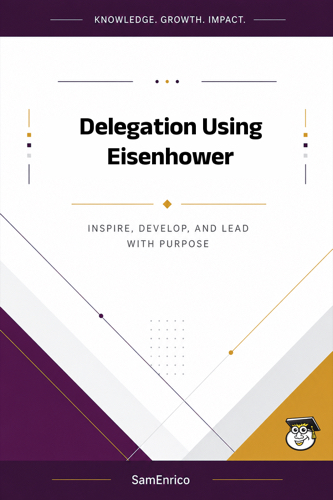
Non-FictionSelf-HelpDelegation
Delegation Using Eisenhower eBook
Teaches identifying tasks for others in Quadrant T
by Page Evelyn
Teaches identifying tasks for others in Quadrant Three (urgent but not important).
Formats
Free sample
Chapter 1: The Bottleneck of You--–- If the Eisenhower Matrix is so simple—if the answer to Quadrant 3 tasks is merely to “delegate them”—then why do so few people actually do it? Why do otherwise brilliant executives, founders, and high-performers spend their afternoons formatting spreadsheets, proofreading internal memos, and chasing down receipts? The answer is not a lack of knowledge. The answer is you. Or more precisely, the answer is the bottleneck that you have become.This book is not another introduction to the Eisenhower Matrix.
You can find that anywhere. A quick internet search yields thousands of colorful quadrants, printable PDFs, and cheerful blog posts telling you to sort your tasks into four boxes: Urgent/Important (do now), Not Urgent/Important (schedule later), Urgent/Not Important (delegate), and Not Urgent/Not Important (delete). The matrix is elegant. It is logical. And it is almost useless without one critical ingredient: the psychological willingness to actually let go.This chapter is called “The Bottleneck of You” because that is the single greatest obstacle to effective delegation.
Not your team. Not your tools. Not your calendar. You. High-performers are selected, rewarded, and conditioned to be the person who gets things done.
You have built a career on reliability, speed, and quality. And now, someone is telling you to hand work off to others who will do it slower, worse, or differently. Every fiber of your professional being resists.That resistance is not a character flaw. It is a predictable, studied, and solvable set of psychological barriers. This chapter will name those barriers, help you measure which ones own you, and reframe delegation from a loss into a multiplication of your most valuable resource: strategic attention.
By the end of this chapter, you will understand why keeping a Q3 task is not a favor to your team or a mark of your work ethic. It is theft from your Quadrant 2—the zone of thinking, planning, relationships, and rest.The Great Illusion: Doing It Yourself Is Faster Let us start with the most seductive trap. You have a task. It is urgent (someone is waiting) but not important (it advances no strategic goal). Perhaps it is reformatting a slide deck, drafting a routine email, pulling a report, or confirming a meeting time.
You look at the task. You look at the person you could delegate to. And you think, “By the time I explain this, I could have just done it myself.”This is the Speed Trap, and it is the number one reason high-performers drown in Q3 work.The Speed Trap feels true in the moment. And in the moment, it is true. Doing a simple task yourself takes two minutes.
Explaining it to someone else might take five. If you only look at the next five minutes, doing it yourself is objectively faster. But this is a failure of time horizon. You are optimizing for the next five minutes at the expense of the next five weeks, five months, and five years.Consider the math. A task takes you two minutes.
You do it yourself. That is two minutes gone. The task appears again tomorrow. Another two minutes. It appears again the next day.
Another two minutes. After one month of daily two-minute tasks, you have spent approximately one hour. After one year, twelve hours. After a decade, five full work weeks. All on a task that was never important.Now consider the alternative.
The first time the task appears, you spend five minutes explaining it to someone else. They do it. It takes them five minutes because they are slower. Total time for that first iteration: ten minutes. That is worse than your two minutes.
But on the second iteration, they remember. You spend zero minutes explaining. They take four minutes because they are improving. On the tenth iteration, they take two minutes—the same as you. On the hundredth iteration, they take one minute, and you have spent nothing.
The cumulative time after one year: approximately two hours of your time (mostly the initial training) versus twelve hours of your time doing it yourself. After a decade: you have saved weeks of your life.The Speed Trap is a failure to recognize compounding. Every time you do a Q3 task yourself, you are not saving time. You are borrowing time from your future self at an extortionate interest rate. The person who falls into the Speed Trap is not efficient.
They are impatient with compound interest.The Control Fallacy: No One Can Do It As Well As I Can The second barrier is more ego-driven and, for many high-performers, more painful to admit. You believe—consciously or not—that you are uniquely qualified to do the task correctly. Everyone else will make mistakes. They will miss the nuance. They will not care as much.
They will produce a 70% or 80% version, and you demand 100%.This is the Control Fallacy.The Control Fallacy masquerades as high standards. You tell yourself that you are not a control freak; you are just committed to excellence. But here is the question the Control Fallacy refuses to ask: Does this task actually need 100%? Or does it need 80% delivered on time?Quadrant 3 tasks are, by definition, not important. They are urgent but trivial.
A routine client email does not need your poetic prose. A internal meeting agenda does not need your perfect formatting. A data entry task does not need your meticulous validation. These tasks need to be done, not perfected. The marginal gain from 80% to 100% is often zero in terms of business impact—but it costs you 100% of your attention.The Control Fallacy also ignores a second-order effect: your team learns only what you let them do.
If you never delegate because no one can do it as well as you, no one will ever learn to do it as well as you. You are not protecting quality; you are hoarding mediocrity. You are ensuring that you remain the only person capable, which guarantees that you will remain the only person doing it forever.A vice president at a mid-sized logistics company once told me, “I can’t delegate the weekly dashboard. No one understands the data like I do.” When we audited his time, the dashboard took him four hours every Friday. He had built it himself three years ago and had never documented it.
He spent the next month documenting the process and training an analyst. The analyst now builds the dashboard in ninety minutes. The vice president reviews it in ten. He gained three hours and twenty minutes every Friday. That is nearly 170 hours per year.
That is an entire month of work. He was not protecting quality. He was protecting his own sense of indispensability—and it was costing him a month of his life annually.The Guilt Factor: Delegation Feels Like Dumping The third barrier is emotional rather than logical. You feel guilty. You were hired to work hard.
Passing work to others feels lazy. It feels like you are shirking responsibility, taking credit for others’ labor, or burdening your colleagues. This is especially acute for people who started as individual contributors and were promoted into management. You remember what…
This is the end of the free sample. Get the eBook to keep going. Buy now
About this book
Details
- Author
- Page Evelyn
- Publisher
- SamEnrico
- Language
- English
- Genre
- Non-Fiction, Self-Help, Delegation
- Released
- 2026-06-10
- Pages (approx.)
- 143
- Available as
- eBook, Audiobook

Read better in the ZLOADR app
Your eBooks on your phone or tablet. Sign in with your SamEnrico account and start reading.
More by Page Evelyn
 Personal Ing For Success Investor AppealPage Evelyn$11.99
 Intuitive Eating Meal Time Mindfulness PrimerPage Evelyn$11.99
 Pharmacist Pain Review ServicePage Evelyn$11.99
 Medicaid Glasses LeaderPage Evelyn$11.99
 Silent Witness: The Unsolved Mystery of the Dyatlov PassPage Evelyn$11.99
 Frozen Footprints: Antarctica’s Secret Link to Vasco da Gama’s VoyagePage Evelyn$11.99
 Understanding Björnstad SyndromePage Evelyn$17.99
 Ultimate Handbook Guide to Quito : (Ecuador) Travel GuidePage Evelyn$11.99
 Bootcamp Teaching Quality TestPage Evelyn$12.99
 Amazon FBA For International SellersPage Evelyn$12.99
 Software Release ManagerPage Evelyn$11.99
You may also like
 Hong Kong Handover 1997Dunn Johnnie$11.99
 Zumba For Postnatal Recovery CourseNeal Christian$11.99
 Zumba for BeginnersLadner Nikia$11.99
 YouTube Comment Mining GuideHumes Pandora$12.99
 Worry Box MeditationCarlin Rudy$11.99
 Workplace Stress MeditationNguyen Lynn$11.99
 Workplace Stress and Sleep RepairHawley Ivory$11.99
 Workplace Perfectionism CureDelaney Jeffry$11.99
 Workplace Injustice Anger GuideWallen Isabelle$11.99
 Work Addiction and Burnout LinkGreenwood Ester$11.99
 Women in Yoga and WellnessBeattie Galina$11.99
 Women in Stand Up ComedyChun Evangeline$11.99