
Non-FictionBusiness BriefRisk Tolerance
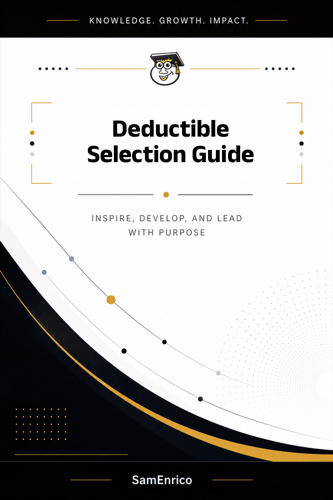
Deductible Selection Guide eBook
Teaches choosing deductibles that balance premium
Teaches choosing deductibles that balance premium savings with out of pocket risk.
Formats
Free sample
Chapter 1: The Risk You Ignore--Every morning, millions of Americans pour coffee into mugs, scan headlines on their phones, and drive to work without once considering the single largest financial vulnerability in their lives. It is not the stock market’s next crash. It is not a medical emergency or a job loss, though those rank high on the anxiety list. It is something far more mundane, far more predictable, and far more fixable than any of those: the deductible they chose five, ten, or fifteen years ago and never thought about again.Let that sink in for a moment. You probably spend more time researching which smartphone to buy or which airline ticket offers the best legroom than you have ever spent evaluating your insurance deductibles.
Yet those deductibles determine whether a minor fender bender becomes a $500 inconvenience or a $2,000 crisis. They determine whether a tree falling on your roof during a storm becomes an annoying insurance claim or a financial event that forces you to borrow money from family. They determine, in the most literal sense, whether you will actually dare to use the insurance you are paying for every single month.This chapter is not about the mechanics of deductibles. You can find those explanations in any basic insurance guide. This chapter is about something far more important: why you have been ignoring the most powerful lever in your financial life, and why that ignorance has cost you thousands of dollars already.The Seven-Figure Blind Spot Insurance is one of the few products people buy hoping never to use.
That simple psychological fact creates a bizarre incentive structure. When you buy a car, you test drive it. When you buy a house, you inspect it. When you buy a television, you read reviews. But when you buy insurance, you scan the price, glance at the deductible, and sign the paperwork with a shrug.
The product you are purchasing—protection against catastrophe—is abstract. It has no engine to rev, no layout to examine, no screen resolution to compare. It is a promise written in legalese, and most people treat it accordingly.The result is a population systematically overpaying for coverage they do not need while remaining dangerously exposed to risks they have not considered. The numbers are staggering. According to industry data, the average American household spends nearly $5,000 annually on insurance premiums across auto, home, health, and umbrella policies.
Yet fewer than one in five policyholders has ever changed their deductible from the initial selection they made when they first bought the policy. That means millions of families are still paying for the deductible they chose when they were twenty-five years old and broke, even though they are now forty-five with a healthy emergency fund. Or worse, they are still paying for the deductible their parents helped them choose when they bought their first car, even though their financial situation has changed completely.This is not just laziness. It is a failure of the entire insurance industry to educate its customers. Agents are compensated based on premiums, not on savings.
Their incentive is to sell you the policy that feels safe, not the policy that is financially optimal. And the policy that feels safe is almost always the one with the lowest possible deductible, because that is what customers ask for. “I want a low deductible” is the insurance equivalent of “I want the extended warranty”—a purchase driven by fear, marketed with emotion, and priced at a steep premium.The Fear Premium Let me tell you about a client I will call Sarah. Sarah was a schoolteacher in her early forties, single, with a modest house and a reliable sedan. She had held the same auto insurance policy for twelve years, and her deductible was still $250—the lowest option available.
She paid almost $1,800 per year for coverage that her neighbors were getting for $1,200.When I asked her why she kept such a low deductible, she gave me the answer I have heard a thousand times: “I can’t afford a big bill if something happens.”That answer sounds reasonable. It is not. It is the fear premium in action.I asked Sarah how much money she had in her emergency fund. She paused, then admitted she had about $15,000 in a savings account. She could easily afford a $1,000 deductible, or even a $2,000 deductible, without any real hardship.
But the fear of that hypothetical bill—the mental image of writing a check for a thousand dollars—had convinced her to pay an extra $600 per year for more than a decade. That is $7,200 in wasted premiums to protect against a risk she could have absorbed without losing a single night’s sleep.Sarah had been paying the fear premium. And so have you, probably.The fear premium is the difference between what you actually need to pay for insurance and what you do pay because you are afraid. It is the extra $200 per year for a $250 deductible instead of a $1,000 deductible. It is the extra $150 per year for roadside assistance you have never used.
It is the extra $300 per year for rental car coverage when you have a second car sitting in your driveway. The fear premium is invisible, recurring, and almost never examined. It flows out of your bank account in small, monthly increments, never large enough to trigger scrutiny but large enough to add up to thousands of dollars over time.The Opposite Problem: Reckless Under-Insurance Fear produces one kind of mistake. Complacency produces another. For every Sarah paying too much for a low deductible, there is a Mark who selected the highest possible deductible to save money on premiums and never stopped to ask whether he could actually pay it.Mark was a contractor, self-employed, with uneven cash flow.
He had a $5,000 deductible on his homeowner’s policy because his agent told him it would save him $800 per year. And it did. But when a pipe burst in his basement and caused $12,000 in damage, Mark did not have $5,000 in liquid savings. He had to put the deductible on a credit card, then carry that balance for eighteen months while paying 18% interest. The $800 he saved in premiums cost him more than $1,200 in interest payments, plus the stress of mounting credit card debt.Mark made the opposite mistake from Sarah.
He optimized for premium savings without checking whether his balance sheet could handle the worst case. His deductible was not too low. It was too high—not mathematically, but personally. He did not have the liquidity to support the risk he had chosen.These two mistakes—over-insuring out of fear and under-insuring out of complacency—are the twin poles of deductible mismanagement. Most people fall somewhere between them, but almost no one has deliberately, systematically chosen their deductible based on their actual financial situation.
They chose based on what felt right at the moment of purchase, and then they never revisited the decision.The Deductible as a Behavioral Contract Here is a perspective that most insurance guides never mention: your deductible is not just a number. It is a behavioral contract between you and your future self.When you select a low deductible, you are making a promise that you will…
This is the end of the free sample. Get the eBook to keep going. Buy now
About this book
Details
- Author
- Benedict Spring
- Publisher
- SamEnrico
- Language
- English
- Genre
- Non-Fiction, Business Brief, Risk Tolerance
- Released
- 2026-06-08
- Pages (approx.)
- 134
- Available as
- eBook, Audiobook

Read better in the ZLOADR app
Your eBooks on your phone or tablet. Sign in with your SamEnrico account and start reading.
More by Benedict Spring
 Empathetic Listening GuideBenedict Spring$11.99
 Detox Hallucinations GuideBenedict Spring$11.99
 The Remote Worker Pomodoro MasteryBenedict Spring$11.99
 Self Esteem Age Gap LoveBenedict Spring$11.99
 Personal Brand for FinanceBenedict Spring$11.99
 Neuroception of SafetyBenedict Spring$11.99
 Bifidobacterium GuideBenedict Spring$11.99
 The Serpent’s Throne: Exile of the Last Dragon KingBenedict Spring$11.99
 The Architect of the Future: Black Engineers Who Built the Modern WorldBenedict Spring$11.99
 How to Produce Fireplace and Wood Stove AccessoriesBenedict Spring$11.99
 How to Trade ZincBenedict Spring$11.99
 How to Produce Safety GlovesBenedict Spring$11.99
You may also like
 Hong Kong Handover 1997Dunn Johnnie$11.99
 Zumba For Postnatal Recovery CourseNeal Christian$11.99
 Zumba for BeginnersLadner Nikia$11.99
 YouTube Comment Mining GuideHumes Pandora$12.99
 Worry Box MeditationCarlin Rudy$11.99
 Workplace Stress MeditationNguyen Lynn$11.99
 Workplace Stress and Sleep RepairHawley Ivory$11.99
 Workplace Perfectionism CureDelaney Jeffry$11.99
 Workplace Injustice Anger GuideWallen Isabelle$11.99
 Work Addiction and Burnout LinkGreenwood Ester$11.99
 Women in Yoga and WellnessBeattie Galina$11.99
 Women in Stand Up ComedyChun Evangeline$11.99