
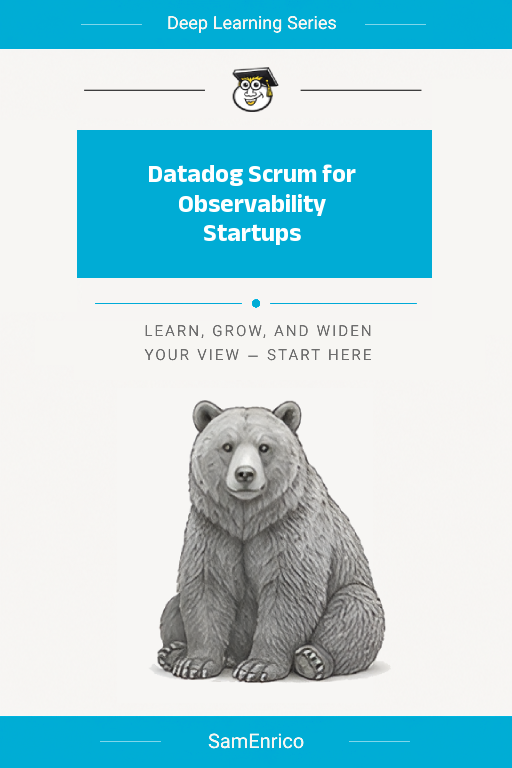
Datadog Scrum for Observability Startups
Monitor your scrum process using Datadog's observa
by Turner Cesar
Monitor your scrum process using Datadog's observability approach, tracking sprint metrics and deployment frequency as dashboards for startup retrospectives.
Formats
About this book
Free sample
Chapter 1: The Velocity Trap--–- Every startup engineering team I have ever coached believed they were doing Scrum. They had the daily standups, the sprint planning sessions, the retrospectives, and—most importantly—they had a spreadsheet or a Jira dashboard showing their velocity trending steadily upward. They celebrated when velocity increased. They worried when it dipped. They made sprint commitments based on it.
And they were all, without exception, measuring the wrong thing.I learned this lesson painfully in 2019, when I was the engineering manager at a fast-growing fintech startup we'll call Finora. We had twelve engineers, two-week sprints, and a Jira board that would make any Scrum purist proud. Our velocity had grown from 42 story points per sprint to 78 over six months. The product owner was thrilled. The CEO mentioned our "engineering productivity" in all-hands meetings.
I was up for a promotion.Then our largest customer—a regional bank—threatened to leave.Their complaint wasn't about missing features. It wasn't about bugs. It was about reliability. Our API had suffered four outages in eight weeks, each one lasting between fifteen minutes and two hours. The bank's own systems would time out, causing failed transactions and angry customers.
Our velocity said we were doing great. Our customers said we were failing.That paradox—high activity, low value—is the central problem this book exists to solve.The Illusion of Progress Traditional Scrum metrics, especially velocity, create what I call the "activity fallacy." Moving tickets from "In Progress" to "Done" feels productive. Closing ten tickets in a day feels better than closing two. But unless those tickets correspond to something your customers actually experience as value, you're just rearranging digital furniture.Let me be precise about what I mean.Velocity measures throughput—how many story points your team completes per sprint. That's it.
It does not measure whether those story points made your product more stable, more useful, or more profitable. It does not measure whether your deployment pipeline is efficient. It does not measure whether your users are happier. It measures only that work items changed status from "open" to…
This is the end of the free sample. Get the eBook to keep going. Buy now
Contents
- Chapter 1
- Chapter 2
- Chapter 3
- Chapter 4
- Chapter 5
- Chapter 6
- Chapter 7
- Chapter 8
- Chapter 9
- Chapter 10
- Chapter 11
- Chapter 12
Details
- Author
- Turner Cesar
- Publisher
- SamEnrico
- Language
- English
- Genre
- Non-Fiction, Startup Guide
- Released
- 2026-05-29
- Pages (approx.)
- 151
- Available as
- eBook, Audiobook

Read better in the ZLOADR app
Your eBooks on your phone or tablet. Sign in with your SamEnrico account and start reading.
More by Turner Cesar
 Influencer Marketing ImpactTurner Cesar$11.99
 Hair Dye Trace EvidenceTurner Cesar$11.99
 The Keto Micronutrient GuideTurner Cesar$11.99
 The AED Maintenance GuideTurner Cesar$11.99
 Workaholic Vacation GuideTurner Cesar$11.99
 SIDS Family Support GuideTurner Cesar$11.99
 Sékou Touré Guinea IndependenceTurner Cesar$11.99
 Anki For Coding InterviewsTurner Cesar$11.99
 The Republic of Genius: Florence, Venice, and the Birth of the Modern MindTurner Cesar$11.99
 The Iron Curtain of the Sands: Al-Ahly vs. Zamalek - Egypt's Eternal Football RivalryTurner Cesar$11.99
 Amazon Product Variation GuideTurner Cesar$12.99
 How to Produce Scale Model AccessoriesTurner Cesar$11.99
You may also like
 Hong Kong Handover 1997Dunn Johnnie$11.99
 Zumba For Postnatal Recovery CourseNeal Christian$11.99
 Zumba for BeginnersLadner Nikia$11.99
 YouTube Comment Mining GuideHumes Pandora$12.99
 Worry Box MeditationCarlin Rudy$11.99
 Workplace Stress MeditationNguyen Lynn$11.99
 Workplace Stress and Sleep RepairHawley Ivory$11.99
 Workplace Perfectionism CureDelaney Jeffry$11.99
 Workplace Injustice Anger GuideWallen Isabelle$11.99
 Work Addiction and Burnout LinkGreenwood Ester$11.99
 Women in Yoga and WellnessBeattie Galina$11.99
 Women in Stand Up ComedyChun Evangeline$11.99