
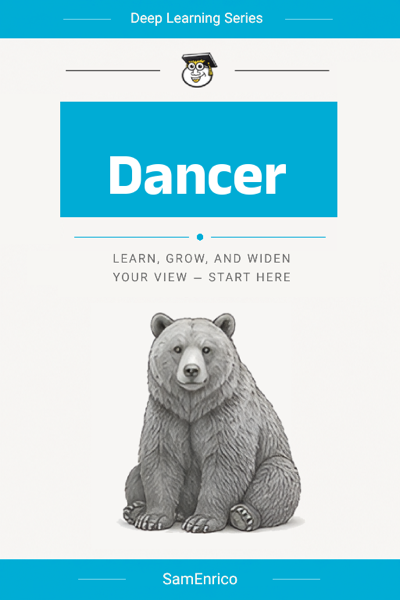
Non-FictionInformativeEducational
Dancer eBook
A Coursebook on Dancer
A Coursebook on Dancer
Formats
Free sample
Chapter 1: The Living Machine...--–- You have spent years perfecting your tendu, memorizing the sequence of a petit allegro, and learning to hold your balance in a passé that lasts eight counts longer than it did last month. You have stared at your reflection in the studio mirror, adjusting the angle of your wrist by two degrees, flattening your ribcage, lifting your sternum as if a string were pulling you toward the ceiling. You have been told to “tuck your pelvis,” “engage your core,” “squeeze your glutes,” and “lengthen through your spine” so many times that these phrases have become ambient noise, like the creak of the floorboards or the pianist’s warm-up scales. But no one has ever shown you what is actually happening beneath your skin. No one has handed you a map of your own body and said, “Here.
This is why you keep hurting your low back. This is why your turnout stops improving after a certain point. This is why your left foot sounds different than your right when you land a jump.”This chapter is that map.It is not a dry anatomy lecture. You will not be asked to memorize the Latin names of every foramen and tubercle. Instead, you will learn to see your body as a living machine—a kinetic chain of bones, joints, muscles, and connective tissue that transfers force from the floor through your feet, up your legs, across your pelvis, along your spine, and out through your fingertips and skull.
You will learn why a dancer with “perfect” alignment on paper can still get injured, while another dancer with so-called “bad” proportions dances pain-free for thirty years. You will learn that injury prevention is not a single secret but a three-pillar system: understanding your structure (this chapter), conditioning that structure intelligently (Chapter 2), and fueling it properly (Chapter 3). And you will leave this chapter with a set of practical tools—partnered palpation exercises, mirror-less joint tracking, and a pre-class body scanning protocol—that you can use tomorrow morning before your first plié.Because here is the truth that the dance world has been slow to admit: Most injuries are not accidents. They are not bad luck. They are not punishment for insufficient effort or a weak character.
Most injuries are the predictable result of a mismatch between a dancer’s unique anatomy and the demands placed upon that anatomy. When you understand the mismatch, you can modify the demand. And when you can modify the demand, you stop fighting your body and start dancing with it.The Kinetic Chain: Why Your Knee Pain Might Actually Start in Your Arch Let us begin with a simple experiment. Stand up. Place your feet hip-width apart.
Now, without moving your feet, deliberately roll your weight to the outside edges of your soles so that your arches lift away from the floor. Hold that position for five seconds. Notice what happens to your knees. If you are like most dancers, you just felt your knees shift outward, slightly bowlegged, and your outer quads engaged more intensely.Now do the opposite. Roll your weight to the inside edges of your feet, flattening your arches so that your ankles roll slightly inward (pronation).
Hold for five seconds. Your knees probably shifted inward as well, turning toward each other, and you may have felt a pinch or a warning signal along your inner knee.This is the kinetic chain in action. Your feet moved, and your knees followed. Your knees moved, and your hips had to adjust. Your hips moved, and your lower spine had to compensate.
Force travels through your body like a wave through water. It does not stop at your ankle joint. It does not stop at your hip. It continues all the way to the crown of your head, and if you are dancing with a partner, it continues through their hands and into their chain as well.Most dancers are taught to think about their bodies in isolated parts. “Point your toes.” “Straighten your knee.” “Square your hips.” “Open your shoulders.” This fragmented approach is like trying to tune a piano by adjusting only every fourth string.
The kinetic chain demands that we think differently. Every movement you make—from a slow, sustained adagio to a explosive sauté—is a conversation between your feet, knees, hips, spine, ribs, shoulders, and head. If one part of the conversation is shouting, another part will have to whisper. If one part is rigid, another will have to compensate. Compensation is not inherently bad; your body is brilliantly designed to adapt.
But chronic, unconscious compensation leads to overuse. And overuse, repeated thousands of times across a career, becomes injury.Let us trace a real-world example. A dancer complains of persistent low back pain during arabesque. She has stretched her hamstrings, strengthened her glutes, and received countless corrections to “tuck her pelvis.” Nothing works. Her teacher assumes she is lazy or insufficiently flexible.
But when we look at her kinetic chain, we discover something else. She has a mildly limited range of motion in her right ankle—specifically, dorsiflexion (the ability to bring her shin forward over her foot). Because of this limitation, her foot cannot absorb force normally during plié. Her knee compensates by shifting slightly inward. Her hip then rotates internally to keep her knee tracking over her second toe.
Her pelvis tips forward to maintain balance. And her lower spine arches excessively to keep her upright. The arabesque itself did not cause the pain. The arabesque simply exposed the fault line that had been building for years.The solution was not more hamstring stretching. It was a simple wedge under her heel during certain exercises to restore ankle range of motion.
Within six weeks, her back pain resolved. She had not been undisciplined. She had been misunderstood.This is why the kinetic chain is the most important concept in this entire book. Memorize it. Internalize it.
When something hurts, do not ask only “What did I do wrong today?” Ask “Where in my chain is the weak link forcing the rest to compensate?”Turnout Mechanics: The Truth About Your Hips Turnout is the foundation of classical ballet and a crucial element in modern, jazz, and even some contemporary forms. It is also one of the most misunderstood and dangerous concepts in all of dance.Here is what you were probably taught: “Turn out from your hips. Not your knees. Not your ankles. Feel the rotation deep in your hip socket.” This is correct as far as it goes.
But it leaves out a critical piece of information: Your hip socket is not a universal joint. The amount of turnout you can achieve without forcing is determined by three anatomical factors that you cannot change, no matter how many hours you spend in a froggy position.First, the angle of your acetabulum. Your acetabulum is the cup-shaped socket in your pelvis that holds the ball of your femur. In some people, this socket faces forward. In others, it faces more outward.
The forward-facing socket allows greater external rotation (turnout). The outward-facing socket restricts it. You can see this variation in a simple test…
This is the end of the free sample. Get the eBook to keep going. Buy now
About this book
Details
- Author
- Mcclellan Kermit
- Publisher
- SamEnrico
- Language
- English
- Genre
- Non-Fiction, Informative, Educational
- Released
- 2026-06-02
- Pages (approx.)
- 157
- Available as
- eBook, Audiobook

Read better in the ZLOADR app
Your eBooks on your phone or tablet. Sign in with your SamEnrico account and start reading.
More by Mcclellan Kermit
 Fiverr Buyer Persona GuideMcclellan Kermit$11.99
 Hawking Zero Gravity FlightMcclellan Kermit$11.99
 Twelve Step for Compulsive ExerciseMcclellan Kermit$11.99
 Anticipatory Grief and LegacyMcclellan Kermit$11.99
 Remote HR Communication GuideMcclellan Kermit$11.99
 The Navy Sailor OverdoseMcclellan Kermit$11.99
 Impossible Standards ChildhoodMcclellan Kermit$11.99
 Hearst Good HousekeepingMcclellan Kermit$11.99
 Dancer Flexibility Maintenance GuideMcclellan Kermit$11.99
 The Forgotten Ecologists of Angkor: Decoding the Khmer Empire's Environmental WisdomMcclellan Kermit$11.99
 The Last Mile: Lance Armstrong's Fall from GraceMcclellan Kermit$11.99
 Steel Behemoths: The Pacific Carrier Duel That Shaped Modern Naval WarfareMcclellan Kermit$11.99
You may also like
 Hong Kong Handover 1997Dunn Johnnie$11.99
 Zumba For Postnatal Recovery CourseNeal Christian$11.99
 Zumba for BeginnersLadner Nikia$11.99
 YouTube Comment Mining GuideHumes Pandora$12.99
 Worry Box MeditationCarlin Rudy$11.99
 Workplace Stress MeditationNguyen Lynn$11.99
 Workplace Stress and Sleep RepairHawley Ivory$11.99
 Workplace Perfectionism CureDelaney Jeffry$11.99
 Workplace Injustice Anger GuideWallen Isabelle$11.99
 Work Addiction and Burnout LinkGreenwood Ester$11.99
 Women in Yoga and WellnessBeattie Galina$11.99
 Women in Stand Up ComedyChun Evangeline$11.99