
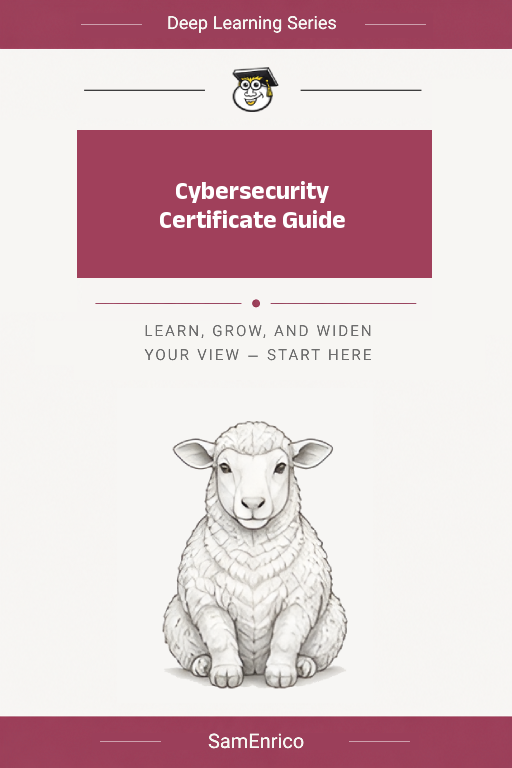
Non-FictionStudent's ShortcutCybersecurity
Cybersecurity Certificate Guide eBook
Earn Security+, CEH, or CISSP through online train
Earn Security+, CEH, or CISSP through online training for security analyst roles.
Formats
Free sample
Chapter 1: The Triangle Trap--–- Marcus sat in his cramped apartment at 2:00 AM, staring at a spreadsheet he had created. Across the top, he had written three acronyms: Security+, CEH, CISSP. Below each, he had listed prices: 392,392, 392,1,199, 749.Thatwasjusttheexamfees—notincludingstudymaterials,practicetests,orthecostofhislostweekends.Hewasacareerchanger,thirty−fouryearsold,workingadead−end IThelpdeskjobthatpaid749. That was just the exam fees—not including study materials, practice tests, or the cost of his lost weekends. He was a career changer, thirty-four years old, working a dead-end IT helpdesk job that paid 749.Thatwasjusttheexamfees—notincludingstudymaterials,practicetests,orthecostofhislostweekends.Hewasacareerchanger,thirty−fouryearsold,workingadead−end IThelpdeskjobthatpaid48,000 per year.
He had no computer science degree, no security clearance, and no friends already working in cybersecurity. His plan was simple: earn all three certifications, then apply for a security analyst role. The internet had told him that certifications were the golden ticket. The problem was that nobody had told him which order to pursue them in, how to actually learn the skills that mattered, or whether he was wasting his time on credentials that might not lead to a job interview. He was trapped in what this book calls the Triangle Trap—the mistaken belief that collecting certifications is the same as building a career.This chapter exists to pull you out of that trap.
In the following pages, you will learn why Security+, CEH, and CISSP form a logical progression only when pursued in a specific sequence and with a specific purpose. You will learn how each certification maps directly to daily tasks inside a Security Operations Center (SOC). You will take an honest self-assessment to determine where you currently stand. And you will receive the first of several reality checks in this book: that certifications open doors only if you build skills alongside them. Let us begin.The Myth of the Certified Security Professional Walk into any online cybersecurity forum, and you will see the same question asked a hundred different ways: “Which certification should I get first?” The answers range from helpful to harmful.
Some people recommend starting with the Comp TIA Security+ because it is vendor-neutral and foundational. Others argue for jumping straight to the Certified Ethical Hacker (CEH) because it sounds more impressive on a resume. A few purists claim that the Certified Information Systems Security Professional (CISSP) is the only certification that truly matters. Behind all of these answers lies a dangerous assumption: that certifications, in isolation, make you employable.This assumption is false. I have interviewed dozens of candidates for security analyst roles, and I have seen the same pattern repeat itself.
A candidate walks in with three or four certifications neatly listed on their resume. They can recite the definition of a SQL injection attack from memory. They know that AES stands for Advanced Encryption Standard. But when I ask them to open a packet capture and tell me what is happening, they freeze. When I give them a sample firewall log and ask them to identify a port scan, they cannot.
They have studied for exams, not for the job. The certifications gave them vocabulary without fluency, knowledge without understanding.The Triangle Trap is the belief that more certifications automatically equal more competence. It is encouraged by certification vendors who profit from exam fees, by online influencers who earn affiliate commissions from study guides, and by a general culture of credential inflation. The reality is harsher but more liberating: employers hire for skills, not for acronyms. A certification is merely a piece of evidence that you might possess those skills.
This book treats certifications as milestones on a skill-building journey, not as the destination itself.Why These Three Certifications?There are hundreds of cybersecurity certifications in existence. You could pursue the GIAC Security Essentials (GSEC), the Comp TIA Cy SA+, the Offensive Security Certified Professional (OSCP), the Certified Cloud Security Professional (CCSP), or any number of vendor-specific credentials from Microsoft, Amazon, or Cisco. Why does this book focus specifically on Security+, CEH, and CISSP?The answer lies in the structure of the security analyst career ladder. Entry-level security analysts need broad, foundational knowledge of threats, vulnerabilities, and defensive tools. That is exactly what Security+ provides.
Junior analysts who want to move into threat hunting or incident response need to understand how attackers think. That is what CEH provides, despite its flaws. Mid-level analysts who aspire to lead teams or manage risk need to understand security from an enterprise perspective. That is what CISSP provides. Together, these three certifications form what this book calls the Golden Triangle: a coherent, sequential pathway from zero experience to senior analyst.No other combination of three certifications maps as cleanly to the SOC career ladder.
You could substitute Cy SA+ for Security+, but Cy SA+ assumes knowledge that Security+ provides. You could substitute OSCP for CEH, but OSCP is significantly harder and more time-consuming for someone still learning the basics. You could substitute CISM for CISSP, but CISM is designed for managers, not for technical analysts. The Golden Triangle is not the only path, but it is the most efficient path for someone starting from scratch and aiming for a security analyst role.The Golden Triangle: A Detailed Breakdown Security+: The Language of Security The Comp TIA Security+ certification is often described as entry-level, but that description undervalues its importance. Imagine trying to work as a journalist in a foreign country without speaking the local language.
You might be an excellent writer, a sharp interviewer, and a relentless fact-checker, but without the language, you are useless. Security+ is the language of cybersecurity. It provides the vocabulary, concepts, and frameworks that every security professional uses every day.The Security+ exam (SY0-701 as of this writing) covers five domains: Threats, Attacks, and Vulnerabilities; Architecture and Design; Implementation; Operations and Incident Response; and Governance, Risk, and Compliance. Each domain maps directly to a set of tasks that a Level 1 SOC analyst performs. When you learn about phishing attacks in the Threats domain, you are learning how to recognize the emails that will land in your investigation queue.
When you learn about firewall rules in the Implementation domain, you are learning how to verify configurations during incident triage. When you learn about incident response steps in the Operations domain, you are learning the exact playbook that your future SOC uses.The typical timeline for Security+ preparation is three to four months of part-time study. The exam costs approximately $392. No formal experience is required, although Comp TIA recommends two years of IT administration experience. Many people pass Security+ with no prior IT experience at all, relying solely on study guides and video courses.
That is both the strength and the weakness of the certification. It is accessible enough that anyone can earn it, which means it does not, by itself, distinguish you from other candidates. You will need to supplement it with hands-on labs and projects—a theme that will recur throughout this book.CEH: The Attacker's Mindset The Certified Ethical Hacker certification from EC-Council is one of the most controversial credentials in cybersecurity. Critics argue that it is too theoretical, that it tests memorization rather than practical skills, and that EC-Council has engaged in questionable business practices. Supporters counter that CEH is widely recognized by employers, that…
This is the end of the free sample. Get the eBook to keep going. Buy now
About this book
Details
- Author
- Rosenbaum Julienne
- Publisher
- SamEnrico
- Language
- English
- Genre
- Non-Fiction, Student's Shortcut, Cybersecurity
- Released
- 2026-06-01
- Pages (approx.)
- 158
- Available as
- eBook, Audiobook

Read better in the ZLOADR app
Your eBooks on your phone or tablet. Sign in with your SamEnrico account and start reading.
More by Rosenbaum Julienne
 Beginner Cycling Fitness PlanRosenbaum Julienne$11.99
 Metta for Miscarriage Recovery CourseRosenbaum Julienne$11.99
 Earthquake Insurance SpecialistsRosenbaum Julienne$11.99
 Rent vs Buy Retirement CalcRosenbaum Julienne$11.99
 The Lonely Perfectionist's GuideRosenbaum Julienne$11.99
 The Vanishing Act: How a 747 Disappeared in the Bermuda TriangleRosenbaum Julienne$11.99
 Teenage Mutiny: The 1970s School Bus Rebellion That Shook AmericaRosenbaum Julienne$11.99
 Supply Management SpecialistRosenbaum Julienne$11.99
 How to Become a ChaperonRosenbaum Julienne$11.99
 Understanding Desanctis–cacchione SyndromeRosenbaum Julienne$17.99
 Trusts And CTA ComplianceRosenbaum Julienne$12.99
You may also like
 Hong Kong Handover 1997Dunn Johnnie$11.99
 Zumba For Postnatal Recovery CourseNeal Christian$11.99
 Zumba for BeginnersLadner Nikia$11.99
 YouTube Comment Mining GuideHumes Pandora$12.99
 Worry Box MeditationCarlin Rudy$11.99
 Workplace Stress MeditationNguyen Lynn$11.99
 Workplace Stress and Sleep RepairHawley Ivory$11.99
 Workplace Perfectionism CureDelaney Jeffry$11.99
 Workplace Injustice Anger GuideWallen Isabelle$11.99
 Work Addiction and Burnout LinkGreenwood Ester$11.99
 Women in Yoga and WellnessBeattie Galina$11.99
 Women in Stand Up ComedyChun Evangeline$11.99