
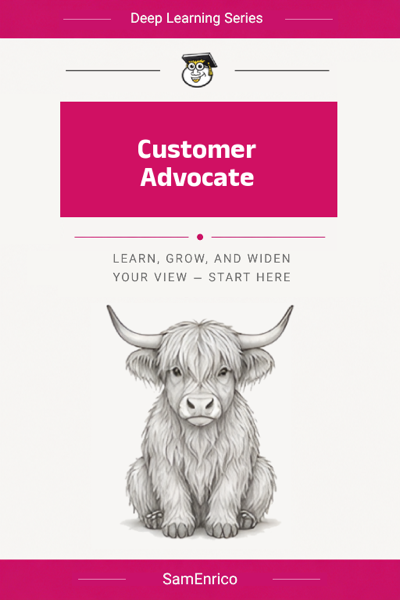
Non-FictionInformativeEducational
Customer Advocate eBook
A Coursebook on Customer Advocate
A Coursebook on Customer Advocate
Formats
Free sample
Chapter 1: The Trust Collapse...--The year is 2025. You are holding a smartphone that contains the sum total of human knowledge. Within three seconds, you can verify any claim, compare any price, and expose any deception. The salesperson sitting across from you has no informational advantage—in fact, they are likely at a disadvantage. You have read twelve reviews, watched three unboxing videos, and scanned two Reddit threads.
You know more about the product than the person selling it.This was impossible twenty years ago. It is routine today.Yet most companies continue to operate as if the internet never happened. They pour billions into interruptive advertising, high-pressure sales tactics, and carefully spun messaging—all while wondering why customers don't trust them. The answer is brutal but simple: The old rules of commerce have been rewritten, and most organizations haven't noticed.This book is about one idea: Customer Advocacy. Not as a slogan.
Not as a department. As a complete reorientation of how business works. Customer Advocacy means telling the truth even when it costs you a sale. It means fixing problems before customers complain. It means treating the customer's interest as identical to your own.This is not idealism.
This is the only viable long-term strategy in a world where information asymmetry has reversed and customers hold unprecedented power. Companies that embrace advocacy will thrive. Companies that cling to push marketing will die—slowly at first, then all at once.This chapter establishes the foundation: why trust has become the only economic moat, how the digital age has dismantled the seller's advantage, and why the collapse of trust at companies like Arthur Andersen and Merck offers a warning for every business leader today.The Death of Information Asymmetry For most of commercial history, sellers enjoyed a profound advantage: they knew more than buyers. A car dealer knew the invoice price. A doctor knew the side effects.
A used car salesman knew the hidden damage. A software company knew the unfixed bugs. This asymmetry allowed sellers to control the narrative, set prices with minimal transparency, and close deals through pressure rather than persuasion.The ancient legal principle of caveat emptor—"let the buyer beware"—codified this imbalance. The buyer bore the risk because the buyer had no way to verify the seller's claims. If you bought a lemon, that was your fault.
If you paid too much, that was your lack of research. The system was not fair; it was simply the only system available.The internet changed everything.Today, a car buyer walks onto the lot having already checked Kelley Blue Book for invoice prices, read Car and Driver reviews, watched a You Tube video comparing three models, and scrolled through a Reddit thread detailing exactly which options are worth the money. The salesperson's "expertise" is now a commodity. The buyer knows more.This reversal is not incremental. It is total.
Across every industry—healthcare, finance, software, retail, travel, education—the customer now has access to more information than the seller at the moment of transaction. The only remaining asymmetry is trust.Consider the mechanics of this shift across five dimensions:First, access to information. Before the internet, a patient had no way to verify a doctor's diagnosis or a pharmacist's recommendation. Today, Web MD, Mayo Clinic, and Pub Med are free. A patient can research symptoms, read about side effects, and even find clinical trial data.
This does not replace medical expertise, but it eliminates the blind trust that once protected mediocre practitioners.Second, alternative access. Before the internet, switching providers required phone calls, paper forms, and often a visit to a physical location. Today, switching is one click. A hotel that overcharges is replaced by Booking.com in five seconds. A Saa S company that raises prices is replaced by a competitor's landing page in one tab.
Loyalty is no longer protected by inconvenience; it must be earned daily.Third, simplified transactions. Technology has collapsed switching costs. Canceling a subscription used to require a phone call during business hours, a conversation with a retention specialist, and often a mailed letter. Now it takes thirty seconds online. Porting a phone number used to take a week; now it takes an hour.
One-click purchasing made buying easy, but one-click canceling made leaving easy too. The easier transactions become, the less inertia protects incumbents.Fourth, networked communication. Word-of-mouth has been amplified beyond recognition. A single bad review on Yelp reaches thousands. A angry tweet reaches ten thousand.
A viral Reddit thread can tank a stock price. Customers no longer suffer in silence; they broadcast. And because negative information spreads faster than positive information, a single bad experience can undo years of brand building.Fifth, customer control. Ad-blockers eliminate interruptive display ads. Spam filters bury unsolicited emails.
The Do Not Call registry made telemarketing nearly obsolete. Customers decide when, where, and how they engage. You cannot force attention; you must earn the privilege of being heard.Together, these five shifts have transferred power from seller to buyer. The old principle of caveat emptor is dead. It has been replaced by caveat venditor—let the seller beware.
In a world where a single bad experience can be broadcast to millions, sellers bear the risk. If you deceive, exaggerate, or hide flaws, you will be caught. And the punishment is permanent reputational damage.The Case Studies of Collapse Theory is useful. But the reality of trust collapse is best understood through two case studies—one from professional services, one from pharmaceuticals. Both companies were industry leaders.
Both were trusted by millions. Both destroyed that trust through deception. And both paid a price that no marketing budget could fix.Arthur Andersen: The Conscience That Sold Out In 2000, Arthur Andersen was one of the "Big Five" accounting firms, a global giant with 85,000 employees and a brand synonymous with integrity. The firm's reputation was so strong that its stamp of approval on a company's financial statements was accepted by banks, regulators, and investors as truth. Andersen did not sell audits; it sold trust.When Enron began to collapse in 2001, the truth emerged: Andersen had shredded documents, ignored conflicts of interest, and knowingly signed off on fraudulent financial statements.
The firm's auditors had abandoned their role as advocates for truth and investors, becoming advocates for Enron's stock price instead.The consequences were swift and total. Andersen was indicted for obstruction of justice. Although the conviction was later overturned by the Supreme Court, the brand was already destroyed. Clients fled. Partners scattered.
Within a year, 85,000 jobs had evaporated. A firm that had taken nearly a century to build disappeared in twelve months.The lesson is not merely about legality. Andersen's crime was not just shredding documents; it was betraying the trust that clients and investors had placed in the firm's judgment. Trust took decades to build and seconds to destroy. And once destroyed, no amount of apology or rebranding could bring it back.Merck and Vioxx: The Suppressed Truth Merck's blockbuster arthritis drug Vioxx was prescribed to twenty million Americans.
It was a financial juggernaut, generating billions in annual revenue. But internal company documents later revealed that Merck knew about increased cardiovascular risks from the drug for years—and suppressed…
This is the end of the free sample. Get the eBook to keep going. Buy now
About this book
Details
- Author
- Ryder Hildred
- Publisher
- SamEnrico
- Language
- English
- Genre
- Non-Fiction, Informative, Educational
- Released
- 2026-05-07
- Pages (approx.)
- 156
- Available as
- eBook, Audiobook

Read better in the ZLOADR app
Your eBooks on your phone or tablet. Sign in with your SamEnrico account and start reading.
More by Ryder Hildred
 Creator Delegation SkillsRyder Hildred$11.99
 Recurring Nightmare Pattern Breaking GuideRyder Hildred$11.99
 Parenting on MAT GuideRyder Hildred$11.99
 The Sponsor Equity Contribution GuideRyder Hildred$11.99
 Injustice Anger TriggersRyder Hildred$11.99
 The Ballad of the Last Pony Express Rider: The Untold Ride of Billy GobleRyder Hildred$11.99
 How to Become a Turbine OperatorRyder Hildred$11.99
 HelloFresh GuideRyder Hildred$12.99
 Executive Summary for IT PlansRyder Hildred$12.99
 Understanding Progressive Black Carbon Hyperpigmentation of InfancyRyder Hildred$17.99
You may also like
 Hong Kong Handover 1997Dunn Johnnie$11.99
 Zumba For Postnatal Recovery CourseNeal Christian$11.99
 Zumba for BeginnersLadner Nikia$11.99
 YouTube Comment Mining GuideHumes Pandora$12.99
 Worry Box MeditationCarlin Rudy$11.99
 Workplace Stress MeditationNguyen Lynn$11.99
 Workplace Stress and Sleep RepairHawley Ivory$11.99
 Workplace Perfectionism CureDelaney Jeffry$11.99
 Workplace Injustice Anger GuideWallen Isabelle$11.99
 Work Addiction and Burnout LinkGreenwood Ester$11.99
 Women in Yoga and WellnessBeattie Galina$11.99
 Women in Stand Up ComedyChun Evangeline$11.99