
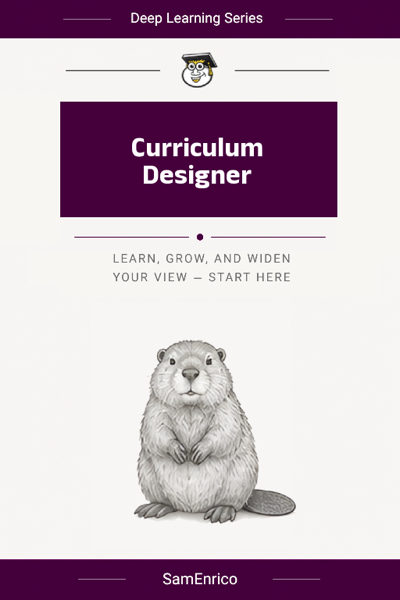
Non-FictionInformativeEducational
Curriculum Designer eBook
A Coursebook on Curriculum Designer
by Shah Armanda
A Coursebook on Curriculum Designer
Formats
Free sample
Chapter 1: The Coffin Principle...--–- Most teachers plan like this: they open a web browser, type "fun lesson for [insert topic here]," and spend 45 minutes clicking through Pinterest boards, Teachers Pay Teachers downloads, and a blog written by someone who taught for two years in 2014. They find a worksheet with cute fonts, a group activity involving colored cards, and a video with an upbeat soundtrack. Then they close their laptop at 11:37 PM, exhausted but satisfied, believing they have done their job.They have not done their job. They have planned an activity. There is a profound difference.I know this because I did exactly that for three years.
I was the teacher who stayed late, who decorated bulletin boards, who had the most engaging hands-on simulations. My students laughed. They cut things out. They glued things in. And then they took my tests and performed… fine.
Not great. Not terrible. Just fine. The kind of fine that makes you think, "Maybe they just didn't study hard enough."Then I read something that broke me open. It was a single line from Grant Wiggins, buried in a curriculum design monograph: "The textbook is not the syllabus.
The test is not the goal. The only goal is transfer."I had no idea what "transfer" meant at the time. I thought it was what you did when a student moved from one school to another. But that sentence haunted me. It forced me to ask a question I had never asked before: what am I actually trying to build here?This chapter introduces the single most transformative idea in curriculum design, an idea so simple and so radical that it will ruin you for forward planning forever.
I call it the Coffin Principle. You will understand why by the end of this chapter. And once you understand it, you will never again open a browser to search for "fun lesson" before you have answered three hard questions.The Three Most Dangerous Words in Education Let me start with a confession that might get me banned from faculty lounges. The three most dangerous words in education are not "you failed" or "I don't know." The three most dangerous words are "I have an activity."I have an activity about fractions where students cut up play-doh pizzas. I have an activity about the American Revolution where students act out the Boston Tea Party with paper cups.
I have an activity about photosynthesis where students hold up green cards. Every time a teacher says "I have an activity," they are substituting entertainment for design. They are assuming that if students are busy, students are learning. They are treating education as a Ponzi scheme where engagement masks the absence of understanding.Here is the brutal truth that the activity-first approach hides: you can run a flawless activity and learn nothing. I have watched students enthusiastically sort vocabulary cards while having zero idea what the words meant.
I have watched students build elaborate dioramas that demonstrated craft skills, not historical thinking. I have watched students perform skits that were, from a theatrical perspective, quite good, and from a learning perspective, completely hollow.The problem is not activities. The problem is sequence. Most teachers design forward: they look at what they are supposed to teach (a standard, a chapter, a theme), then they look for engaging ways to deliver that content, then they write a test at the end to check if anything stuck. This is the pedagogical equivalent of building a house by buying furniture first.
You pick out a beautiful couch (your activity), then you try to build a living room around it, then you realize the walls don't fit, then you knock out a support beam, then the whole thing collapses.Backward design reverses this sequence entirely. It says: start with the end. Decide what success looks like before you decide what Tuesday looks like. Choose your destination, then build the map, then pack your bags. It sounds obvious when I say it like that.
And yet almost no one does it.What Is Backward Design? (And Why Most People Get It Wrong)Backward design, as originally articulated by Wiggins and Mc Tighe in Understanding by Design, has three stages. I am going to give you these stages in plain language, because the academic versions tend to obscure rather than illuminate.Stage One: Identify Desired Results. This is not as simple as "look at the standard." This is the hard work of asking: what should students actually understand three weeks from now? Not memorize.
Not recite. Understand. What should they be able to do with that understanding? And what is worth understanding in the first place? (Spoiler: not everything in the textbook is worth understanding.
Some of it is trivia. Some of it is filler. Some of it is actively misleading. More on this in Chapter 2.)Stage Two: Determine Acceptable Evidence. Before you plan a single worksheet, before you write a single discussion question, before you queue up a single video, you design the final assessment.
You decide what students will produce, perform, or demonstrate to prove they have reached the desired results. This is the hardest stage for most teachers because it requires you to sit with uncertainty. You do not yet know how you will teach it, but you must decide how you will know they learned it.Stage Three: Plan Learning Experiences. Only now, after you have identified the destination and designed the proof, do you plan the journey. What activities will equip students to succeed on that final assessment?
What lessons will build the prerequisite skills? What scaffolding will support struggling learners? This is where activities belong—not at the front of the process, driving the bus, but at the back, serving the destination.Here is what most people get wrong about this framework. They think backward design is just "write your test first." That is technically correct but spiritually bankrupt. The point is not the sequence of documents.
The point is the shift in authority. In forward design, the activity is the authority. You do the activity because it exists, because it's fun, because the teacher next door did it. In backward design, the desired result is the authority. Every activity, every worksheet, every discussion question must justify its existence by serving the end goal.If an activity does not directly prepare students for the final assessment, cut it.
If a worksheet covers content that is not essential to the desired understanding, cut it. If a video is entertaining but not equipping, cut it. This is not joyless. This is respectful—of your time, of your students' time, of the limited hours you have to move the needle on actual learning.The Coffin Principle: A Dark Metaphor for Clarity I promised you the Coffin Principle. Here it is.Imagine you are building a coffin.
Morbid, I know, but stay with me. You are building a coffin. You do not start by selecting beautiful wood. You do not start by designing ornate handles. You do not start by watching a You Tube video called "Fun Coffin-Building Activities for Beginners." You start by asking: who is this coffin for?
How tall are they? How wide? What position will the body be in? These are not pleasant questions, but they…
This is the end of the free sample. Get the eBook to keep going. Buy now
About this book
Details
- Author
- Shah Armanda
- Publisher
- SamEnrico
- Language
- English
- Genre
- Non-Fiction, Informative, Educational
- Released
- 2026-05-11
- Pages (approx.)
- 159
- Available as
- eBook, Audiobook

Read better in the ZLOADR app
Your eBooks on your phone or tablet. Sign in with your SamEnrico account and start reading.
More by Shah Armanda
 Anticipatory Grief and AnxietyShah Armanda$11.99
 Twelve Step for Compulsive ShoppingShah Armanda$11.99
 The Hand Clasp StylesShah Armanda$11.99
 Fiverr Level System ExplainedShah Armanda$11.99
 Only Child Dysfunction StoryShah Armanda$11.99
 Growth Hormone for Wound HealingShah Armanda$11.99
 Managing Remote UnderperformersShah Armanda$11.99
 The Fisherman OverdoseShah Armanda$11.99
 Fox News RiseShah Armanda$11.99
 The Algorithm and the Oracle: How a 12th-Century Monk Predicted Social MediaShah Armanda$11.99
 The Vanishing Heiress: The Unsolved Disappearance of Dorothy ArnoldShah Armanda$11.99
 The Quantum Leap That Changed Everything: How Google's 2019 Breakthrough Reshaped the FutureShah Armanda$11.99
You may also like
 Hong Kong Handover 1997Dunn Johnnie$11.99
 Zumba For Postnatal Recovery CourseNeal Christian$11.99
 Zumba for BeginnersLadner Nikia$11.99
 YouTube Comment Mining GuideHumes Pandora$12.99
 Worry Box MeditationCarlin Rudy$11.99
 Workplace Stress MeditationNguyen Lynn$11.99
 Workplace Stress and Sleep RepairHawley Ivory$11.99
 Workplace Perfectionism CureDelaney Jeffry$11.99
 Workplace Injustice Anger GuideWallen Isabelle$11.99
 Work Addiction and Burnout LinkGreenwood Ester$11.99
 Women in Yoga and WellnessBeattie Galina$11.99
 Women in Stand Up ComedyChun Evangeline$11.99