
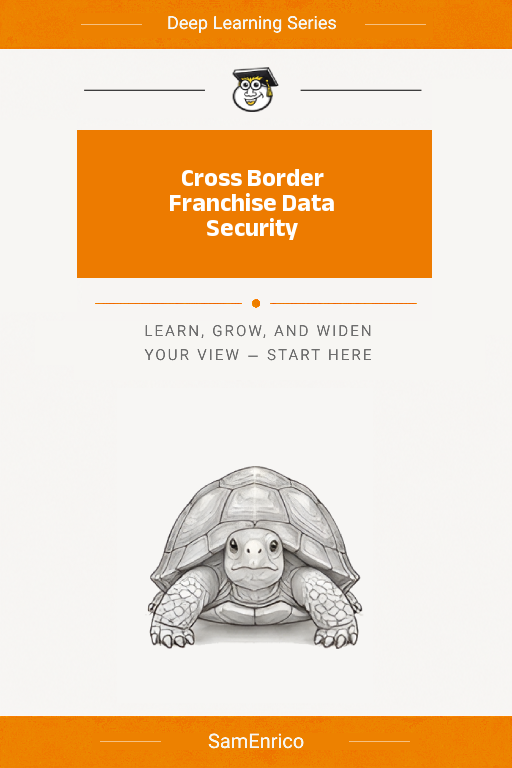
Cross Border Franchise Data Security eBook
Encrypt customer and financial data transferred be
Encrypt customer and financial data transferred between countries, using VPNs and secure servers that comply with local data residency requirements.
Formats
Free sample
Chapter 1: The Burgers Were Fine--The credit card numbers were stolen at 11:47 on a Tuesday morning. The franchisee’s point-of-sale system—a standard terminal used in over two hundred locations—processed the transaction without any alert, without any delay, and without any indication that a hacker had been sitting inside the network for the past forty-seven days. The customer, a regular who had bought the same sandwich every week for three years, handed over her card, tapped it against the reader, and walked away with her lunch. The sandwich was perfect. The lettuce was crisp.
The bread was fresh. The data breach that would eventually cost the brand over ten million dollars in lawsuits, forensic investigations, and lost customer trust had just occurred, and no one in the restaurant had the slightest idea.This is the fundamental problem of data security in the modern franchise system. The failure is invisible. The customer cannot see it, taste it, or complain about it. Unlike a dirty restroom, a rude cashier, or a burger cooked to the wrong temperature, a data breach leaves no physical evidence at the location where it happened.
The franchisee continues to sell products. The customers continue to swipe their cards. The brand continues to advertise its commitment to quality. And somewhere, often in a different country entirely, a criminal is sifting through the stolen information, building a profile of every customer who walked through that door.The 2014 Jimmy John’s breach was not an isolated incident. It was a warning.
Over two million credit cards were compromised across 216 franchise locations, not because the corporate headquarters had weak security, but because a common point-of-sale vendor used by individual franchisees had a vulnerability that went unpatched for months. The lawsuits did not distinguish between the franchisor and the franchisee. The customers sued everyone. The media did not report that “a single franchisee in a single city had a problem.” The headlines read: “Jimmy John’s Customer Data Stolen.” The brand paid the price for a failure that occurred at the local level, in a system that the corporate office did not directly control.This is the new reality of franchise risk. Physical consistency—uniform products, signage, service standards—has been the bedrock of franchising for over a century.
Customers expect that a burger in Chicago tastes the same as a burger in Berlin. They expect that the logo is the same color, the uniforms are the same cut, and the opening hours are posted in the same font. And for decades, that physical consistency was enough. If a single location served a bad meal, the customer might avoid that specific restaurant but would still trust the brand elsewhere.But data does not work that way. Data is invisible, portable, and infinitely replicable.
A single compromised point-of-sale terminal in a single franchise location can expose customer information that is then used to commit fraud in every state and country where those customers live. The customer whose card is stolen does not know—cannot know—whether the breach happened at the location they visited last week or the one they visited last year. They only know that the brand they trusted failed to protect them. And so they punish the brand, not the individual franchisee.The Three-Party Risk Model To understand why cross-border franchise data security is fundamentally different from standard corporate data security, we must abandon the traditional two-party model of risk. In a standard corporation, data flows between the company and the customer.
The company controls its own servers, its own software, its own security policies, and its own employees. If a breach occurs, the chain of responsibility is relatively clear. The company made a mistake, or a vendor made a mistake, but the company has direct authority over both.Franchising introduces a third party, and that third party changes everything.The three-party risk model looks like this: Customer → Franchisee → Franchisor. The customer provides data to the franchisee at the point of sale. The franchisee, operating as an independent business owner, processes that data using systems that may be provided by the franchisor, the franchisee’s own vendors, or a combination of both.
The franchisor receives aggregated data from the franchisee for reporting, analytics, and loyalty programs. Data flows in multiple directions, across multiple jurisdictions, through systems that the franchisor may not own and that the franchisee may not fully understand.Every link in this chain introduces unique vulnerabilities. The franchisee may be technically unsophisticated, running a small business with minimal IT support. The franchisee may be cost-sensitive, unwilling to invest in security measures that do not produce immediate revenue. The franchisee may be indifferent, believing that data security is the franchisor’s problem.
And in many cases, the franchisee may be right to believe that, because the franchisor’s brand is the one that will suffer in the headlines.But the franchisor cannot simply mandate solutions. Unlike a corporate chain where headquarters can order a new software installation and terminate any manager who refuses, a franchisor operates within a legal framework that respects the franchisee’s status as an independent business owner. Direct orders can create joint employer liability. Excessive control can violate franchise laws. And yet, without control, the brand remains exposed to the actions of its least secure franchisee.This is the central tension that drives every decision in cross-border franchise data security: centralized control versus local autonomy.
The franchisor wants uniform security policies, consistent software, and centralized monitoring. The franchisee wants to run their business without interference, without added expense, and without the franchisor looking over their shoulder. Both positions are reasonable. Both positions are incomplete. And the failure to resolve this tension has led to some of the most damaging data breaches in franchise history.The Reputational Contagion Problem Reputational contagion is the phenomenon where a failure at one franchise location immediately and indiscriminately tarnishes the entire brand.
Unlike a product recall, which can be traced to a specific batch and a specific manufacturing facility, a data breach has no geographic or temporal boundaries. The stolen data does not carry a label indicating which franchisee lost it. The fraudster does not know—and does not care—whether the card was stolen at a corporate-owned store or a franchisee-owned store. The customer only knows that the card they used at the brand was compromised.This creates an asymmetric risk profile that is unique to franchising. In a typical product liability case, the harm is localized.
A defective product sold at one store harms customers of that store. Other stores selling the same product may be unaffected, or may recall the product proactively. The brand can isolate the damage. In a data breach, isolation is impossible. The data is digital.
It moves instantly. It can be copied, sold, and used anywhere in the world.Consider the 2018 breach of a major hotel franchise. A single point-of-sale system at a single franchised location was compromised. The attacker gained access to customer names, addresses, credit card numbers, and loyalty program credentials. Within weeks, those credentials were being used to book rooms at other locations in the same franchise system—not because those locations were compromised, but because the attacker simply used the…
This is the end of the free sample. Get the eBook to keep going. Buy now
About this book
Details
- Author
- Espinal Hettie
- Publisher
- SamEnrico
- Language
- English
- Genre
- Non-Fiction, Business Brief
- Released
- 2026-05-29
- Pages (approx.)
- 147
- Available as
- eBook, Audiobook

Read better in the ZLOADR app
Your eBooks on your phone or tablet. Sign in with your SamEnrico account and start reading.
More by Espinal Hettie
 Fear Of Costumes Treatment GuideEspinal Hettie$11.99
 One Hour Meal Planning SystemEspinal Hettie$11.99
 Pet Loss Tattoo GuideEspinal Hettie$11.99
 Surgery Recovery SuggestionEspinal Hettie$11.99
 The Social Media Distraction FixEspinal Hettie$11.99
 Parental Stress And BirthdaysEspinal Hettie$11.99
 Tolle Causam PrincipleEspinal Hettie$11.99
 REIT Secondary OfferingEspinal Hettie$11.99
 Socrates' Symphony: The Music of WisdomEspinal Hettie$11.99
 Silk and Gold: The Byzantine Merchants Who Built an EmpireEspinal Hettie$11.99
 How to Produce Roller Skating PadsEspinal Hettie$11.99
 A Collector's Handbook to the Alvis Speed 25 SbEspinal Hettie$11.99
You may also like
 Hong Kong Handover 1997Dunn Johnnie$11.99
 Zumba For Postnatal Recovery CourseNeal Christian$11.99
 Zumba for BeginnersLadner Nikia$11.99
 YouTube Comment Mining GuideHumes Pandora$12.99
 Worry Box MeditationCarlin Rudy$11.99
 Workplace Stress MeditationNguyen Lynn$11.99
 Workplace Stress and Sleep RepairHawley Ivory$11.99
 Workplace Perfectionism CureDelaney Jeffry$11.99
 Workplace Injustice Anger GuideWallen Isabelle$11.99
 Work Addiction and Burnout LinkGreenwood Ester$11.99
 Women in Yoga and WellnessBeattie Galina$11.99
 Women in Stand Up ComedyChun Evangeline$11.99