
Non-FictionSelf-HelpCollective Trauma
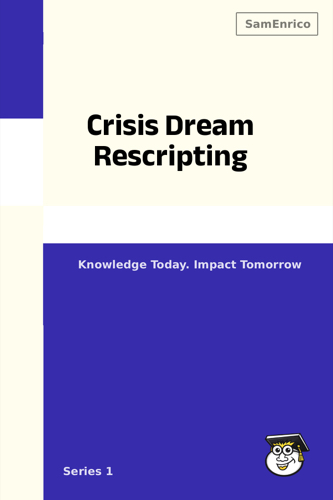
Crisis Dream Rescripting eBook
Process dreams about world events and helplessness
by Putnam Ward
Process dreams about world events and helplessness using this therapeutic guide.
Formats
Free sample
Chapter 1: The 3 AM Broadcast...--You wake up gasping.Your heart is hammering against your ribs like a trapped animal. The sheets are tangled around your legs—you were running, or drowning, or trying to scream. For a long moment, you don't know where you are. The bedroom is dark. The clock on your nightstand reads 3:17 AM.
And then, like a wave crashing back over you, the dream returns.You were standing at a window. Outside, the sky was the color of bruises. A wall of water was advancing toward your childhood home, and you couldn't move. Your feet were glued to the floor. You tried to call out to your family, but no sound came.
The water hit the glass. You woke up.Or maybe it was different. Maybe you were in a crowded street, and soldiers were rounding people up. You ducked behind a car, but you knew they would find you. You could feel the cold metal of a gun against your neck before you even opened your eyes.Or maybe there was no plot at all.
Just a shadow—faceless, enormous, hungry—standing at the foot of your bed. You couldn't scream. You couldn't run. You could only watch.If any of this feels familiar, you are not alone. And you are not broken.The Epidemic No One Is Talking About Over the past five years, sleep clinics, trauma research centers, and online mental health platforms have documented a dramatic surge in what researchers now call "crisis dreaming." Unlike ordinary nightmares—which tend to be personal, idiosyncratic, and rooted in individual fears—crisis dreams follow a strikingly consistent template across thousands of people who have never met each other.The templates include:The Chase Dream: You are being pursued by an undefined threat—a mob, a monster, a faceless authority.
You run, but your legs are heavy. You hide, but you are always found.The Drowning Dream: Water is rising. A flood, a tsunami, a sinking ship. You cannot find air. You cannot find solid ground.The Frozen Dream: You are watching disaster unfold—a bomb falling, a fire spreading, a loved one in danger—but you cannot move.
Your body is paralyzed. Your voice is gone.The Lost Dream: You are searching for someone or something. A child in a crowd. Your home in a destroyed neighborhood. Your country on a map that no longer makes sense.The Shadow Dream: No plot, no narrative.
Just a presence. A dark shape. An overwhelming sense of dread with no source and no escape.These dreams are not random. They are not signs of madness. They are the brain's ancient threat simulation system doing exactly what it evolved to do—except now, the threats it is simulating are not predators or rival tribes.
They are twenty-four-hour news cycles, climate collapse, political instability, global pandemics, and the slow, creeping sense that the world is becoming less safe than the one you were born into.The Social Brain Hypothesis Why do strangers in different countries report the same dream? The answer begins with a deceptively simple fact: human brains are social organs.We tend to think of dreams as private, intimate, uniquely personal. And in their details, they are. But in their emotional architecture, dreams are remarkably collective. This is because the human brain evolved not to survive alone, but to survive in groups.
Our threat detection systems are calibrated to respond not only to direct danger, but to signs of danger in the people around us.Rosalind Cartwright, one of the most influential dream researchers of the twentieth century, spent decades studying how dreams respond to life crises. In her landmark research on divorce and job loss, she discovered that people going through similar life transitions produced similar dream patterns—not because they shared a subconscious, but because their brains were solving the same emotional problems with the same neural toolkit.When Cartwright's subjects dreamed of being trapped in a house with an ex-spouse, they were not receiving mystical messages. They were running threat simulations: If I encounter this person, what will happen? How will I respond? What are my escape routes?Now scale that observation from individual crises to collective ones.
When millions of people watch the same news, scroll through the same social media feeds, and absorb the same ambient sense of danger, their brains begin running similar threat simulations. The details vary—your flood is my fire, your soldier is my shadow—but the emotional structure is identical: Something is coming. I cannot stop it. I cannot escape.This is the 3 AM broadcast. Your brain is not broken.
It is doing exactly what it evolved to do. The problem is that the world has changed faster than your brain can adapt.Helplessness: The Real Toxin Let me say something that might sound strange, given how terrifying these dreams feel.The crisis itself is not the problem.Climate change is real. Political instability is real. War is real. These threats are not going away because you learn to sleep better.
But here is what the research shows, clearly and repeatedly: the primary driver of crisis dreams is not the objective severity of the threat. It is the perceived helplessness in the face of that threat.Two people can watch the same news broadcast. One thinks: That is terrible. What can I do to help? The other thinks: That is terrible.
There is nothing I can do. The second person is far more likely to have a crisis dream that night.Why? Because the brain's threat simulation system has one job: to prepare you for danger. When it detects a threat, it runs scenarios. If those scenarios end with you taking effective action, the system calms down.
I know what to do, the brain concludes. The threat is manageable.But if the scenarios keep ending with you frozen, helpless, unable to change the outcome, the system goes into a loop. It runs the same script again and again, hoping for a different ending. This is the neurological definition of a maladaptive nightmare: a threat simulation that reinforces helplessness instead of resolving it.The toxin, in other words, is not the crisis. The toxin is the expectation of helplessness.
And that expectation can be unlearned.The News Cycle and the Nightmare Loop To understand how helplessness becomes embedded in your dreams, you have to look at what happens in the hours before you fall asleep.Consider a typical evening. You finish dinner. You pick up your phone. You scroll through headlines: a bombing in a city you visited once, a new climate report that feels like a death sentence, a political development that makes you feel like the ground is shifting beneath your feet. You tell yourself you are staying informed.
You are being a responsible citizen. You are not looking away.But your brain is not a citizen. It is a threat detection organ. And every headline, every image, every comment section fight, is data. Your amygdala—the brain's smoke alarm—logs each threat.
Your hippocampus—the brain's filing system—stores each memory. And then, during REM sleep, the two regions collaborate to run simulations.Here is what that looks like in…
This is the end of the free sample. Get the eBook to keep going. Buy now
About this book
Details
- Author
- Putnam Ward
- Publisher
- SamEnrico
- Language
- English
- Genre
- Non-Fiction, Self-Help, Collective Trauma
- Released
- 2026-06-06
- Pages (approx.)
- 144
- Available as
- eBook, Audiobook

Read better in the ZLOADR app
Your eBooks on your phone or tablet. Sign in with your SamEnrico account and start reading.
More by Putnam Ward
 Philosophy Palace GuidePutnam Ward$11.99
 Assertiveness for Therapists in TrainingPutnam Ward$11.99
 The DHEA Supplement GuidePutnam Ward$11.99
 Multiple Pet Loss GuidePutnam Ward$11.99
 Wholesaling Inherited PropertiesPutnam Ward$11.99
 Freelance Work BoundariesPutnam Ward$11.99
 ED and Performance AnxietyPutnam Ward$11.99
 The Outback Pioneers: Taming the Sunburnt LandPutnam Ward$11.99
 Whispers in the Bamboo: The Haunting of the Abandoned SchoolhousePutnam Ward$11.99
 How to Become a Hardening-machine OperatorPutnam Ward$11.99
 Return on Investment FormulaPutnam Ward$12.99
 German Health Insurance RequirementPutnam Ward$12.99
You may also like
 Hong Kong Handover 1997Dunn Johnnie$11.99
 Zumba For Postnatal Recovery CourseNeal Christian$11.99
 Zumba for BeginnersLadner Nikia$11.99
 YouTube Comment Mining GuideHumes Pandora$12.99
 Worry Box MeditationCarlin Rudy$11.99
 Workplace Stress MeditationNguyen Lynn$11.99
 Workplace Stress and Sleep RepairHawley Ivory$11.99
 Workplace Perfectionism CureDelaney Jeffry$11.99
 Workplace Injustice Anger GuideWallen Isabelle$11.99
 Work Addiction and Burnout LinkGreenwood Ester$11.99
 Women in Yoga and WellnessBeattie Galina$11.99
 Women in Stand Up ComedyChun Evangeline$11.99