
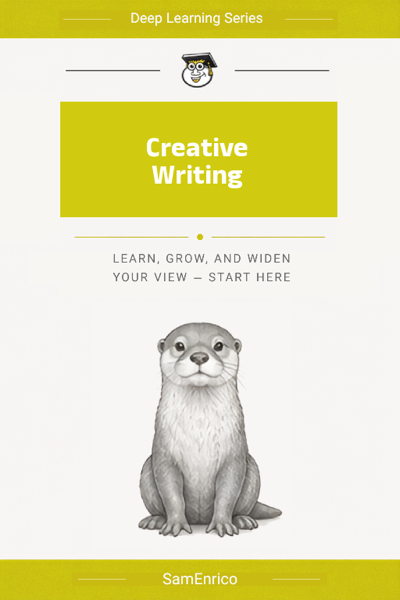
Non-FictionInformativeEducational
Creative Writing eBook
A Coursebook on Creative Writing
by Himes Dean
A Coursebook on Creative Writing
Formats
Free sample
Chapter 1: The Permission to Suck...--Every aspiring writer I have ever met—and I have met hundreds in workshops, classrooms, and coffee shops—carries the same secret terror. It hides behind the confident questions about plot structure and character arcs. It lurks beneath the casual mentions of Murakami and Morrison. And it sounds something like this: What if I sit down to write and nothing comes out? What if the thing I produce is so embarrassing that it proves, once and for all, that I am not a real writer?Let me tell you a story.
When I was twenty-two years old, freshly graduated from a creative writing program where I had been told I had “potential” (a word that should come with a warning label), I submitted a short story to one of the most prestigious literary journals in the country. I had worked on that story for six months. I had rewritten the opening paragraph thirty-seven times. I had shown it to my most honest friend, who said it was “really something,” which I chose to interpret as praise rather than the diplomatic evasion it almost certainly was.The rejection came back six weeks later. It was not a form letter.
Someone had taken the time to write a single sentence in the margin, in handwriting I still remember as being aggressively loopy: “No. Just… no.”I did not write another word for two years.Not because I lacked ideas. Not because I didn’t have time. Not because I hadn’t read enough craft books (I had read them all). I stopped writing because I had absorbed a toxic lie about what writing was supposed to feel like.
I believed that real writers were visited by inspiration like a divine lightning bolt. I believed that first drafts should be good—or at least not humiliating. I believed that the voice in my head that said “this is garbage” was telling me the truth.That voice, as it turns out, is a liar. And this chapter is designed to prove it.The Muse Is a Story We Tell Ourselves (And It's Not Helping)The Romantic myth of the writer—the solitary genius, the midnight oil, the fevered inspiration—is one of the most destructive legacies of literary culture. It makes us believe that writing is a mystical act rather than a craft.
It convinces us that if the words do not flow effortlessly, we are impostors. And it quietly omits the most important truth about every writer you have ever admired: they all wrote thousands of terrible sentences before they wrote a good one.Let’s look at the evidence. We know that Maya Angelou rented a hotel room and wrote on legal pads from six in the morning until two in the afternoon. Every day. She did not wait for the muse.
She showed up, and the muse—whatever that even means—learned to show up too. We know that Stephen King writes 2,000 words every single day, including Christmas. He has described the process as “a job,” which sounds unglamorous until you realize that treating writing as a job is the only way to ensure you actually do it. We know that Toni Morrison wrote Beloved while working as a full-time editor and raising two children as a single mother. She woke up at four in the morning to write.
The muse was not a lightning bolt; it was a clock radio.The research on creativity backs this up. Psychologist Dean Keith Simonton, who has spent his career studying creative genius, found that the single best predictor of creative output is not IQ, not education, not personality type. It is quantity of work. The most creative people produce the most stuff, most of which is mediocre. The difference between the genius and the amateur is not that the genius never writes garbage.
It is that the genius writes enough garbage that eventually, statistically, some of it turns out to be valuable.Consider the case of the composer Wolfgang Amadeus Mozart, who is often held up as the archetype of the effortless genius. Simonton analyzed Mozart’s catalog and found that the works we consider masterpieces appear only after hundreds of compositions. The young Mozart wrote plenty of forgettable music. We just don’t remember it because no one performs the early stuff. The same is true of every writer.
The published novel is the tip of an iceberg. Beneath the waterline are thousands of pages of false starts, abandoned drafts, and sentences that will never see the light of day.Terminology note: The word inspiration (see Glossary) appears throughout this chapter. In the Romantic tradition, inspiration was something that happened to the writer—a visitation. In this book, we will redefine inspiration as the byproduct of regular, disciplined engagement with language and observation. You do not wait for inspiration.
You create the conditions in which inspiration becomes possible. That is a radically different model, and it is the first mindset shift this book asks you to make.The Two Components of a Sustainable Writing Life: Discipline and Observation If the muse is a lie, what actually works? Based on decades of research into creative habits and hundreds of interviews with working writers, two practical pillars support every sustainable writing life. The first is discipline—the ability to show up even when you don’t feel like it. The second is observation—the ability to see the world with the kind of attention that generates material worth writing about.Discipline: The Art of Showing Up Discipline is not the same thing as suffering.
Many aspiring writers believe that if they are not miserable, they are not working hard enough. This is nonsense. Discipline is simply the practice of keeping appointments with yourself. You do not need to write for four hours a day. You do not need to write at dawn.
You do not need a special desk, a special pen, or a special room. You need fifteen minutes. That’s it.Fifteen minutes a day of writing—real writing, not planning or researching or organizing—adds up to ninety hours a year. Ninety hours is enough to draft a short story every six weeks, or a novel in two years. But the real benefit of the fifteen-minute habit is not the quantity of words.
It is the psychological shift that occurs when you stop identifying as “someone who wants to write” and start identifying as “someone who writes.” The habit makes the identity. The identity does not create the habit.Here is how to build the fifteen-minute habit, drawn from the research of psychologist B.J. Fogg, who studies behavior design:Anchor the new habit to an existing one. Do not try to “find time” to write. Attach writing to something you already do every day.
Examples: “After I brush my teeth, I will write for fifteen minutes.” “After I finish my first cup of coffee, I will write for fifteen minutes.” “After I put the kids to bed, I will write for fifteen minutes.” The anchor is the trigger.Make the habit absurdly easy. Fifteen minutes is the maximum on hard days. On most days, set a…
This is the end of the free sample. Get the eBook to keep going. Buy now
About this book
Details
- Author
- Himes Dean
- Publisher
- SamEnrico
- Language
- English
- Genre
- Non-Fiction, Informative, Educational
- Released
- 2026-06-03
- Pages (approx.)
- 137
- Available as
- eBook, Audiobook

Read better in the ZLOADR app
Your eBooks on your phone or tablet. Sign in with your SamEnrico account and start reading.
More by Himes Dean
 Lucid Dreaming For Nightmare Control CourseHimes Dean$11.99
 Trauma Based Anger TriggersHimes Dean$11.99
 The Teen Self Esteem Coaching GuideHimes Dean$11.99
 Creator Morning RoutineHimes Dean$11.99
 The Bullying Self Esteem RecoveryHimes Dean$11.99
 The Iron Protocol: Prussia's Pandemic DefenseHimes Dean$11.99
 Executive Summary AI Writing GuideHimes Dean$12.99
 Apple Ecosystem GuideHimes Dean$12.99Apple Ecosystem GuideHimes Dean$12.99
 How to Start a Balloon (not Toy) Business (Beginners Guide)Himes Dean$11.99
 Understanding ProgeriaHimes Dean$17.99
You may also like
 Hong Kong Handover 1997Dunn Johnnie$11.99
 Zumba For Postnatal Recovery CourseNeal Christian$11.99
 Zumba for BeginnersLadner Nikia$11.99
 YouTube Comment Mining GuideHumes Pandora$12.99
 Worry Box MeditationCarlin Rudy$11.99
 Workplace Stress MeditationNguyen Lynn$11.99
 Workplace Stress and Sleep RepairHawley Ivory$11.99
 Workplace Perfectionism CureDelaney Jeffry$11.99
 Workplace Injustice Anger GuideWallen Isabelle$11.99
 Work Addiction and Burnout LinkGreenwood Ester$11.99
 Women in Yoga and WellnessBeattie Galina$11.99
 Women in Stand Up ComedyChun Evangeline$11.99