
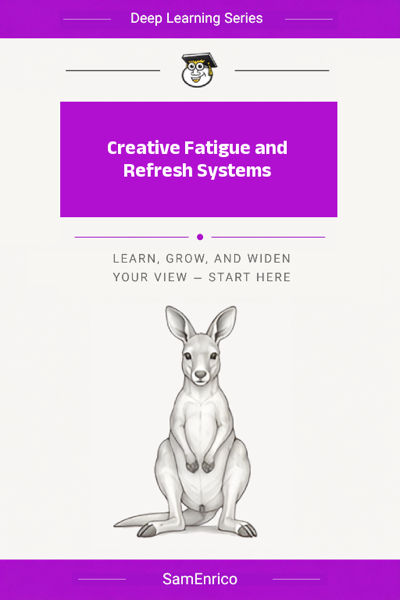
Non-FictionInformativeEducational
Creative Fatigue and Refresh Systems eBook
A Coursebook on Creative Fatigue and Refresh Syste
A Coursebook on Creative Fatigue and Refresh Systems
Formats
Free sample
Chapter 1: The Infinite Lie--–- Every creative professional I have ever worked with believes, deep down, that their creativity is different. It is supposed to be infinite. It is supposed to flow like a river, generate like a star, renew like a forest after rain. And when it doesn't—when the ideas stop coming, when the energy collapses, when the page stays blank—they believe something is wrong with them.That belief is the most dangerous myth in creative work.I have sat across from brilliant designers who cannot open their own portfolios without nausea. I have spoken with writers who have won awards and now stare at cursors for hours, producing nothing.
I have coached software engineers who once built entire systems in weekends and now cannot debug a single function without exhaustion. Every single one of them said the same thing: "I used to be creative. Now I'm just tired. And I think I've lost it forever."They had not lost it. They had withdrawn more creative energy than they had deposited.
And no one had ever taught them that creativity runs on a battery.The Energy Investment Theory Here is the foundational truth of this entire book: every creative act is a withdrawal from a finite battery. Every idea generated, every problem solved, every sentence written, every design drafted, every strategy formulated—every single one of these actions consumes energy. Not metaphorical energy. Biological energy. Neurological energy.
The same energy that powers your heartbeat, your digestion, your immune system, and your ability to walk up a flight of stairs.You cannot withdraw without depositing. This is not philosophy. This is physiology.For years, I believed the opposite. I was raised on the romantic myth of the tortured artist—the genius who sacrifices sleep, health, and relationships on the altar of creativity. The writer who drinks whiskey until dawn.
The musician who channels pain into beauty. The entrepreneur who works one hundred-hour weeks and calls it passion. These stories are seductive because they make suffering seem noble. They make burnout feel like proof of commitment.They are also wrong.The research on elite performers tells a very different story. Anders Ericsson's landmark study of violinists at Berlin's Academy of Music found that the best players did not practice more hours per day than the good players.
They practiced in focused sprints of about ninety minutes, and crucially, they practiced less total time because they rested more deliberately. The top performers averaged about four hours of deliberate practice per day. The rest was recovery. Sleep. Naps.
Walks. Social time. Deliberate rest.The same pattern appears in chess grandmasters, Olympic athletes, Nobel laureates, and Pulitzer Prize winners. They do not grind until collapse. They oscillate.
They work, then rest. They expend, then replenish. And they have learned—often through painful experience—that the battery is real.Why Time Management Fails Creatives Let me say something that might sound controversial but is simply true: time management is a trap for creative people.Think about every productivity system you have ever encountered. The Pomodoro Technique. Getting Things Done.
The Eisenhower Matrix. Time blocking. The eighty-twenty rule. What do they all assume? They assume that if you manage your hours correctly, you will get more done.
They assume that time is the limiting factor.It is not.Energy is the limiting factor. And energy does not follow a clock. It follows a wave.I can sit at my desk for eight hours and produce nothing of value if my energy is depleted. I can sit for ninety minutes at my peak energy hour and produce a week's worth of work. The difference is not time management.
The difference is energy management.Here is the distinction that will transform how you think about creative work:Time management is linear, clock-based, and industrial. It asks: "How many hours can I squeeze from my day?" It treats humans like machines. It assumes that output is proportional to hours worked. It leads to burnout, because it ignores the biological reality that human beings are not assembly lines.Energy management is oscillatory, biological, and cyclical. It asks: "At what point in my cycle am I most creative, and when should I rest?" It treats humans like living organisms.
It assumes that output is proportional to energy invested per unit of time, not time alone. It leads to sustainable creativity, because it works with biology instead of against it.Every creative professional who has burned out—and I have worked with hundreds—was practicing time management. Every creative professional who has produced consistently for decades was practicing energy management. The difference is not subtle. It is the difference between a forest that burns and a forest that renews.The Circuit and the Battery Let me give you a more precise metaphor, because the battery alone is not enough.Imagine your creative system as a battery connected to a circuit.
The battery holds your energy. The circuit is everything else: your habits, your boundaries, your environment, your beliefs, your relationship to work and rest, your nervous system's baseline state, your relationship to your devices, your internal stories about failure and success.Most people focus only on the battery. They say: "I am tired. I need a vacation. I need a break.
I need to recharge." So they take a week off. They go to the beach. They sleep in. They disconnect.And then they return to work, and within three days, they are exhausted again.Why? Because they did not change the circuit.Pausing the battery does nothing to fix a broken circuit.
If your habits drain you faster than you can replenish, a vacation is just a pause button. If your boundaries are nonexistent, a week of rest is just a delay before the next invasion. If your environment is designed for distraction, a break is just a reset to the same broken default. If your nervous system is locked in chronic stress, a few days of relaxation will not rewire it.A vacation is a pause. Rewiring the circuit is a change.This book is about rewiring the circuit.
The battery matters, and we will talk about replenishing it. But if you only learn to rest without learning to change the conditions that exhaust you, you will be a well-rested person in a burning building. You will crash again. And you will believe the crash is your fault.It is not your fault. It is the circuit.The Three States: Empty, Fumes, and Flow Before we go further, you need to know where you are right now.
Not where you want to be. Not where you used to be. Where you are today.Based on my work with thousands of creative professionals, creative energy exists in three distinct states. Each state requires a different strategy. Each state has its own warning signs.
And most people misdiagnose themselves, which is why most recovery efforts fail.State One: Flow Flow is the state of sustainable oscillation. In Flow, you work hard and rest deliberately. You experience periods of deep focus followed by genuine recovery. You wake up with energy most days. You have occasional low-energy days, but they are the exception…
This is the end of the free sample. Get the eBook to keep going. Buy now
About this book
Details
- Author
- Grayson Rosalba
- Publisher
- SamEnrico
- Language
- English
- Genre
- Non-Fiction, Informative, Educational
- Released
- 2026-06-02
- Pages (approx.)
- 129
- Available as
- eBook, Audiobook

Read better in the ZLOADR app
Your eBooks on your phone or tablet. Sign in with your SamEnrico account and start reading.
More by Grayson Rosalba
 The AgTech Capital Allocation GuideGrayson Rosalba$11.99
 Loneliness Phone Call GuideGrayson Rosalba$11.99
 Cross Industry Relationship BuildingGrayson Rosalba$11.99
 Hard Talks HandbookGrayson Rosalba$11.99
 Wholesaling Investor MeetupsGrayson Rosalba$11.99
 The Search Team DisappearanceGrayson Rosalba$11.99
 Trial Of The Antwerp GangGrayson Rosalba$11.99
 Pull Over Reset GuideGrayson Rosalba$11.99
 CrossFit Sandbag Training GuideGrayson Rosalba$11.99
 The Last Empress: How a Teenage Girl Ruled an EmpireGrayson Rosalba$11.99
 The Jade Emperor's Forgotten Dragon: A Celestial Mentor's RiseGrayson Rosalba$11.99
 The Silent Heist: How a Teen Hacker Stole $50 Million in BitcoinGrayson Rosalba$11.99
You may also like
 Hong Kong Handover 1997Dunn Johnnie$11.99
 Zumba For Postnatal Recovery CourseNeal Christian$11.99
 Zumba for BeginnersLadner Nikia$11.99
 YouTube Comment Mining GuideHumes Pandora$12.99
 Worry Box MeditationCarlin Rudy$11.99
 Workplace Stress MeditationNguyen Lynn$11.99
 Workplace Stress and Sleep RepairHawley Ivory$11.99
 Workplace Perfectionism CureDelaney Jeffry$11.99
 Workplace Injustice Anger GuideWallen Isabelle$11.99
 Work Addiction and Burnout LinkGreenwood Ester$11.99
 Women in Yoga and WellnessBeattie Galina$11.99
 Women in Stand Up ComedyChun Evangeline$11.99