
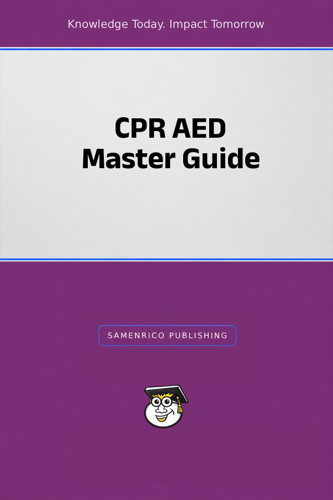
Non-FictionHealth & WellnessComplete
CPR AED Master Guide Audiobook
Complete reference for cardiac arrest response.
Complete reference for cardiac arrest response.
Formats
Free sample
Chapter 1: The Golden Minute--–- On a Tuesday morning in downtown Seattle, a 58-year-old accountant named David collapsed in the middle of a crosswalk. His heart, which had been beating steadily for over two billion times, suddenly erupted into chaos—quivering like a bag of worms instead of pumping blood. He was, by any clinical definition, dead. Across the street, a barista who had taken a CPR course six years earlier saw David fall. She hesitated for seven seconds.
Then she ran. Those seven seconds of hesitation, followed by action, would determine whether David walked out of a hospital or left in a body bag. This chapter is about why those first sixty seconds matter more than any other minute in medicine—and why understanding that single fact will transform you from a bystander into a rescuer.The Misconception That Kills Before we discuss what to do, we must first understand what sudden cardiac arrest actually is—because most people get it wrong, and that misunderstanding costs lives.Ask any ten people on the street what a heart attack is, and nine will give you a reasonably accurate answer: blocked artery, chest pain, maybe an angioplasty. Ask those same ten people what sudden cardiac arrest is, and you will hear a cascade of confusion. Some will say it is the same thing as a heart attack.
Others will describe a "massive heart attack" or "the big one." Almost no one will correctly identify cardiac arrest as an electrical problem—a malfunction of the heart's wiring rather than its plumbing.This distinction is not academic. It is the difference between a patient who is awake and talking (heart attack) and a patient who is dead without immediate intervention (cardiac arrest). Understanding this difference means understanding why you, the rescuer, are the single most important factor in whether someone survives.The Plumbing Analogy: A heart attack, medically known as a myocardial infarction, occurs when one of the coronary arteries—the blood vessels that supply oxygen-rich blood to the heart muscle itself—becomes blocked, usually by a cholesterol-laden plaque that ruptures. The heart muscle downstream of that blockage begins to die from lack of oxygen. This causes crushing chest pain, often radiating to the left arm or jaw, along with shortness of breath, nausea, and sweating.
But here is the crucial point: the heart usually keeps beating during a heart attack. The electrical system remains intact…
This is the end of the free sample. Get the Audiobook to keep going. Buy now
About this book
Details
- Author
- Parsons Eleanor
- Publisher
- SamEnrico
- Language
- English
- Genre
- Non-Fiction, Health & Wellness, Complete
- Released
- 2026-06-06
- Pages (approx.)
- 147
- Available as
- eBook, Audiobook

Listen in the VoxFlicks app
Audiobooks and audio dramas wherever you go. Sign in with your SamEnrico account and press play.
More by Parsons Eleanor
 Withdrawal for Liver Disease PatientsParsons Eleanor$11.99
 Priority Planner HandbookParsons Eleanor$11.99
 Shoulder and Neck ReleaseParsons Eleanor$11.99
 DBT Skills Group GuideParsons Eleanor$11.99
 Empathic Listening WorkbookParsons Eleanor$11.99
 Empathy in HealthcareParsons Eleanor$11.99
 Remote Work for DevelopersParsons Eleanor$11.99
 The Sage of Timbuktu: Al-Maghili and the Philosophy of JusticeParsons Eleanor$11.99
 Benjamin West: The Painter Who Captured America’s RevolutionParsons Eleanor$11.99
 How to Produce ICE ScoopsParsons Eleanor$11.99
 WIPO Madrid Member Countries MapParsons Eleanor$12.99
 International Student SupportParsons Eleanor$12.99
You may also like
 Hong Kong Handover 1997Dunn Johnnie$11.99
 Zumba For Postnatal Recovery CourseNeal Christian$11.99
 Zumba for BeginnersLadner Nikia$11.99
 YouTube Comment Mining GuideHumes Pandora$12.99
 Worry Box MeditationCarlin Rudy$11.99
 Workplace Stress MeditationNguyen Lynn$11.99
 Workplace Stress and Sleep RepairHawley Ivory$11.99
 Workplace Perfectionism CureDelaney Jeffry$11.99
 Workplace Injustice Anger GuideWallen Isabelle$11.99
 Work Addiction and Burnout LinkGreenwood Ester$11.99
 Women in Yoga and WellnessBeattie Galina$11.99
 Women in Stand Up ComedyChun Evangeline$11.99