
Non-FictionSelf-HelpActive ListeningConversation Skills
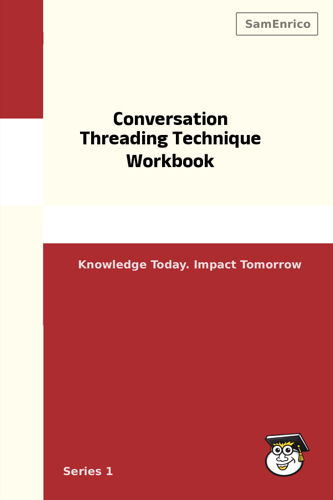
Conversation Threading Technique Workbook eBook
Listen for keywords and extend dialogues naturally
Listen for keywords and extend dialogues naturally by following topic links the other person provides.
Formats
Free sample
Chapter 1: The Silent Epidemic--–- You are standing at a cocktail party. The person across from you just finished a sentence. You heard the words, but your brain is already somewhere else—already calculating your exit, already rehearsing what you will say next, already scanning the room for a more interesting person to talk to. The silence stretches for one second. Then two.
Then someone laughs nearby, and you both glance toward the sound, grateful for the interruption. The conversation dies. Another one bites the dust.This moment is so common that we have stopped noticing it. We call it "awkward silence" or "running out of things to say" or "not clicking." But what if I told you that every single one of those dead conversations was killed by a predictable, fixable error? What if the problem is not that you are boring, not that they are boring, not that you have nothing in common, but that you were never taught the most basic mechanical skill of human conversation?You were taught to ride a bike.
You were taught to write a thank-you note. You were probably even taught how to make eye contact during a job interview. But no one ever taught you how to listen for the one word that could turn a dying chat into a two-hour journey. No one taught you how to thread.This book exists to fix that silence.The Anatomy of a Dead Conversation Let us perform an autopsy. Think back to the last time a conversation fizzled.
Maybe it was with a colleague in the elevator. Maybe it was a first date that never became a second. Maybe it was a family dinner where everyone eventually reached for their phones. Replay that moment in your mind. What actually happened?In nearly every case, the conversation followed the same fatal pattern.
Person A spoke. Person B responded not to what Person A said, but to something else entirely—something Person B was already thinking about while Person A was still talking. Then Person A responded to Person B's response, also without listening. Within four exchanges, the two people were having completely different conversations in the same room. Topic hop.
Topic hop. Topic hop. Death.This pattern is so pervasive that communication researchers have given it a name: conversational entropy—the natural tendency for dialogue to break down into unrelated fragments. Studies using recorded conversation analysis have found that the average person lasts only ninety seconds before introducing a topic unrelated to what the other person just said. Ninety seconds.
That is shorter than a pop song. That is less time than it takes to brew a cup of coffee.Here is what that means: you are not bad at conversation because you lack charisma. You are not bad at conversation because you are introverted or awkward or socially anxious. You are bad at conversation because you are doing what every untrained human does—you are hopping from topic to topic like a stone skipping across water, never stopping to see what lies beneath the surface.The good news is that hopping is a habit, not a destiny. And habits can be rewired.The Three Assassins of Conversation Before we can learn to thread, we must name the enemy.
Through decades of communication research and analysis of thousands of recorded conversations, three specific failure modes emerge again and again. I call them The Three Assassins. You will recognize yourself in at least one of them.Assassin One: Interview Mode This is the person who responds to every statement with a fact-based question. "Where do you work?" "How long have you lived there?" "What do you do for fun?" On the surface, this seems polite. You are asking questions!
You are showing interest! But here is the problem: fact-based questions generate fact-based answers, and fact-based answers are dead ends. "I work at a bank." "Three years." "I like hiking." Each answer is a door that closes immediately after opening.Interview Mode kills conversation because it treats the other person as a Wikipedia page to be skimmed rather than a universe to be explored. The interviewer is collecting data, not building connection. And the person being interviewed feels exactly like they are in an interview—performative, pressured, and eager to escape.Assassin Two: Waiting-for-Your-Turn Syndrome This assassin is more subtle.
The person afflicted with this syndrome appears to be listening. They nod. They make eye contact. They even say "mm-hmm" at appropriate intervals. But inside their head, a different movie is playing.
They are not hearing the other person's words; they are rehearsing their own response. They are waiting for a gap—any gap—to jump in with their story, their opinion, their clever observation.Waiting-for-Your-Turn Syndrome is the most common assassin because it feels like engagement. But it is actually the opposite. When you are rehearsing, you are not listening. When you are not listening, you cannot find the thread.
And when you cannot find the thread, you will inevitably hop to whatever you were rehearsing, leaving their last sentence abandoned on the floor.Assassin Three: The Exit Hunter This assassin has already decided the conversation is doomed before it begins. They are constantly scanning for an escape route—a glance at the phone, a wave to someone across the room, a sudden urgent need to refill their water glass. The Exit Hunter treats conversation as a trap to be avoided rather than a door to be opened. Their body language telegraphs boredom even when their words say "tell me more." And because they are not truly present, they miss every thread offered to them.Which assassin lives in you? Be honest.
Most people contain elements of all three, but one tends to dominate. Take a moment to name yours. Write it down if you need to. Because the first step to killing the assassin is recognizing their face.What Threading Actually Is (And Is Not)Now that we have named the problem, let us name the solution. Threading is the act of taking one specific word or phrase the other person just said and making that the entire subject of your next response.
Not the whole sentence. Not the general gist. One word. One phrase. That is your thread.Here is an example.
Someone says: "I just got back from a trip to Japan, and honestly, the thing that surprised me most was how quiet the trains were."Most people will respond in one of three ways. Interview Mode: "Oh, what cities did you visit?" Waiting-for-Your-Turn: "That reminds me of when I took the train in Germany—it was so efficient." Exit Hunter: "Cool. Hey, have you tried the dip?" All three are topic hops. All three kill the thread.A threaded response looks different. It picks one word from their sentence—just one—and builds from there.
"You said 'quiet.' What was that quiet like? Was it peaceful quiet or eerie quiet?" Or: "You said 'surprised'—what were you expecting instead?" Or: "You said 'honestly'—that makes me think there's more to this story. What weren't you expecting to feel?"Notice what happened there. Each threaded response took the speaker's own word and handed it back…
This is the end of the free sample. Get the eBook to keep going. Buy now
About this book
Details
- Author
- Crisp Antonette
- Publisher
- SamEnrico
- Language
- English
- Genre
- Non-Fiction, Self-Help, Active Listening, Conversation Skills
- Released
- 2026-06-10
- Pages (approx.)
- 135
- Available as
- eBook, Audiobook

Read better in the ZLOADR app
Your eBooks on your phone or tablet. Sign in with your SamEnrico account and start reading.
More by Crisp Antonette
 Pet Disturbance Sleep AidCrisp Antonette$11.99
 Chemistry Nobel BreakthroughsCrisp Antonette$11.99
 Parent Death in Indigenous CommunitiesCrisp Antonette$11.99
 Motivational Interviewing WeightCrisp Antonette$11.99
 Baba Yaga’s Unseen Path: The Witch Who Walks Between WorldsCrisp Antonette$11.99
 The Unseen Playbook: How Vince Lombardi Rewrote the Rules of LeadershipCrisp Antonette$11.99
 One Page Social Media WorkbookCrisp Antonette$12.99
 Grant Management SoftwareCrisp Antonette$12.99
 Understanding Glycogenosis Type ViiCrisp Antonette$17.99
 Packaging SpecialistCrisp Antonette$11.99
 How to Start a Hobby in PenpalCrisp Antonette$11.99
You may also like
 Hong Kong Handover 1997Dunn Johnnie$11.99
 Zumba For Postnatal Recovery CourseNeal Christian$11.99
 Zumba for BeginnersLadner Nikia$11.99
 YouTube Comment Mining GuideHumes Pandora$12.99
 Worry Box MeditationCarlin Rudy$11.99
 Workplace Stress MeditationNguyen Lynn$11.99
 Workplace Stress and Sleep RepairHawley Ivory$11.99
 Workplace Perfectionism CureDelaney Jeffry$11.99
 Workplace Injustice Anger GuideWallen Isabelle$11.99
 Work Addiction and Burnout LinkGreenwood Ester$11.99
 Women in Yoga and WellnessBeattie Galina$11.99
 Women in Stand Up ComedyChun Evangeline$11.99