
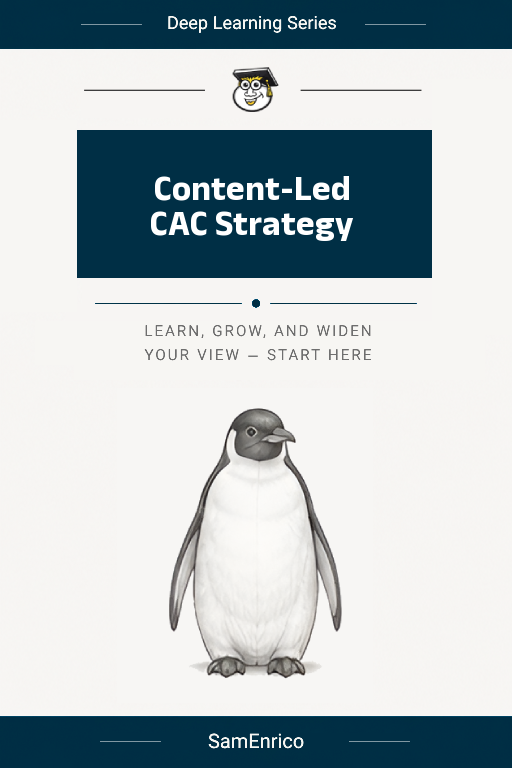
Content-Led CAC Strategy eBook
Drive customer acquisition through high-value cont
Drive customer acquisition through high-value content that attracts and converts without ad spend.
Formats
Free sample
Chapter 1: The Ad Tax--–- In 2015, Alex Kessler celebrated her first profitable month. Her B2B Saa S, a workflow automation tool for small agencies, had generated 47,000inrevenueagainst47,000 in revenue against 47,000inrevenueagainst23,000 in ad spend. A 2x return. She felt like a genius. She doubled down.
By 2017, she was spending 120,000permonthon Facebook,Google,and Linked Inads.Herrevenuehadgrownto120,000 per month on Facebook, Google, and Linked In ads. Her revenue had grown to 120,000permonthon Facebook,Google,and Linked Inads.Herrevenuehadgrownto300,000 monthly. The math still worked—barely. By 2019, something shifted. The same spend generated 310,000.Then310,000.
Then 310,000.Then305,000. Then 290,000.Hercostperleadclimbedfrom290,000. Her cost per lead climbed from 290,000.Hercostperleadclimbedfrom12 to 41.Hercostperdemowentfrom41. Her cost per demo went from 41.Hercostperdemowentfrom89 to 247.Heragencypartnerskeptsaying,"Wejustneedtotestnewcreative,"or"Thealgorithmchanged,"or"Yourcompetitorsincreasedtheirbudgets."By2021,Alexwasspending247. Her agency partners kept saying, "We just need to test new creative," or "The algorithm changed," or "Your competitors increased their budgets." By 2021, Alex was spending 247.Heragencypartnerskeptsaying,"Wejustneedtotestnewcreative,"or"Thealgorithmchanged,"or"Yourcompetitorsincreasedtheirbudgets."By2021,Alexwasspending200,000 per month to generate $210,000 in new revenue.
After salaries, software, and overhead, she was losing money on every customer she acquired. She wasn't a bad marketer. She wasn't running bad ads. She was paying the Ad Tax—and the tax had become confiscatory.This chapter deconstructs the single most dangerous assumption in modern business: that scalable growth requires a massive advertising budget. It argues that the era of "algorithmic arbitrage"—buying cheap clicks and selling expensive products—ended between 2018 and 2022, driven by three irreversible shifts that have permanently changed the economics of customer acquisition.
Most founders haven't noticed because the changes happened gradually, then suddenly. They keep doing what used to work, bleeding margin with every passing month, convinced that they just need to optimize a little more, test a little more, spend a little more.They are wrong. And the math proves it.The Three Crashes That Killed the Click Economy To understand why your ad budget is a trap, you need to understand how the trap was built. From approximately 2008 to 2018, digital advertising operated on a simple, beautiful logic: platforms knew everything about their users, advertisers could target with surgical precision, and the cost of attention was artificially low because the platforms were still fighting for market share. That era is over.
It ended because of three simultaneous crashes.The Privacy Crash. Between 2018 and 2022, every major platform lost its ability to track users across the web. Apple's Intelligent Tracking Prevention (ITP) arrived in 2017 and got progressively stricter with each i OS release. The General Data Protection Regulation (GDPR) hit Europe in 2018, forcing explicit consent for tracking. The California Consumer Privacy Act (CCPA) followed in 2020.
Then, in 2021, Apple dropped the bomb: i OS 14.5 required apps to ask for permission before tracking users across other companies' properties. Opt-in rates hovered around 20-30%. Facebook admitted this single change would cost them $10 billion in annual revenue—revenue that had come directly from advertisers like Alex, who could no longer reliably track whether their ads led to purchases.The result is not just less data. It's fundamentally different data. Pre-2018, you could run a Facebook ad, track exactly which users clicked, which of those users visited your site, which of those visited your pricing page, and which of those purchased.
You could then upload that purchase list back to Facebook to build lookalike audiences. That closed-loop system was the engine of algorithmic arbitrage. Today, that loop is broken. Platforms use statistical modeling—guesses, essentially—to estimate conversions. Your ad manager shows you numbers that look precise but are often off by 30-50%.
You are making million-dollar decisions based on data that is, in many cases, fictional.The Saturation Crash. In 2015, the average Facebook CPM (cost per thousand impressions) was around 3.50.By2020,ithadrisento3.50. By 2020, it had risen to 3.50.By2020,ithadrisento12. By 2025, top-tier audiences regularly exceed $25. The same pattern holds across Google, Linked In, and Tik Tok.
This is not inflation. This is competition. Every business that survived the pandemic learned to run digital ads. Every VC-backed startup raised massive rounds and spent indiscriminately on customer acquisition. Every solo entrepreneur with a credit card watched the same You Tube tutorials and entered the same auctions.Here is the math that should terrify you.
In 2015, you could bid 1.50foraclickonamoderatelycompetitivekeywordandwin801.50 for a click on a moderately competitive keyword and win 80% of auctions. In 2025, that same keyword might have 50 advertisers bidding. The top ten will bid 1.50foraclickonamoderatelycompetitivekeywordandwin808-12 per click. You can choose to match them, in which case your cost per click has increased 5-8x. Or you can bid lower, in which case you lose 95% of auctions and your ads never show.
There is no third option. The platforms have built a sealed auction system designed to extract maximum spend. Every dollar you bid is a dollar the platform captures. The only question is how many dollars your competitors force you to bid.The Creative Fatigue Crash. In the early days of Facebook advertising, a single ad creative could run for months before showing signs of fatigue.
Click-through rates would decay slowly, maybe 10-15% per month. Today, creative fatigue hits in days—sometimes hours. Platforms' algorithms have become extraordinarily efficient at showing the same creative to the same user repeatedly across different placements. That user becomes blind to the ad, stops clicking, and the algorithm penalizes your entire campaign. The result is a constant, exhausting, expensive production treadmill.
To maintain performance, you must produce new creative: new images, new video, new copy, new hooks, new angles. Agencies charge 2,000−10,000percreativevariation.Freelancevideographerscharge2,000-10,000 per creative variation. Freelance videographers charge 2,000−10,000percreativevariation.Freelancevideographerscharge500-1,500 per 15-second spot. Even if you produce in-house, your team's time is not free.Alex, the founder from our opening, calculated her true creative cost in 2022. She was spending 15,000permonthonfreelancerstoproduce20−30advariationsweekly.Only3−4ofthosevariationswouldperformwell.Therestwoulddiewithin48hours.Shewasspending15,000 per month on freelancers to produce 20-30 ad variations weekly.
Only 3-4 of those variations would perform well. The rest would die within 48 hours. She was spending 15,000permonthonfreelancerstoproduce20−30advariationsweekly.Only3−4ofthosevariationswouldperformwell.Therestwoulddiewithin48hours.Shewasspending15,000 per month on creative that produced, on average, 18,000inincrementalrevenue.A18,000 in incremental revenue. A 18,000inincrementalrevenue.A3,000 profit before she paid for the ads themselves. "I am working a full-time job," she told me, "to break even on creative production.
The ads themselves are a separate loss."The Hidden CAC Equation No One Talks About When founders talk about Customer Acquisition Cost (CAC), they typically calculate it as: total sales and marketing spend divided by number of new customers acquired. That equation hides more than it reveals. It lumps together salaries, software, ad spend, creative production, agency fees, and testing costs into a single number. It treats all spend as equal. It assumes that higher spend leads to proportionally higher acquisition.Let's be precise.
True CAC has four components that most founders ignore:The Ad Spend Component. This is the obvious one. The dollars you give directly to Facebook, Google, Linked In, Tik Tok, or any other platform in exchange for impressions, clicks, or conversions. In 2025, for a competitive B2B Saa S category, this component alone ranges from 80−250perqualifiedleadand80-250 per qualified lead and 80−250perqualifiedleadand1,500-5,000 per demo. For e-commerce, customer acquisition costs via Meta ads have risen to 45−80forlow−ticketitemsand45-80 for low-ticket items and 45−80forlow−ticketitemsand150-300 for high-ticket items.…
This is the end of the free sample. Get the eBook to keep going. Buy now
About this book
Details
- Author
- Pagan Kanisha
- Publisher
- SamEnrico
- Language
- English
- Genre
- Non-Fiction, Startup Guide
- Released
- 2026-06-01
- Pages (approx.)
- 143
- Available as
- eBook, Audiobook

Read better in the ZLOADR app
Your eBooks on your phone or tablet. Sign in with your SamEnrico account and start reading.
More by Pagan Kanisha
 Paleo Diet for Binge RecoveryPagan Kanisha$11.99
 Hospital Waiting RoomPagan Kanisha$11.99
 Blue Zone Elder Respect CulturePagan Kanisha$11.99
 Meeting Pre Read Requirement GuidePagan Kanisha$11.99
 The Rolestorming Technique GuidePagan Kanisha$11.99
 The Lion of Rhodes: Constantine XI Palaiologos and the Last Stand of ByzantiumPagan Kanisha$11.99
 How to Start a Photograph Copying Business (Beginners Guide)Pagan Kanisha$11.99
 Understanding Wolcott–rallison SyndromePagan Kanisha$17.99
 Founder Depression During LayoffsPagan Kanisha$12.99
You may also like
 Hong Kong Handover 1997Dunn Johnnie$11.99
 Zumba For Postnatal Recovery CourseNeal Christian$11.99
 Zumba for BeginnersLadner Nikia$11.99
 YouTube Comment Mining GuideHumes Pandora$12.99
 Worry Box MeditationCarlin Rudy$11.99
 Workplace Stress MeditationNguyen Lynn$11.99
 Workplace Stress and Sleep RepairHawley Ivory$11.99
 Workplace Perfectionism CureDelaney Jeffry$11.99
 Workplace Injustice Anger GuideWallen Isabelle$11.99
 Work Addiction and Burnout LinkGreenwood Ester$11.99
 Women in Yoga and WellnessBeattie Galina$11.99
 Women in Stand Up ComedyChun Evangeline$11.99