
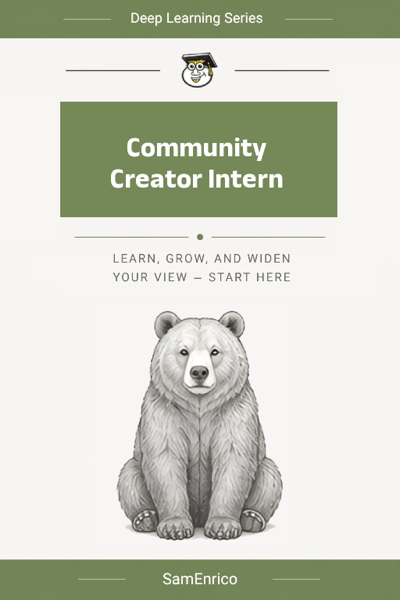
Non-FictionInformativeEducational
Community Creator Intern eBook
A Coursebook on Community Creator Intern
A Coursebook on Community Creator Intern
Formats
Free sample
Chapter 1: The Compass Crisis--The first thing they tell you in community management is a lie.The lie is this: “Build it, and they will come.”No one tells you that “they” might be three bots, your mom, and a guy who posts conspiracy theories about birds. No one tells you that “build it” means inheriting a Discord server with 10,000 members and 12 active users, where the last intern quit after someone doxxed their dog’s Instagram. And no one—absolutely no one—tells you that the most important skill you need isn’t empathy, or writing, or data analysis.It’s knowing when to shut up and listen.This book exists because I learned that lesson the hard way. My name isn’t important, but my disaster is. On my third day as a Community Creator Intern at a mid-sized software company, I launched a “Welcome Wednesday” post in a server that hadn’t seen a human moderator in six months.
I wrote a warm, thoughtful, deeply earnest message asking people to introduce themselves. I used an exclamation point. I used two exclamation points. I believed in the power of belonging.I got zero replies. Not one.
Not even a thumbs-up emoji.What I got instead was a direct message from a user named “Ghost Dog42” that read: “Who the hell are you and why should we care?”That message changed everything. Not because it was cruel—it wasn’t, really. It was honest. Ghost Dog42 had been in that server for two years. They’d watched three previous interns come and go.
They’d seen empty promises, abandoned projects, and a company that treated “community” like a checkbox on a marketing spreadsheet. Why should they care about me? I hadn’t earned it.That moment forced me to ask a question that most community guides ignore: What gives anyone the right to walk into an existing social space and call themselves a leader?The answer, I learned over the next ninety days, is nothing. No one gives you that right. You have to build it, brick by brick, through listening, humility, and the willingness to be wrong.
And you have to start by understanding why community leadership is fundamentally different from every other job you’ve ever had.The First Mistake: Treating Community Like a Channel Most companies don’t understand what a community is. They think it’s a channel—like email, or social media, or a blog. A place to broadcast messages, drive engagement, and collect data. They hire interns like you to “manage” this channel, which usually means posting scheduled content, deleting spam, and reporting “growth” in the form of member counts that mean absolutely nothing.This is catastrophic.A channel is a one-way pipe. You pour content in, and something comes out the other end—clicks, likes, shares, sales.
A community is not a pipe. It is a living system. It has its own culture, its own history, its own grudges. It breathes. It fights.
It ignores you if you’re irrelevant, and it devours you if you’re inauthentic.Here’s the distinction that will save your career: Marketing-led growth treats people as audiences to be converted. Community-led growth treats people as participants to be connected.Marketing says: “We have a message. Let’s find people who will listen.”Community says: “These people already have something in common. Let’s help them talk to each other.”The difference is not subtle. When you approach a community as a marketer, you ask: “What can I get from these people?” When you approach as a community builder, you ask: “What do these people need from each other that I can help provide?”Ghost Dog42 taught me this.
They didn’t need another welcome post. They needed someone to acknowledge that the server had been abandoned, that their contributions had been ignored, that the company saw them as free labor disguised as “engagement.” They needed someone to listen before speaking.So that’s what I did. I didn’t post anything for the next seven days. I just watched.The Three Pillars You Cannot Ignore After that first humiliating week, I started reading everything I could find about community building. The best book I discovered was The Business of Belonging by David Spinks, and it introduced me to a framework that became my operating system: the three pillars of belonging.Every healthy community rests on three foundations.
If any one is missing, the community will eventually collapse.Pillar One: Connection Connection is the feeling that you are not alone. That other people share your interests, your struggles, your questions. This is the easiest pillar to see but the hardest to build authentically. Connection doesn’t come from icebreaker threads or “introduce yourself” prompts. It comes from shared vulnerability—moments when someone admits they don’t know something, and someone else says, “I didn’t either, until last week.”In my silent week of listening, I noticed that connection happened most often in the aftermath of failure.
Someone would post about a bug they couldn’t fix, and three other users would chime in with their own similar bugs. The conversation wasn’t about solutions—it was about solidarity. “Same here” was the most powerful phrase in the entire server.Pillar Two: Purpose Purpose answers the question: “Why are we all here?” Without purpose, a community is just a chat room where people kill time. With purpose, a community becomes a force—a group of people aligned around a shared goal, whether that’s mastering a software tool, raising children with less anxiety, or building an open-source project.The server I inherited had lost its purpose. It was originally created for beta testers of our product, but the beta had ended two years ago.
No one had updated the purpose, so the remaining members had invented their own: complaining about the product. Every day, the same five people posted the same five complaints, and no one from the company responded. The purpose had become “vent here because no one is listening.”Pillar Three: Safety Safety is the most overlooked pillar. It’s not just about banning harassment (though that matters). It’s about psychological safety—the confidence that you can ask a stupid question, share a half-formed idea, or admit you’re struggling without being mocked, ignored, or punished.In that abandoned server, safety was shattered.
The active members had developed a culture of sarcasm and gatekeeping. New users who asked basic questions were met with “Did you even read the docs?” The last intern had tried to enforce a code of conduct, but without consistent moderation, the rules were just words on a screen. Safety isn’t a document. It’s a pattern of behavior that you model, reward, and protect.When I finally understood these three pillars, I realized my job wasn’t to “manage” anything. My job was to diagnose which pillar was weakest and strengthen it, one small intervention at a time.Why Seth Godin Is Right (And Wrong) About Tribes Seth Godin’s Tribes is required reading for anyone in community work, and for good reason.
Godin argues that a tribe is any group of people connected to one another, a leader, and an idea. He…
This is the end of the free sample. Get the eBook to keep going. Buy now
About this book
Details
- Author
- Gallant Jammie
- Publisher
- SamEnrico
- Language
- English
- Genre
- Non-Fiction, Informative, Educational
- Released
- 2026-05-04
- Pages (approx.)
- 143
- Available as
- eBook, Audiobook

Read better in the ZLOADR app
Your eBooks on your phone or tablet. Sign in with your SamEnrico account and start reading.
More by Gallant Jammie
 Medical Imposter Syndrome GuideGallant Jammie$11.99
 Bipolar And Seasonal PatternsGallant Jammie$11.99
 SOAR Automation ReviewGallant Jammie$11.99
 The Teen Bullying Recovery GuideGallant Jammie$11.99
 The Night Eating Syndrome GuideGallant Jammie$11.99
 Silent Shadows: The Vanished Spy Who Never ExistedGallant Jammie$11.99
 Search Console Redirect ReportGallant Jammie$12.99
 ASC Aquaculture Export GuideGallant Jammie$12.99
 Understanding Premature AgingGallant Jammie$17.99
 How to Start a Chicory Root Drying Business (Beginners Guide)Gallant Jammie$11.99
You may also like
 Hong Kong Handover 1997Dunn Johnnie$11.99
 Zumba For Postnatal Recovery CourseNeal Christian$11.99
 Zumba for BeginnersLadner Nikia$11.99
 YouTube Comment Mining GuideHumes Pandora$12.99
 Worry Box MeditationCarlin Rudy$11.99
 Workplace Stress MeditationNguyen Lynn$11.99
 Workplace Stress and Sleep RepairHawley Ivory$11.99
 Workplace Perfectionism CureDelaney Jeffry$11.99
 Workplace Injustice Anger GuideWallen Isabelle$11.99
 Work Addiction and Burnout LinkGreenwood Ester$11.99
 Women in Yoga and WellnessBeattie Galina$11.99
 Women in Stand Up ComedyChun Evangeline$11.99