
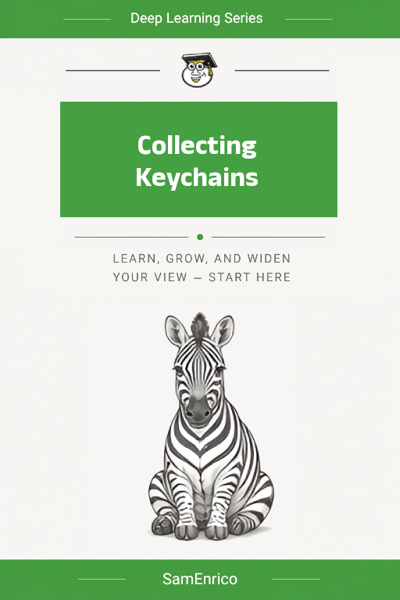
Non-FictionInformativeEducational
Collecting Keychains eBook
A Coursebook on Collecting Keychains
A Coursebook on Collecting Keychains
Formats
Free sample
Chapter 1: The Pocket-Sized Universe...--Every human being on earth who owns a set of keys is, whether they know it or not, a keychain collector. The cheap plastic logo from a bank that closed a decade ago, the faded Eiffel Tower from a trip you barely remember, the scratched leather fob your father carried until the day he died—these are not clutter. They are artifacts. They are the most intimate, most handled, most overlooked objects in your daily life. And they are screaming to tell you their stories.This chapter is not about how to find rare keychains at estate sales, nor about the chemical composition of celluloid versus early Bakelite.
Those lessons arrive in later chapters. Instead, this chapter asks a more fundamental question: Why does any of this matter? Why would a sane adult spend time, money, and mental energy accumulating small metal and plastic tokens designed to hold keys? The answer, it turns out, runs deeper than nostalgia and richer than mere hobbyism. To collect keychains is to engage in one of the last remaining forms of democratic, portable, deeply personal museum-building available to ordinary people.Consider the sheer ubiquity of the keychain.
Nearly two billion keychains are produced globally each year, according to industry estimates, yet almost no academic or popular literature exists about them. They are the invisible infrastructure of everyday life. A keychain touches your hand multiple times per day—when you leave home, when you return, when you start your car, when you open your office. That constant physical contact creates a relationship unlike any other collectible. Stamps live in albums.
Coins live in velvet trays. Figurines live behind glass. But keychains live in your palm, jangling against your hip, warming to your body temperature, wearing down in the exact pattern of your grip.This chapter explores the psychology, the hidden history, and the surprising emotional architecture of keychain collecting. By the end, you will never look at your key ring the same way again.The Archaeology of the Everyday Every keychain is a miniature time capsule. Unlike a photograph, which captures a single frozen moment, a keychain captures a continuum—the years of use, the scratches from being dropped on pavement, the faded lettering from thousands of pocket insertions.
Archaeologists call this kind of object a "primary source artifact," something that was never intended for preservation but nonetheless carries the fingerprints of daily life.Think of the souvenir keychain from the 1964 World's Fair in New York. When it was new, it was cheap merchandise, mass-produced for pennies, handed out or sold to millions of visitors. The manufacturers expected most to break within months. But the ones that survived tell us something that no official history book can: they tell us what people actually valued enough to keep. They tell us about the materials available to mid-century mass production.
They tell us about the aesthetic preferences of the average American family in the 1960s—preferring bright enamel, state shapes, and whimsical figural designs over the minimalist metal fobs of today.The keychain collector, therefore, is not merely an accumulator of small objects. The collector is an accidental archaeologist, assembling a private museum of ordinary life. This is the first and most important distinction between keychain collecting and more prestigious hobbies. Stamp collecting is the pursuit of official government-issued artifacts, designed for beauty and rarity from the start. Coin collecting is the pursuit of state-sanctioned currency, graded by professional services, bought and sold at auction houses with centuries of history.
Keychain collecting is messier, more democratic, and arguably more honest. No one ever designed a keychain to be collected. They were designed to be used, lost, and forgotten. Their survival is an accident of sentimental stubbornness.The Emotional Architecture of Pocket Objects Psychologists have long studied what they call "attachment to ordinary objects." The phenomenon is not limited to hoarders or the elderly. Consider the following: a 2019 study from the University of California, Berkeley found that over 80 percent of adults reported having at least one small, portable object they would be upset to lose—and that object was most commonly a keychain or a key fob.
This attachment is not rational. A keychain has no intrinsic monetary value in most cases. It cannot be traded for food or shelter. And yet the thought of losing it produces a measurable stress response.Why? Because keychains function as what the psychologist D.W.
Winnicott called "transitional objects"—items that bridge the gap between the self and the outside world. A child's stuffed animal is the classic example: it carries the smell of home into the陌生的 space of a new school. A keychain does the same thing for adults. When you leave your house, you take a piece of your domestic life with you, coiled around the keys that lock your front door. The keychain is the anchor.
It says, no matter how far I travel, something from home is still in my hand.This emotional function explains why keychain collecting feels different from other collecting hobbies. A coin collector rarely carries their best coins in their pocket. A stamp collector would never glue a rare issuance to an envelope and mail it across the country. But keychain collectors almost always carry at least one piece from their collection daily. The collection is not separate from life.
It is embedded in life. This creates a unique dynamic: the collector is simultaneously the curator and the primary wear-and-tear agent. You are not preserving your keychains for future generations in a hermetically sealed case. You are living with them. And that is exactly the point.The Three Tribes of Keychain Collectors Through interviews with hundreds of collectors across the United States, Europe, and Japan, this book has identified three primary motivational tribes.
Understanding which tribe you belong to—or whether you are a hybrid—will shape every subsequent decision about what to collect, how much to spend, and how to display your finds.The Memorialists collect keychains as memory anchors. For them, each keychain is attached to a specific place, person, or period of life. A Memorialist might have a keychain from every vacation they have ever taken, or a keychain from every car they have ever owned, or a keychain that belonged to a deceased relative. The value is entirely sentimental. These collectors rarely sell pieces and rarely care about market prices.
Their collecting rule is simple: if it reminds me of something important, I keep it. Memorialists are the largest tribe, probably representing 60 to 70 percent of all people who own multiple keychains. Many do not even identify as collectors. They just never throw things away.The Aesthetes collect keychains for their design, material, or craftsmanship. They are drawn to unusual shapes, rare materials, or particular eras.
An Aesthete might collect only keychains made of sterling silver, or only keychains shaped like animals, or only keychains from the Art Deco period. Unlike Memorialists, Aesthetes are willing to buy keychains that have no personal connection to their own lives. They are curators of beauty and strangeness. They are also the most likely to display their collections openly, framing keychains on walls or arranging them in shadow boxes.The Treasure…
This is the end of the free sample. Get the eBook to keep going. Buy now
About this book
Details
- Author
- Carder Carylon
- Publisher
- SamEnrico
- Language
- English
- Genre
- Non-Fiction, Informative, Educational
- Released
- 2026-05-08
- Pages (approx.)
- 132
- Available as
- eBook, Audiobook

Read better in the ZLOADR app
Your eBooks on your phone or tablet. Sign in with your SamEnrico account and start reading.
More by Carder Carylon
 EQ Diversity And Inclusion GuideCarder Carylon$11.99
 Rafa Nadal Unbreakable SpiritCarder Carylon$11.99
 Business Model Canvas Team GuideCarder Carylon$11.99
 Sugar Addiction TruthCarder Carylon$11.99
 SAS Mountain Troop TrainingCarder Carylon$11.99
 The Inca’s Lost Heat: How Thermodynamics Shaped Andean SurvivalCarder Carylon$11.99
 Frozen Whispers: The Lost Expedition of the *Franklin*Carder Carylon$11.99
 Remote Skills First GuideCarder Carylon$12.99
 ESL Headset Microphone GuideCarder Carylon$12.99
 How to Become a Jig BuilderCarder Carylon$11.99
 Understanding Gamma-cystathionase DeficiencyCarder Carylon$17.99
You may also like
 Hong Kong Handover 1997Dunn Johnnie$11.99
 Zumba For Postnatal Recovery CourseNeal Christian$11.99
 Zumba for BeginnersLadner Nikia$11.99
 YouTube Comment Mining GuideHumes Pandora$12.99
 Worry Box MeditationCarlin Rudy$11.99
 Workplace Stress MeditationNguyen Lynn$11.99
 Workplace Stress and Sleep RepairHawley Ivory$11.99
 Workplace Perfectionism CureDelaney Jeffry$11.99
 Workplace Injustice Anger GuideWallen Isabelle$11.99
 Work Addiction and Burnout LinkGreenwood Ester$11.99
 Women in Yoga and WellnessBeattie Galina$11.99
 Women in Stand Up ComedyChun Evangeline$11.99