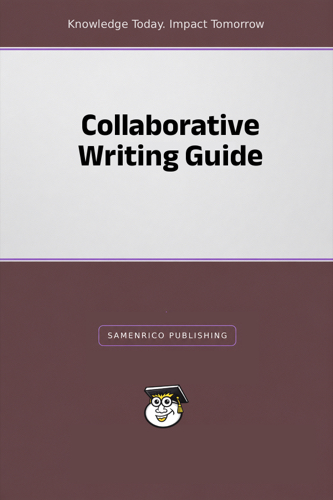
Collaborative Writing Guide eBook
Produce documents and proposals together using ver
Produce documents and proposals together using version control and commenting.
Formats
Free sample
Chapter 1: The $10,000 Attachment--–- The email arrived at 4:47 PM on a Friday. Subject line: "FINAL Proposal - Client ABC - DO NOT EDIT." Attached was a file named Proposal_ABC_Final_v3_REAL.doc. The lead partner opened it, did a final scan, and hit send. The proposal was for $2.1 million. The deadline was midnight.
The team went home exhausted but satisfied. On Monday morning, the client replied: "Thank you, but we've decided to go with another firm." Confused, the partner reopened the sent folder. That's when he saw it. The file he had attached was not the version Legal had approved on Thursday. It was the version from Tuesday—missing the critical liability cap that limited the company's risk to $50,000.
The $50,000 cap had been replaced by unlimited liability. The client's legal team had spotted it immediately and flagged the proposal as amateurish. The deal was dead. The partner's bonus was gone. And the admin who had named the file FINAL_v3_REAL.doc had no idea she had caused any of it.This is not a cautionary tale from 1999.
This happened at a top-ten consulting firm in 2023. The only difference today is the file might be in Google Docs or Share Point instead of an email attachment. The chaos remains the same.The Hidden Mathematics of Collaboration Friction Let us define a term you will see throughout this book: collaboration friction. It is the sum total of all time, energy, and attention wasted not on writing but on coordinating the writing. Every time you ask "Which version is the latest?" you are burning collaboration friction.
Every time you copy a paragraph from an old proposal instead of pulling from a shared library, you are burning collaboration friction. Every time two people edit the same sentence and someone has to manually reconcile the changes, you are burning collaboration friction.Here is the math that keeps executives awake at night. In a 2019 study by the International Data Corporation (IDC), knowledge workers reported spending an average of 2.5 hours per day searching for information, recreating documents, or resolving version conflicts. For a team of ten people earning an average of $50 per hour (fully loaded), that is $1,250 per day, $6,250 per week, $325,000 per year—wasted on nothing productive. And that is a conservative estimate.
Teams working on complex proposals, regulatory filings, or technical documentation often report numbers closer to 40% of their time lost to collaboration friction.But the math gets worse. The hidden costs are larger than the visible ones:Visible Cost Hidden Cost Time spent merging changes Morale loss from repetitive drudgery Missed deadlines Client perception of disorganization Wrong version sent Lost deals (as in the opening story)Duplicate work Talent attrition (good writers quit chaotic systems)The $2.1 million proposal from our opening story did not fail because anyone was incompetent. It failed because the team was using a collaboration system—email attachments and file naming—that was designed for 1995, not 2025. The admin who named the file FINAL_v3_REAL.doc was following the only convention she knew. The partner who attached the wrong file was rushing on a Friday afternoon.
The system set them both up to fail.The Five Symptoms of a Dying Collaboration System How do you know if your team is suffering from chronic collaboration friction? Look for these five symptoms. If you recognize three or more, your team is bleeding time and money.Symptom 1: The Proliferation of "Final" Files Walk through your shared drive or cloud folder. Count how many files contain the word "FINAL" in the name. Then count how many contain "FINAL2," "FINAL_REAL," "FINAL_FINAL," or the particularly desperate "FINAL_USE_THIS_ONE." Each one of these files represents a moment of confusion, a failed handoff, or a writer who gave up on the system.
In one Fortune 500 company we studied, a single project folder contained forty-seven versions of the same document, with names ranging from Draft_v1.doc to FINAL_FINAL_3_REALLY_FINAL.doc. The team could not reliably tell which version was current. So they kept creating new ones.Symptom 2: The "Who Edited This?" Mystery You open a document and see a change you do not recognize. The last modified timestamp shows your colleague's name, but the change was made three days ago, and no one left a comment. You spend fifteen minutes scrolling through the document, comparing it to a printed copy from last week, trying to reverse-engineer what happened.
This is not editing. This is forensics.Symptom 3: The Merge from Hell Two people work on the same document for three hours—one in the morning, one in the afternoon. They save their changes to separate files. On Friday, someone has to open both documents side by side and manually copy every paragraph, every chart, and every formatting change from one into the other. This takes two hours.
During those two hours, three new errors are introduced. The person doing the merge misses a critical change in section 4.2. That error makes it to the client.Symptom 4: The "Where Did That Paragraph Go?" Panic You distinctly remember writing a perfect paragraph about your company's security protocols. It had statistics, a third-party validation, and a beautiful transition. Now it is gone.
Not deleted—just not in the current draft. It might be in a version from last Tuesday. Or in a comment. Or in an email attachment that your colleague sent to herself. You spend forty-five minutes searching.
You never find it. You rewrite it from memory, but it is not as good.Symptom 5: The Post-Mortem Blame Game The proposal is late. The client is annoyed. The team gathers for a post-mortem. Someone says, "I sent my section on time, but I didn't know where to put it." Someone else says, "I thought you were handling the executive summary." The project manager says, "I assumed everyone was using the shared drive." No one is lying.
Everyone is describing the same failure: the absence of a shared, explicit, enforced collaboration system.If you recognize these symptoms, take heart. You are not alone. And the solution is not to work harder. The solution is to work differently.Collaborative Literacy: A New Definition Most people assume that writing is an individual skill. You learn grammar in school.
You learn structure in college. You learn persuasion in business. But almost nowhere—not in high school, not in university, not in corporate training—do we teach people how to write together.This book introduces a new term: Collaborative Literacy. It is the ability to:Share a document with others without losing control of the master version Comment on someone else's work in a way that is clear, actionable, and respectful Accept, reject, or negotiate changes without creating conflict Track who changed what, when, and why Recover from mistakes without drama Work across time zones, departments, and skill levels without friction Collaborative Literacy is not about the tool. Google Docs, Microsoft Word, Git, Dropbox—these are just enablers.
Collaborative Literacy is about the discipline of using those tools together. A team with high Collaborative Literacy can produce a complex proposal in three days with ten contributors. A team with low Collaborative Literacy will take two weeks and still send the wrong…
This is the end of the free sample. Get the eBook to keep going. Buy now
About this book
Details
- Author
- Chambers Sharon
- Publisher
- SamEnrico
- Language
- English
- Genre
- Non-Fiction, Self-Help, Collaborative Writing
- Released
- 2026-06-10
- Pages (approx.)
- 135
- Available as
- eBook, Audiobook

Read better in the ZLOADR app
Your eBooks on your phone or tablet. Sign in with your SamEnrico account and start reading.
More by Chambers Sharon
 PTSD Growth Mindset GuideChambers Sharon$11.99
 Assertiveness for Trauma SurvivorsChambers Sharon$11.99
 The OKR Common MistakesChambers Sharon$11.99
 Mindfulness for ADHD BeginnersChambers Sharon$11.99
 Congo Basin Lost WorldChambers Sharon$11.99
 Slow Driver Patience GuideChambers Sharon$11.99
 Delegation for Construction ManagersChambers Sharon$11.99
 The Sultan’s Whisper: A Djinn’s Bargain in the Sands of TimeChambers Sharon$11.99
 The Moonlit Pact of Otohime and UrashimaChambers Sharon$11.99
 Small Naked Oat: Naked Oat HarvestingChambers Sharon$11.99
 How to Produce PvcChambers Sharon$11.99
 How to Produce Elliptical TrainersChambers Sharon$11.99