
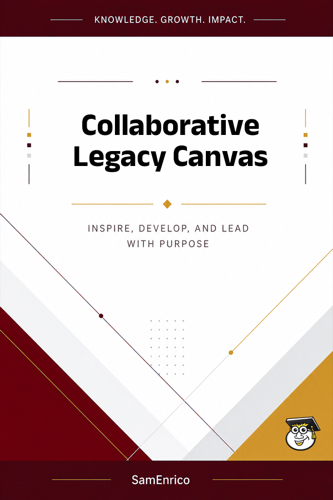
Non-FictionSelf-HelpLegacy Planning
Collaborative Legacy Canvas eBook
Teams envision desired creative impact to reverse-
Teams envision desired creative impact to reverse-engineer actions.
Formats
Free sample
Chapter 1: The Forward Illusion--The会议室 smelled of stale coffee and exhausted ambition. Twelve executives sat around a polished mahogany table, each holding a three-ring binder titled “Strategic Plan 2024-2028.” They had spent four months and $240,000 on this plan. It contained seventy-three KPIs, fourteen strategic pillars, and a Gantt chart so dense it looked like a subway map of Tokyo. The CEO, a woman named Priya who had been hired six months earlier to “disrupt the industry,” waited until the CFO finished his forty-second slide. Then she asked one question.“What in this plan scares us?”Silence.
Then nervous laughter. Then the COO said, “Well, nothing should scare us. That’s why we planned.”Priya closed her binder. “That,” she said, “is exactly why we’re going to fail.”She was right. Eighteen months later, the company missed every single target.
The “disruptive” product launched to a shrug. The Gantt chart was never updated after month four. And the team quietly went back to doing what they had always done: fighting fires, pleasing the loudest stakeholder, and celebrating incremental progress as if it were victory.This book is about what Priya understood that her executive team did not. She understood that most strategic planning is built on a hidden flaw – an invisible bias that guarantees mediocrity. She understood that the only way to build something that outlasts you is to stop planning forward and start winning backward.
And she understood that the first step is not a better spreadsheet or a smarter metric. The first step is admitting that everything you think you know about planning is wrong.The Pipeline That Never Delivers Let me tell you about the Pipeline Fallacy, because until you see it in yourself, you will keep building plans that look impressive and deliver nothing.The Pipeline Fallacy is the seductive belief that a healthy queue of current projects ensures future relevance. It is the assumption that if you keep the machine running – if you feed the hopper with enough initiatives, enough sprints, enough quarterly OKRs – then tomorrow will be a slightly better version of today. It is the logic of the assembly line applied to the chaos of creativity.Here is why it is a fallacy. Every breakthrough work you have ever admired – the first i Phone, the musical Hamilton, the COVID m RNA vaccines – required abandoning the pipeline entirely.
The i Phone was not the next i Pod. Hamilton was not the next Wicked. The m RNA vaccines were not the next flu shot. In each case, the team did not extrapolate from their current resources. They started with a finished masterpiece in their minds and worked backward to the present.
They planned backward. You plan forward. That is the difference between legacy and mediocrity.Consider the story of Blockbuster. In 2000, Blockbuster had a beautiful pipeline. They had thousands of stores, billions in revenue, and a strategic plan that extended five years into the future.
They were the picture of corporate health. When a tiny startup called Netflix offered to sell themselves for $50 million, Blockbuster laughed. Why? Because Netflix did not fit the pipeline. Netflix was a threat to the existing projects, not an extension of them.
Twenty years later, Blockbuster is a footnote and Netflix is a verb. The pipeline that looked so healthy was actually a trap.The Pipeline Fallacy is not about bad execution. It is about bad imagination. It assumes that the future will look like the past, only more efficient. But the future never looks like the past.
The future looks like a surprise that you either saw coming or did not. And you cannot see it coming by staring at your current pipeline. You can only see it by staring at a finished masterpiece that does not exist yet and asking, “What must be true for this to be real?”Andy Warhol, Serena Williams, and the Secret They Share In 1962, Andy Warhol stood in front of a blank canvas. He had been a successful commercial illustrator, but he wanted to make something that would outlive him. He did not start by asking, “What paints do I have?” or “What do galleries want?” He started by visualizing a finished silkscreen of Marilyn Monroe’s face – thirty-two iterations, grid-like, simultaneously reverent and alienating.
He saw the finished wall before he mixed the first color. Then he worked backward: “For that wall to exist, I need silkscreens. For silkscreens, I need photographs. For photographs, I need permissions.” The Marilyn Diptych became one of the most recognizable artworks of the twentieth century. Warhol did not plan forward.
He won backward.Thirty years later, a teenage tennis player named Serena Williams stood on a practice court before a match she had not yet won. She closed her eyes. She visualized the final point – the serve, the return, the crowd’s roar, the feeling of her arm raised in victory. She felt the sweat. She heard the announcer say her name.
She saw the trophy. Then she opened her eyes and worked backward: “For that moment to happen, I need to win this point. For this point, I need my backhand to be perfect. For my backhand, I need to practice for two more hours today.” Serena Williams did not plan forward from her current ranking. She won backward from a future that already existed in her mind.Warhol and Williams share a cognitive habit that most teams lack.
They start with the finished feeling of success – the sensory, emotional, concrete experience of having already achieved the impossible. Then they reverse-engineer the path from that future to the present. This is not visualization as self-help woo. It is a practical, disciplined methodology used by every great creative team in history.Here is the neurological reason it works. When you visualize a finished masterpiece in vivid detail, your brain activates the same neural circuits that fire during actual performance.
This is called functional equivalence. Your brain cannot fully distinguish between a richly imagined experience and a real one. By starting with the finished feeling, you prime your entire cognitive apparatus to recognize opportunities and obstacles that you would otherwise miss. You build a mental model of success so detailed that reality has no choice but to follow.Most teams do the opposite. They start with resources: “What can we do with what we have?” Then they extrapolate: “If we do that, what comes next?” Then they add milestones and KPIs.
This is the Forward Bias – the tendency to project current constraints linearly into the future. The Forward Bias feels responsible. It feels realistic. It is actually the fastest path to irrelevance.The Two Questions That Separate Legends from Also-Rans Every team asks questions. The difference between teams that build legacies and teams that build mediocrity is which questions they ask first.The Mediocre Team’s First Question: “What can we do with what we have?”This question feels prudent.
It respects budgets, timelines, and political realities. It produces plans that are achievable, measurable, and completely forgettable. This question guarantees that you will never build anything that outlasts you, because you have already surrendered to the constraints of the present. You have made your current reality the ceiling…
This is the end of the free sample. Get the eBook to keep going. Buy now
About this book
Details
- Author
- Jacques Marcy
- Publisher
- SamEnrico
- Language
- English
- Genre
- Non-Fiction, Self-Help, Legacy Planning
- Released
- 2026-06-10
- Pages (approx.)
- 133
- Available as
- eBook, Audiobook

Read better in the ZLOADR app
Your eBooks on your phone or tablet. Sign in with your SamEnrico account and start reading.
More by Jacques Marcy
 Intermittent Fasting for WomenJacques Marcy$11.99
 Combat Veteran Nightmare GuideJacques Marcy$11.99
 Teacher and Educator Stress GuideJacques Marcy$11.99
 Lean Startup Validation MethodsJacques Marcy$11.99
 Bipolar Creativity Management GuideJacques Marcy$11.99
 UAE Green Tax IncentivesJacques Marcy$11.99
 TM for ScientistsJacques Marcy$11.99
 HGH Prescription GuideJacques Marcy$11.99
 The Last Emperor of the West: The Rise and Fall of MaxentiusJacques Marcy$11.99
 Silk & Spies: The Secret War of Parisian CoutureJacques Marcy$11.99
 Pharaoh's Shadow: The Lost Tomb of the Forgotten QueenJacques Marcy$11.99
 Growing SaritaeaJacques Marcy$11.99
You may also like
 Hong Kong Handover 1997Dunn Johnnie$11.99
 Zumba For Postnatal Recovery CourseNeal Christian$11.99
 Zumba for BeginnersLadner Nikia$11.99
 YouTube Comment Mining GuideHumes Pandora$12.99
 Worry Box MeditationCarlin Rudy$11.99
 Workplace Stress MeditationNguyen Lynn$11.99
 Workplace Stress and Sleep RepairHawley Ivory$11.99
 Workplace Perfectionism CureDelaney Jeffry$11.99
 Workplace Injustice Anger GuideWallen Isabelle$11.99
 Work Addiction and Burnout LinkGreenwood Ester$11.99
 Women in Yoga and WellnessBeattie Galina$11.99
 Women in Stand Up ComedyChun Evangeline$11.99