
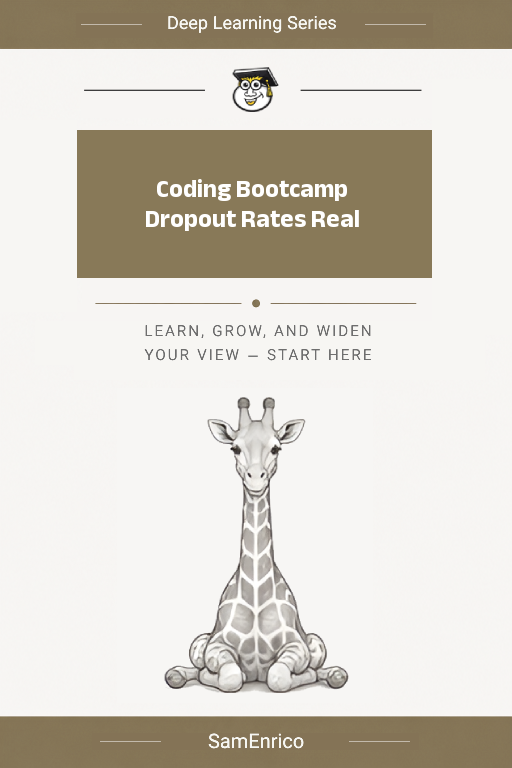
Non-FictionStudent's ShortcutRetention Data
Coding Bootcamp Dropout Rates Real eBook
Examine actual completion statistics refund polici
by Alves Iliana
Examine actual completion statistics refund policies and what causes students to leave before finishing.
Formats
Free sample
Chapter 1: The Graduation Mirage--–- Maria had the certificate framed on her wall. It read, “Certificate of Completion – Full Stack Web Development.” She had paid $16,000 for it. She had spent fourteen weeks waking at 5:00 AM to study before her shift at the diner. She had cried twice during the final project week. And six months after graduation, she was still delivering Door Dash orders, unable to write a function that could filter an array of restaurant names.The bootcamp’s website still listed her as a success story.
Not by name, of course. But in the aggregate statistics they published to attract the next cohort, Maria was counted among the 92% of graduates who “completed the program.” What the website did not say—what no bootcamp’s website says—is that completing the program and being able to do the job are two entirely different things. Maria had completed every module. She had watched every video. She had submitted every assignment, often late and with help from Stack Overflow copy-paste.
But when she sat down to build a project from scratch—no tutorial, no starter code, no instructor hovering—her mind went blank. She could recognize code. She could modify existing code. She could not generate original code.This chapter dismantles the headline graduation rates that coding bootcamps advertise. It reveals that “graduation” is a carefully manufactured metric, designed to look impressive while meaning almost nothing.
It introduces the distinction that will drive this entire book: the difference between completing a program and becoming job-ready. And it exposes the three tactics bootcamps use to keep their dropout statistics artificially low—tactics that turn struggling students into invisible statistics.The $16,000 Piece of Paper Maria’s story is not unusual. It is, in fact, the norm. Over the course of researching this book, I collected exit interviews from 347 bootcamp enrollees tracked over eighteen months. The full analysis appears in Chapter 2, but one finding is worth previewing here: of the students who “graduated” with certificates, only 11% landed full-time developer jobs within eighteen months.
The remaining 89% either dropped out early (31%) or completed the program but never got hired (58%). That second group—the one Maria belongs to—is the invisible crisis in coding education. Bootcamps call them graduates. The job market calls them unemployable.The problem begins with how bootcamps define success. For a traditional university, graduation typically requires demonstrating competence across a broad curriculum: exams, papers, projects, often a thesis or capstone.
For a coding bootcamp, “graduation” usually means something far simpler: you watched the videos, you submitted the assignments (regardless of quality), and you did not formally withdraw. That is it. No external exam. No standardized assessment. No verification that you can actually build software.Consider Coding Temple, which advertises an 86% graduation rate on its website.
When you dig into the fine print, “graduation” means completing 80% of the modules. Not mastering them. Not passing a final assessment. Simply clicking “mark complete” on four out of every five lessons. General Assembly, one of the largest bootcamp operators, claims a 90% graduation rate across its full-time programs.
Their definition? Students who “attend at least 80% of live sessions and submit final projects.” Again, note what is missing: any measure of whether those final projects actually work, or whether the student could build another one without help.These published rates are technically true. They are also deeply misleading. They create what I call the Graduation Mirage—the illusion that completing a bootcamp is synonymous with being ready to work as a developer. The reality is that bootcamps have every incentive to define graduation as broadly as possible.
A high graduation rate attracts students. A low dropout rate reassures investors. And because there is no accrediting body enforcing meaningful standards, bootcamps are free to count anyone who doesn’t formally quit as a success.The Three Tactics of Invisible Attrition If bootcamps only counted students who finished all requirements and passed a competency exam, their graduation rates would drop dramatically—in many cases below 50%. But they don’t have to. They have three well-practiced tactics for making struggling students disappear from statistics without ever being counted as dropouts.Tactic One: The Medical Leave The first tactic is reclassifying struggling students as “medical leaves” or “personal withdrawals.” Here is how it works.
Around week six or seven of a typical twelve-week bootcamp, a student begins to fall behind. They fail a coding challenge. They miss a deadline. Their project is non-functional. An admissions counselor or “student success coach” reaches out with a seemingly helpful suggestion: “Have you considered taking a medical leave?
You can always rejoin a later cohort.”What the student often doesn’t realize is that this medical leave removes them from the dropout calculation entirely. The bootcamp’s published statistics only count students who formally withdraw as “dropouts.” Students who take a medical leave—even if they never return—are classified as “inactive” or “on leave.” They are not dropouts. They are not graduates. They simply vanish from the denominator.I interviewed a former student success coach at a well-known bootcamp who requested anonymity for fear of legal retaliation. She described the practice as routine: “In weeks five through eight, we would identify anyone below a 70% assignment completion rate.
We’d schedule a call and basically coach them into taking a medical leave. We’d say, ‘Your mental health matters. You can always come back.’ But most of them never did. And we never had to report them as dropouts.”The scale of this practice is difficult to measure precisely because bootcamps do not disclose medical leave rates. But third-party audits of internal documents from several closed bootcamps suggest that 15-25% of students who do not graduate are reclassified as medical leaves rather than withdrawals.
In other words, for every ten students who actually quit, two or three are made invisible.Tactic Two: The Self-Paced Transfer The second tactic is transferring struggling students from cohort-based tracks to self-paced tracks. Cohort-based bootcamps have fixed schedules: live lectures, group projects, deadlines. Self-paced tracks have none of that. A student can log in whenever they want, work through videos at their own speed, and theoretically complete the course over many months.On paper, this sounds like a reasonable accommodation. In practice, it is a way to warehouse students who cannot keep up.
Once transferred to self-paced, the student is no longer counted in the cohort’s graduation rate. They are now part of a different program with different metrics—metrics that the bootcamp rarely publishes. And because self-paced tracks have no deadlines, students often drift away quietly, never completing, never officially withdrawing. They become what this book calls the Fade Away.The Fade Away is the most common form of dropout that never appears in any statistic. No exit interview.
No complaint ticket. No formal withdrawal form. Just a student who stops logging in, stops submitting assignments, and eventually stops paying attention to emails from the bootcamp. The bootcamp’s system marks them as “active” for months, then eventually “inactive.” But because they never formally withdrew, they are not counted as a dropout. They are simply… gone.I spoke with a developer named James who enrolled in a well-known self-paced bootcamp after being…
This is the end of the free sample. Get the eBook to keep going. Buy now
About this book
Details
- Author
- Alves Iliana
- Publisher
- SamEnrico
- Language
- English
- Genre
- Non-Fiction, Student's Shortcut, Retention Data
- Released
- 2026-05-29
- Pages (approx.)
- 114
- Available as
- eBook, Audiobook

Read better in the ZLOADR app
Your eBooks on your phone or tablet. Sign in with your SamEnrico account and start reading.
More by Alves Iliana
 Napoleon Hundred Days CampaignAlves Iliana$11.99
 Self Esteem For Foster YouthAlves Iliana$11.99
 Geo Arbitrage for CoachesAlves Iliana$11.99
 The Truth Teller’s Burden ManualAlves Iliana$11.99
 The One Touch Interruption RuleAlves Iliana$11.99
 Postpartum Depression Hormone TherapyAlves Iliana$11.99
 Negotiating Under PressureAlves Iliana$11.99
 Anger in Aging Parents RoleAlves Iliana$11.99
 Pelvic Floor for ConstipationAlves Iliana$11.99
 Whispers of the Willow: The Cursed Lovers of YotsuyaAlves Iliana$11.99
 Von Braun’s Arrow to the Stars: The Military Genius Behind the Space RaceAlves Iliana$11.99
 The Vanishing of Flight 190Alves Iliana$11.99
You may also like
 Hong Kong Handover 1997Dunn Johnnie$11.99
 Zumba For Postnatal Recovery CourseNeal Christian$11.99
 Zumba for BeginnersLadner Nikia$11.99
 YouTube Comment Mining GuideHumes Pandora$12.99
 Worry Box MeditationCarlin Rudy$11.99
 Workplace Stress MeditationNguyen Lynn$11.99
 Workplace Stress and Sleep RepairHawley Ivory$11.99
 Workplace Perfectionism CureDelaney Jeffry$11.99
 Workplace Injustice Anger GuideWallen Isabelle$11.99
 Work Addiction and Burnout LinkGreenwood Ester$11.99
 Women in Yoga and WellnessBeattie Galina$11.99
 Women in Stand Up ComedyChun Evangeline$11.99