
Non-FictionAI OperatorCode Quality
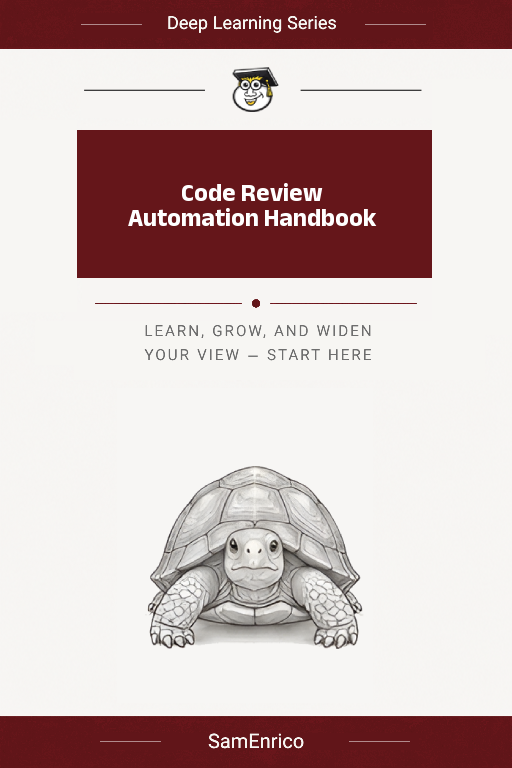
Code Review Automation Handbook
Train AI on your team's style guide and past PR fe
by Fish Dalene
Train AI on your team's style guide and past PR feedback to catch anti patterns, naming violations, and security smells before human review.
Formats
About this book
Free sample
Chapter 1: The Blind Spot--–- It was 2:47 AM when Sarah, a senior engineer at a fast-growing fintech startup, finally received the notification she’d been dreading. After fourteen hours of waiting, a colleague had approved her pull request. The approval came with nine comments. Eight were about naming conventions, import ordering, and a missing space after a comma. The ninth read: “Logic looks good.” Sarah closed her laptop, stared at the ceiling, and wondered if this was what fifteen years of engineering experience had prepared her for—becoming a human linter.Her story is not unique.
Across the global software industry, senior engineers spend an estimated 40 percent of their code review time on issues that could be automated. Style violations, naming inconsistencies, common anti-patterns, and security smells that follow predictable patterns dominate the review landscape. The irony is brutal: the same engineers who should be designing architecture, mentoring juniors, and solving difficult technical problems are instead arguing about whether a variable should be called user Data or user_data or fetch User.This book exists because that waste is avoidable. And in this chapter, we will confront the uncomfortable truth about why your current tools are failing you—and why the solution is not another linter rule.The Myth of the Complete Linter Most engineering teams believe they have solved the problem of automated code checking. They run ESLint, Pylint, Rubocop, or any of the dozens of static analysis tools available.
They may have invested in SAST tools like Code QL, Semgrep, or Sonar Qube. And yet, the pull request comments keep coming. The nitpicks persist. The fatigue compounds.Why?Because deterministic tools—linters and SAST scanners—operate on a fundamentally limited model of code. They parse abstract syntax trees.
They match regular expressions. They check against fixed rule sets. What they cannot do is understand meaning.Consider a function named process(). A linter sees a valid identifier. It cannot know that this function actually performs three unrelated operations: writing to a database, sending an email, and invalidating a cache.
There is no rule for “this function does too many unrelated things” that works across every codebase. The definition of…
This is the end of the free sample. Get the eBook to keep going. Buy now
Contents
- Chapter 1
- Chapter 2
- Chapter 3
- Chapter 4
- Chapter 5
- Chapter 6
- Chapter 7
- Chapter 8
- Chapter 9
- Chapter 10
- Chapter 11
- Chapter 12
Details
- Author
- Fish Dalene
- Publisher
- SamEnrico
- Language
- English
- Genre
- Non-Fiction, AI Operator, Code Quality
- Released
- 2026-05-30
- Pages (approx.)
- 132
- Available as
- eBook, Audiobook

Read better in the ZLOADR app
Your eBooks on your phone or tablet. Sign in with your SamEnrico account and start reading.
More by Fish Dalene
 Weapon Risk Road Rage GuideFish Dalene$11.99
 Therapy Access Success Stories Poor NationsFish Dalene$11.99
 SECURE Act 2.0 GuideFish Dalene$11.99
 Dream Setting GeographyFish Dalene$11.99
 Face Recognition and SleepFish Dalene$11.99
 Bipolar Lifestyle Stability ManualFish Dalene$11.99
 Virtual Ideation Workshop GuideFish Dalene$11.99
 Vitamin B6 Premenstrual GuideFish Dalene$11.99
 Peripheral Neuropathy RLSFish Dalene$11.99
 The Lost Caves of the Atlantic: Ancient Divers of the Blue AbyssFish Dalene$11.99
 The Devil's Ledger: The Forgotten Witch Hunts of New FranceFish Dalene$11.99
 Red Tails Over Berlin: The Secret Mission That Changed the WarFish Dalene$11.99
You may also like
 Hong Kong Handover 1997Dunn Johnnie$11.99
 Zumba For Postnatal Recovery CourseNeal Christian$11.99
 Zumba for BeginnersLadner Nikia$11.99
 YouTube Comment Mining GuideHumes Pandora$12.99
 Worry Box MeditationCarlin Rudy$11.99
 Workplace Stress MeditationNguyen Lynn$11.99
 Workplace Stress and Sleep RepairHawley Ivory$11.99
 Workplace Perfectionism CureDelaney Jeffry$11.99
 Workplace Injustice Anger GuideWallen Isabelle$11.99
 Work Addiction and Burnout LinkGreenwood Ester$11.99
 Women in Yoga and WellnessBeattie Galina$11.99
 Women in Stand Up ComedyChun Evangeline$11.99