
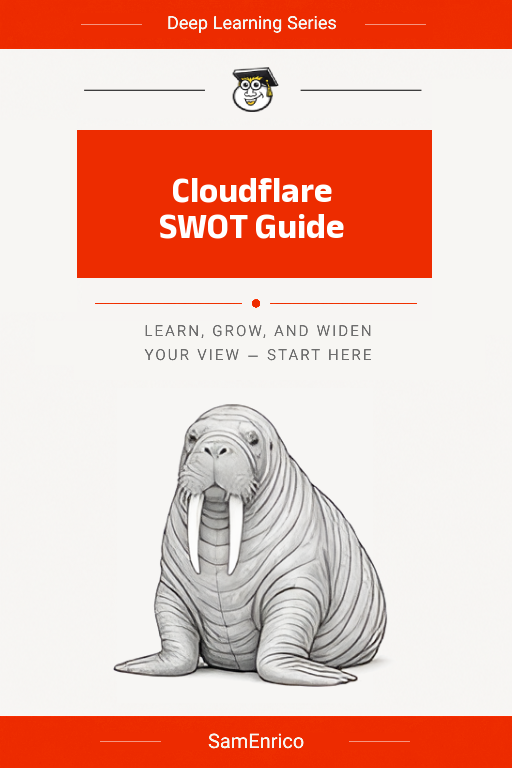
Non-FictionStrategic AtlasEdge Computing
Cloudflare SWOT Guide Audiobook
Assess CDN network edge, security and performance
Assess CDN network edge, security and performance features, free tier growth, and enterprise monetization.
Formats
Free sample
Chapter 1: The Forgotten Infrastructure--Every time you load a webpage, check your email, or stream a video, your data travels across an invisible battlefield. That battlefield is the internet’s physical infrastructure—thousands of data centers, millions of miles of fiber-optic cable, and a complex web of routing protocols designed in an era when "security" meant a firewall at your office door. For nearly thirty years, the Content Delivery Network, or CDN, was a quiet utility. It did one thing well: it moved static files—images, CSS, Java Script—closer to users so pages loaded faster. And then the world changed.The mid-2010s marked an inflection point.
Cyberattacks ceased to be sporadic nuisances and became existential threats. DDo S attacks grew from hundreds of megabits per second to hundreds of gigabits, then to terabits. The average website faced botnets, credential stuffing, API abuse, and application-layer attacks that traditional CDNs were never designed to see, let alone stop. Meanwhile, the CDN itself had become a commodity. Akamai, Fastly, Cloud Front—all offered essentially the same caching mechanics.
Differentiation collapsed to price. The market was ripe for disruption, but not in the way most analysts expected.Cloudflare did not invent a faster cache. It did not discover a new compression algorithm or a magical routing protocol. Instead, it asked a different question: what if the network that moves your content could also protect your origin? What if the same 300 points of presence that cache your homepage could also absorb a DDo S attack before it ever reaches your server?
What if the firewall lived at the edge, not in a data center thousands of miles away?This chapter introduces the foundational architecture that makes Cloudflare possible: the hybrid CDN plus security model. We will explore Anycast routing, the network effect of shared threat intelligence, and why the marriage of performance and protection creates a strategic asset that legacy vendors cannot easily replicate. Most importantly, we will establish the first pillar of the SWOT analysis that runs through this entire book. By the end of this chapter, you will understand not just what Cloudflare does, but why its architecture turns a cost center—bandwidth—into a competitive weapon.The Commodity Trap: How the CDN Lost Its Differentiation To understand Cloudflare’s innovation, you must first understand what the CDN industry looked like before 2010. A CDN is, at its simplest, a distributed network of servers placed in geographically…
This is the end of the free sample. Get the Audiobook to keep going. Buy now
About this book
Details
- Author
- Heckman Kirstin
- Publisher
- SamEnrico
- Language
- English
- Genre
- Non-Fiction, Strategic Atlas, Edge Computing
- Released
- 2026-06-01
- Pages (approx.)
- 155
- Available as
- eBook, Audiobook

Listen in the VoxFlicks app
Audiobooks and audio dramas wherever you go. Sign in with your SamEnrico account and press play.
More by Heckman Kirstin
 Senior Organizing Esteem GuideHeckman Kirstin$11.99
 Family Savings ZeroHeckman Kirstin$11.99
 The Mindfulness Bell Cue MethodHeckman Kirstin$11.99
 Gratitude for FriendsHeckman Kirstin$11.99
 Assertive Healthcare CommunicationHeckman Kirstin$11.99
 Bragi's Lament: The Forgotten Bard of AsgardHeckman Kirstin$11.99
 How to Start a Music Tape Reproduction From Master Copies Business (Beginners Guide)Heckman Kirstin$11.99
 Understanding Myopathy Growth and Mental Retardation HypospadiasHeckman Kirstin$17.99
 Accounting Formulas for Bond AccountingHeckman Kirstin$12.99
 Casino Surveillance OfficerHeckman Kirstin$11.99
You may also like
 Hong Kong Handover 1997Dunn Johnnie$11.99
 Zumba For Postnatal Recovery CourseNeal Christian$11.99
 Zumba for BeginnersLadner Nikia$11.99
 YouTube Comment Mining GuideHumes Pandora$12.99
 Worry Box MeditationCarlin Rudy$11.99
 Workplace Stress MeditationNguyen Lynn$11.99
 Workplace Stress and Sleep RepairHawley Ivory$11.99
 Workplace Perfectionism CureDelaney Jeffry$11.99
 Workplace Injustice Anger GuideWallen Isabelle$11.99
 Work Addiction and Burnout LinkGreenwood Ester$11.99
 Women in Yoga and WellnessBeattie Galina$11.99
 Women in Stand Up ComedyChun Evangeline$11.99