
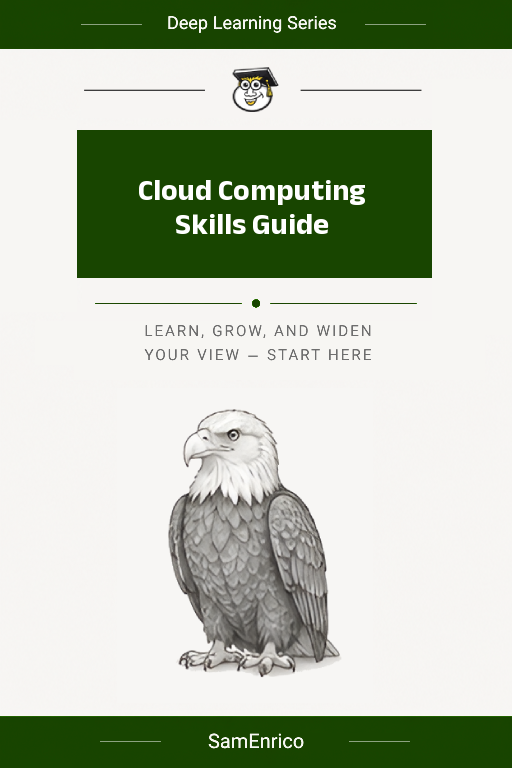
Cloud Computing Skills Guide eBook
Project AWS, Azure, and Google Cloud certification
by Saenz Tona
Project AWS, Azure, and Google Cloud certification demand for architects, DevOps, and administrators.
Formats
Free sample
Chapter 1: The Trinity Reality–- The cloud certification market in 2026 resembles a gold rush where the prospectors who understand where each river flows differently earn the most gold. AWS owns the widest river, Azure flows through the largest forts, and GCP cuts through the richest veins of data. Your success depends not on picking the “best” cloud, but on knowing which cloud’s current aligns with your career trajectory.In the winter of 2024, a senior systems administrator named Marcus found himself staring at three certification study guides spread across his desk. His employer, a mid-sized financial services firm, had just announced a “cloud-first” initiative but had not decided whether to go all-in on AWS, Azure, or Google Cloud. Marcus had twelve years of on-premises experience, a family to support, and a gnawing fear that his skills were becoming obsolete.
He had seen five colleagues lose their jobs in the past eighteen months, replaced by automation and cloud-native tools he barely understood.Marcus’s story is not unusual. It is the story of hundreds of thousands of IT professionals standing at the same crossroads in 2026. The cloud market has matured beyond the early adopter phase, yet it remains turbulent enough to reward strategic thinkers and punish those who follow outdated advice. The difference between Marcus six months from now—whether he lands a $165,000 Solutions Architect role or scrambles for another on-premises contract—depends entirely on how well he understands the landscape laid out in this chapter.This book begins where most cloud guides end: with the uncomfortable truth that no single cloud provider offers a complete answer to your career questions. AWS, Azure, and Google Cloud Platform (GCP) have diverged into distinct strategic positions, each with its own market share story, salary implications, and future trajectory.
Understanding these differences is not academic—it directly determines which certifications command premium salaries, which skills attract recruiters, and which career paths offer stability versus explosive growth.The Market Share Reality: Why Percentages Deceive Let us begin with the numbers that everyone cites but few interpret correctly. As of early 2026, the global cloud infrastructure market looks roughly like this: AWS holds approximately 31 percent market share, Azure follows with 24 percent, Google Cloud trails with 11 percent, and the remaining 34 percent belongs to Alibaba Cloud, IBM Cloud, Oracle Cloud, and dozens of smaller providers. These figures come from the Flexera 2025 State of the Cloud Report, which surveyed 750 enterprise cloud decision-makers, and are consistent with Synergy Research Group’s Q4 2025 data.If you stopped reading at these percentages, you would make a catastrophic career decision. You would assume AWS is the obvious choice because it has the largest slice of the pie. But market share tells you only about past infrastructure spending, not about future job demand, salary premiums, or strategic value.Consider this counterintuitive reality: Azure dominates the Fortune 500 to a degree that its overall market share does not reveal.
Among companies with over $10 billion in annual revenue, Azure adoption exceeds AWS by approximately 12 percentage points. Why? Because these enterprises already run Windows Server, Active Directory, SQL Server, and the entire Microsoft productivity stack. Moving to Azure feels like upgrading rather than migrating. For a financial analyst at JPMorgan Chase or a supply chain manager at Walmart, the path of least resistance leads to Azure.AWS, by contrast, dominates the startup ecosystem and the developer community.
Approximately 60 percent of all cloud-native startups launch on AWS. The reasons are cultural as much as technical—AWS has a twelve-year head start in building services that developers love, a vast ecosystem of community-contributed tools, and a certification program that employers recognize worldwide. When a venture capitalist asks a portfolio company which cloud they use, the answer is usually “AWS” not because it is technically superior for every workload, but because finding engineers who know AWS is dramatically easier than finding engineers who know anything else.GCP occupies a different niche entirely. Its 11 percent market share hides the fact that it leads in two high-value categories: data analytics and artificial intelligence. Among companies spending over $1 million annually on cloud data warehouses, 45 percent use Big Query as their primary platform.
Among organizations training large language models from scratch, GCP’s Tensor Flow ecosystem and TPU (Tensor Processing Unit) hardware give it a technical edge that AWS and Azure cannot easily replicate.The implication for your career is clear. If you want the highest raw number of job opportunities and the flexibility to work at startups or enterprises, AWS is your safest bet. If you want to work at the largest financial institutions, healthcare systems, and government agencies, Azure opens doors that AWS cannot. And if you want to earn the highest possible salary by specializing in data engineering or AI infrastructure, GCP offers a path that, while narrower, pays exceptionally well.The AI Premium: Why Generative AI Changed Everything Before 2023, cloud certifications followed a predictable pattern: foundational, associate, professional, and specialty. Employers valued these credentials roughly in proportion to their difficulty.
A Solutions Architect Professional certification might earn you 15,000to15,000 to 15,000to25,000 more than an Associate certification. The math was straightforward.The release of Chat GPT and the subsequent explosion of generative AI applications disrupted this model completely. Suddenly, every enterprise wanted to build AI agents, retrieval-augmented generation (RAG) pipelines, and fine-tuned models. And they discovered that infrastructure engineers who understood how to deploy, scale, and secure these workloads were extraordinarily rare.The data from Lightcast’s 2026 cloud skills report tells the story. Job postings requiring both a cloud certification and an AI-related skill (such as “large language models,” “prompt engineering,” or “model deployment”) grew 340 percent between 2023 and 2025.
Salaries for these combined roles exceed standard cloud roles by 20 to 47 percent, depending on the specific combination of skills.Let me be precise about what this means for your wallet. According to the 2026 Robert Half Technology Salary Guide, a Solutions Architect with an AWS Solutions Architect Professional certification but no AI specialization earns a median base salary of 162,000.ASolutions Architectwiththesamecertificationplusdemonstratedexperiencedeploying RAGpipelinesusing AWSBedrockor Azure Open AIServiceearns162,000. A Solutions Architect with the same certification plus demonstrated experience deploying RAG pipelines using AWS Bedrock or Azure Open AI Service earns 162,000.ASolutions Architectwiththesamecertificationplusdemonstratedexperiencedeploying RAGpipelinesusing AWSBedrockor Azure Open AIServiceearns198,000. That is a 22 percent premium.The gap widens for Dev Ops engineers. A Dev Ops engineer with an Azure Dev Ops Engineer Expert certification and no AI skills earns approximately 148,000.Addthe AI−102(Azure AIEngineer)certificationandsixmonthsofhands−onexperiencewith Azure Open AIService,andthemedianrisesto148,000.
Add the AI-102 (Azure AI Engineer) certification and six months of hands-on experience with Azure Open AI Service, and the median rises to 148,000.Addthe AI−102(Azure AIEngineer)certificationandsixmonthsofhands−onexperiencewith Azure Open AIService,andthemedianrisesto192,000—a 30 percent increase.But the highest premium belongs to a role that barely existed two years ago: the AI Infrastructure Engineer. These professionals hold either the AWS Certified Generative AI Developer (Professional), the Azure AI-102 combined with AZ-305, or the GCP Professional Data Engineer certification. Their median base salary ranges from 185,000to185,000 to 185,000to220,000, with total compensation often exceeding $275,000 at top-tier technology companies.Here is what the numbers do not show: the AI premium is not automatic. Simply passing a certification exam without building real projects will not command these salaries. Employers have learned to ask specific technical questions during interviews.…
This is the end of the free sample. Get the eBook to keep going. Buy now
About this book
Details
- Author
- Saenz Tona
- Publisher
- SamEnrico
- Language
- English
- Genre
- Non-Fiction, Forecast & Outlook, Cloud Skills
- Released
- 2026-05-30
- Pages (approx.)
- 148
- Available as
- eBook, Audiobook

Read better in the ZLOADR app
Your eBooks on your phone or tablet. Sign in with your SamEnrico account and start reading.
More by Saenz Tona
 Attempt Survivor Poetry Healing WorkbookSaenz Tona$11.99
 The Eisenhower Matrix for Stay at Home ParentsSaenz Tona$11.99
 HGH and Acromegaly GuideSaenz Tona$11.99
 AI IEP Goal TrackerSaenz Tona$11.99
 The Afghan Immigrant SuccessSaenz Tona$11.99
 The Architects of the Sky: Building the Pyramids of MeroëSaenz Tona$11.99
 Understanding Megacystis Microcolon Intestinal Hypoperistalsis SyndromeSaenz Tona$17.99
 How to Become a Cloth DesignerSaenz Tona$11.99
 India Raise Quick ReferenceSaenz Tona$12.99
 Project Evaluation and Review Technique SpecialistSaenz Tona$11.99