
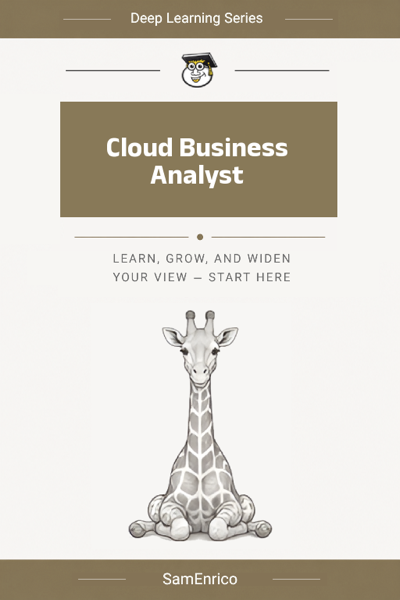
Non-FictionInformativeEducational
Cloud Business Analyst eBook
A Coursebook on Cloud Business Analyst
A Coursebook on Cloud Business Analyst
Formats
Free sample
Chapter 1: The Obsolete Analyst...--–- The email arrived at 4:47 PM on a Friday. Sarah had been a Senior Business Analyst for eleven years. She had mastered requirements gathering, user story writing, and stakeholder management. She had earned her CBAP certification. She had successfully delivered seventeen software projects.
She was, by every traditional measure, excellent at her job.The email was from her CTO. Subject line: "Cloud Migration Initiative – Team Restructuring."She opened it expecting to see her name leading the requirements effort. Instead, she read: "As we move our entire infrastructure to AWS over the next eight months, we are restructuring the Business Analysis team. We will be retaining three Cloud Business Analysts with experience in cloud economics, migration strategies, and Fin Ops. All other BA roles will be transitioned to project support functions."Sarah did not know what a Cloud Business Analyst was.
She had never heard of Fin Ops. She did not know the difference between a lift-and-shift migration and a refactor. She had vaguely heard of AWS but assumed "the cloud" was where IT people stored backups.By Monday morning, she had updated her resume. But she had also done something else: she had registered for a cloud fundamentals course. Sarah was not going to become obsolete.
She was going to evolve.This book is for everyone who received that email—or who will receive it soon. The traditional Business Analyst role is dying. The Cloud Business Analyst role is thriving, paying forty to sixty percent more than traditional BA roles, and is currently experiencing a talent shortage so severe that companies are hiring candidates with six months of focused upskilling over candidates with ten years of irrelevant experience.The question is not whether you will become a Cloud Business Analyst. The question is whether you will do it before or after your role is eliminated.The Great Unlearning: Why Traditional BA Skills Are No Longer Enough Every profession goes through moments of existential disruption. For travel agents, it was Expedia.
For taxi drivers, it was Uber. For traditional Business Analysts, it is cloud computing. But here is the crucial difference: the role of the Business Analyst is not disappearing. It is transforming. The skills that made you valuable in an on-premise, waterfall, Cap Ex world are not the same skills that will make you valuable in a cloud-native, agile, Op Ex world.Let us be brutally honest about what traditional BA training emphasizes.
You learned to write Software Requirements Specifications (SRS) documents. You learned to facilitate joint application development (JAD) sessions. You learned to trace requirements from stakeholder interviews to test cases. You learned to manage scope creep. These are not bad skills.
They are simply incomplete.Cloud computing changes the fundamental unit of analysis. In traditional IT, the unit of analysis was the application: "What does this software need to do?" In cloud computing, the unit of analysis is the combination of the application AND its infrastructure AND its cost model. You cannot ask "what does the user want?" without also asking "what does the bill say?" because those two questions are now inextricably linked.Consider a simple example. A stakeholder says: "We need our inventory system to respond faster during holiday shopping peaks." In traditional IT, a BA writes a performance requirement: "The system shall respond to inventory queries within two hundred milliseconds at the ninety-fifth percentile." The development team adds more application-level caching. The project moves forward.In cloud computing, that same stakeholder request triggers a cascade of questions the traditional BA never had to answer.
Do we want to add application-level caching, which requires developer time? Or do we want to add a read replica of the database, which requires infrastructure changes? Or do we want to auto-scale the application servers horizontally, which requires configuration changes? Each option has a different cost profile, a different implementation timeline, and a different operational risk. The Cloud BA does not just document the requirement.
The Cloud BA facilitates a trade-off conversation that balances performance, cost, and complexity.This is not a small shift. This is a fundamental redefinition of the BA's role from "requirements documenter" to "value architect."The Cap Ex to Op Ex Revolution: Why Your Finance Department Will Love You To understand why the Cloud BA role exists, you must understand the single most important financial shift in the history of enterprise IT: the transition from Capital Expenditure (Cap Ex) to Operational Expenditure (Op Ex).Under the traditional Cap Ex model, when a company needed IT infrastructure, it purchased servers, storage arrays, networking equipment, and software licenses. These were capital assets. They appeared on the balance sheet. They were depreciated over three to five years.
They required a large upfront payment that had to be approved by the finance committee, sometimes months in advance. If the company guessed wrong about its capacity needs, it either wasted money on idle servers or suffered performance problems while waiting for new hardware to arrive.Under the cloud Op Ex model, the company pays only for what it uses, only when it uses it. Need one hundred virtual servers for three hours to run a batch processing job? You pay for exactly that. Need to store a petabyte of customer data?
You pay for the storage, month by month, and you can stop paying the moment you delete the data. No upfront approval. No depreciation schedules. No idle hardware.This sounds like an unalloyed good. And in many ways, it is.
But it creates profound challenges for Business Analysts who have never had to think about financial governance.Under the Cap Ex model, once the servers were purchased, the marginal cost of running an additional workload was essentially zero. The hardware was already there, already paid for, already depreciating. A BA could write requirements that added new features, new data processing jobs, new integrations, without worrying about the incremental cost, because the cost was sunk.Under the Op Ex model, every single workload has a marginal cost. Every API call costs something. Every gigabyte of storage costs something.
Every hour of compute time costs something. A BA who writes requirements without considering these costs is like a procurement officer who signs blank checks. You are spending the company's money with every requirement you write.This is why the Cloud BA must learn to ask different questions. Instead of "Can the system do X?" the Cloud BA asks "What is the marginal cost of doing X?" Instead of "How fast does the system need to respond?" the Cloud BA asks "How much are we willing to pay for each millisecond of reduced latency?" Instead of "How much data should we store?" the Cloud BA asks "What is the business value of retaining this data versus the storage cost?"These questions change the conversation with stakeholders. They transform the BA from a passive scribe into an active financial steward.
And they explain why Cloud BAs earn dramatically more than their traditional counterparts: they are trusted with the company's money.The Hybrid Role: Speaking Architecture and Spreadsheets Fluently One of the most common questions from BAs transitioning to the cloud is: "Do I need to learn how to code?" The…
This is the end of the free sample. Get the eBook to keep going. Buy now
About this book
Details
- Author
- Lantz Cleopatra
- Publisher
- SamEnrico
- Language
- English
- Genre
- Non-Fiction, Informative, Educational
- Released
- 2026-05-11
- Pages (approx.)
- 157
- Available as
- eBook, Audiobook

Read better in the ZLOADR app
Your eBooks on your phone or tablet. Sign in with your SamEnrico account and start reading.
More by Lantz Cleopatra
 Sweden Green Tax Reduction GuideLantz Cleopatra$11.99
 Hunger Management StrategiesLantz Cleopatra$11.99
 Sleep and Autism SpectrumLantz Cleopatra$11.99
 Innocence Project Minnesota CasesLantz Cleopatra$11.99
 Rise of the Phoenix: The Miracle of the 1980 U.S. Olympic Hockey TeamLantz Cleopatra$11.99
 Clash of the Feathered Legion: The Untold War Against Australia’s Emu ArmyLantz Cleopatra$11.99
 Understanding Chromosome 2, Monosomy 2q24Lantz Cleopatra$17.99
 EE NOC Code Selection GuideLantz Cleopatra$12.99
 PDP For Marketing ProfessionalsLantz Cleopatra$12.99
 How to Start a Motor Repair Depot Business (Beginners Guide)Lantz Cleopatra$11.99
You may also like
 Hong Kong Handover 1997Dunn Johnnie$11.99
 Zumba For Postnatal Recovery CourseNeal Christian$11.99
 Zumba for BeginnersLadner Nikia$11.99
 YouTube Comment Mining GuideHumes Pandora$12.99
 Worry Box MeditationCarlin Rudy$11.99
 Workplace Stress MeditationNguyen Lynn$11.99
 Workplace Stress and Sleep RepairHawley Ivory$11.99
 Workplace Perfectionism CureDelaney Jeffry$11.99
 Workplace Injustice Anger GuideWallen Isabelle$11.99
 Work Addiction and Burnout LinkGreenwood Ester$11.99
 Women in Yoga and WellnessBeattie Galina$11.99
 Women in Stand Up ComedyChun Evangeline$11.99